AP Biology FRQ: How to Score Full Marks on Every Question Type
AP Biology FRQ: How to Score Full Marks on Every Question Type The AP Biology FRQ section is worth 50% of your exam score. You have 90 minutes to answer 6 quest...
Key Takeaways
- Before we get into question types, understand how scoring works.
- The AP Biology exam uses a consistent set of question types.
- For every FRQ response, use the Claim-Evidence-Reasoning framework:.
- With 90 minutes for 6 questions, here's how to allocate your time:.
- The best way to improve your FRQ scores is to practice with real questions and real rubrics.
Ready to Boost Your Biology Grade?
Our AP Biology tutors work with students at every level — whether you're aiming to move from a 4 to a 5 or pushing for that final jump to a 7. We'll match you with someone who understands the AP Biology syllabus inside out. Find your tutor → (This guide has been for the 2025-26 academic year.)
Frequently Asked Questions
What is the best way to study IB Biology?
Active recall and spaced repetition are the most effective methods. Create flashcards for key terms, practice diagram labeling regularly, and work through past paper questions to reinforce understanding.
For more on this topic, explore our guide on 3 Top Chemistry Ia Topics That Score High Marks.
How many hours should I study Biology per week?
Aim for 3-5 hours weekly outside of class for SL, and 5-7 hours for HL. Break this into short focused sessions rather than long cramming sessions for better retention.
What are the hardest topics in IB Biology?
Genetics, biochemistry (especially HL topics like protein synthesis), and ecology data analysis tend to be the most challenging. Dedicate extra revision time to these areas.
How do I improve at Biology data-based questions?
Practice interpreting graphs and tables regularly. Focus on identifying trends, calculating percentage changes, and drawing evidence-based conclusions. Past papers are the best preparation tool for these questions.
The AP Biology FRQ section is worth 50% of your exam score. You have 90 minutes to answer 6 questions — 2 long-form (8-10 points each) and 4 short-form (4 points each). Every point you leave on the table here directly impacts whether you end up with a 4 or a 5.
Most students know the biology well enough to score full marks on at least some of these questions. The problem isn't knowledge — it's technique. AP Biology FRQs are scored by a rubric that awards points for specific statements, not for general understanding. You can write a beautiful paragraph that demonstrates deep comprehension and still score 0 if you don't hit the exact scoring criteria.
This guide breaks down each FRQ type, shows you what the rubric actually rewards, and gives you a framework for answering that maximizes your points in the time you have.
If you're looking for a structured approach to AP Biology, working with an AP Biology tutor who's been through the AP system can make a real difference — especially when it comes to exam technique and time management. Tell us what you need help with →
How AP Biology FRQs Are Scored
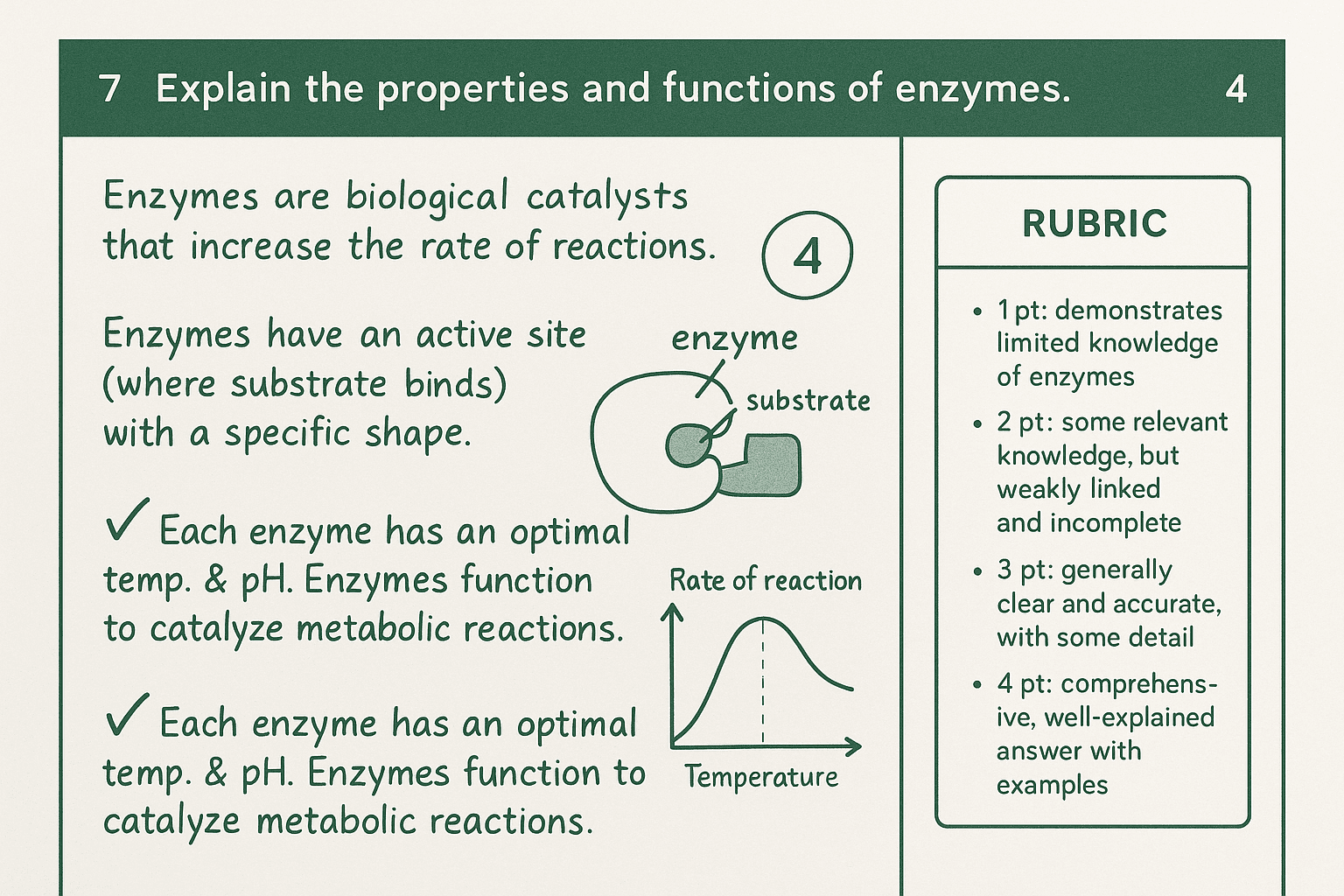
Before we get into question types, understand how scoring works. AP Biology FRQs use point-based scoring, not holistic grading. Each question has a rubric with specific statements or ideas that earn points. If your answer includes that statement, you get the point. If it doesn't, you don't — regardless of how much else you wrote.
For more on this topic, explore our guide on How to Study Biology Like a Top Student the Science Backed Method.
This means three things for your approach. First, precision matters more than length. A three-sentence answer that hits all the rubric points scores higher than a full-page response that misses them. Second, you earn partial credit. If a question is worth 4 points and you nail 3 of them, you get 3 points. Never leave a question blank. Third, wrong information doesn't cost you points (in most cases). College Board uses a "no penalty for extra information" policy as long as the extra information doesn't directly contradict a correct statement. When in doubt, write more rather than less.
The 6 FRQ Types You'll See
The AP Biology exam uses a consistent set of question types. While the specific content changes every year, the structure is predictable. Here's what to expect and how to handle each one.
Long-Form Questions (Q1 and Q2): 8-10 Points Each
These are your highest-value questions. Each one is multi-part and typically covers multiple units or science practices. You should spend about 22-25 minutes on each.
Question 1: Interpreting and Evaluating Experimental Results
This question gives you a description of an experiment — often with a data table, graph, or figure — and asks you to interpret the results. You'll typically need to identify variables and controls, describe a pattern or trend in the data, explain the biological mechanism behind the results, and predict what would happen if a variable changed.
How to score full marks: Start by reading the data carefully. State the specific trend you see, using numbers from the data ("Enzyme activity increased from 2.1 to 8.7 µmol/min as temperature rose from 25°C to 37°C"). Then explain the biological mechanism — don't just describe what happened, explain why it happened at the molecular level. For predictions, connect your answer to the mechanism you just described.
Question 2: Scientific Investigation (Experimental Design)
This question asks you to design or modify an experiment. You'll need to state a testable hypothesis, identify independent and dependent variables, describe a control group and how variables are controlled, explain the procedure clearly enough that someone could replicate it, and describe expected results that would support the hypothesis.
How to score full marks: Be specific about your experimental design. "Change the temperature" is not specific enough — "Expose three groups of seedlings to 15°C, 25°C, and 35°C for 72 hours" is. Always include sample size, replication, and how you'll measure the dependent variable. For expected results, connect them directly to your hypothesis and the underlying biology.
Short-Form Questions (Q3-Q6): 4 Points Each
These are more focused. Each one targets a specific concept or skill and should take about 9-10 minutes.
Question 3: Conceptual Analysis
This question tests your understanding of a biological concept by asking you to explain, compare, or apply it. There's usually no data — it's pure content knowledge applied to a scenario.
How to score full marks: Use precise biological terminology. "The cell swells because water moves in" scores lower than "The cell swells due to osmosis — water moves down its concentration gradient from the hypotonic extracellular environment through aquaporins into the cell." Define terms when you use them, and connect cause to effect explicitly.
Question 4: Analyzing a Model or Visual Representation
This question presents a diagram, model, flowchart, or visual and asks you to interpret it. You might need to identify what's happening at a specific step, predict what would happen if a component were removed, or explain how the model connects to a broader biological concept.
How to score full marks: Reference specific parts of the visual in your answer. "As shown in the diagram, step 3 involves..." Examiners need to see that you're interpreting the model, not just recalling textbook information. If asked to predict, trace the effects through the model step by step.
Question 5: Analyzing Data
Similar to Question 1 but shorter. You'll get a graph, table, or dataset and need to identify a pattern, calculate something (like a rate or percentage), or draw a conclusion.
How to score full marks: For any calculation, show your work. Even if the final answer is wrong, correct setup earns partial credit. When describing patterns, use specific numbers from the data. When drawing conclusions, connect the data to the biological mechanism.
Question 6: Analyzing Data (continued)
This is another data analysis question, sometimes asking you to evaluate the validity of a claim based on evidence, or to compare two datasets.
How to score full marks: If asked whether data supports a claim, take a position and defend it with specific evidence. "The data supports/does not support this claim because..." followed by a direct reference to the numbers. Avoid hedging with "it kind of supports it" — commit to a clear answer and back it up.
The CER Framework: Your Answer Template
For every FRQ response, use the Claim-Evidence-Reasoning framework:
Claim: Directly answer the question in one sentence. Don't restate the question — answer it.
Evidence: Provide specific data, facts, or observations. If there's a graph, quote numbers. If there's no data, reference specific biological details.
Reasoning: Explain why the evidence supports your claim using biological principles. This is where most students lose points — they state what happens but not why.
Here's the difference in practice. A weak answer: "The enzyme works better at 37°C." A strong answer: "Enzyme activity peaks at 37°C (8.7 µmol/min) because this temperature provides optimal kinetic energy for substrate-enzyme collisions, maximizing the formation of enzyme-substrate complexes at the active site. Above 37°C, activity decreases because thermal energy disrupts the hydrogen bonds and hydrophobic interactions that maintain the enzyme's tertiary structure, denaturing the active site."
The strong answer hits multiple rubric points: identifying the trend with data, explaining the molecular mechanism, and connecting structure to function.
Common Mistakes That Cost You Points
1. Writing introductions and conclusions. FRQs aren't essays. Don't waste time writing "In this response, I will discuss..." or "In conclusion, enzymes are important." Jump straight to the answer.
You might also find these guides helpful: How to Master Biology Data Based Questions a Student Proven Guide and Things No One Will Tell You About What to Expect at University Part Ii.
2. Using vague language. "The population changed" tells the examiner nothing. "The population decreased from 450 to 120 over 8 generations due to a bottleneck event that reduced genetic diversity" earns points.
3. Contradicting yourself. If you write both "the membrane is permeable to glucose" and "glucose cannot cross the membrane," the examiner may cancel both statements and award zero points. Be consistent.
4. Skipping the "why." Describing what happens without explaining why is the single most common way to lose points on AP Biology FRQs. Every time you state a biological fact, ask yourself "why?" and add the answer.
5. Not using data when it's given. If the question includes a graph or table, your answer must reference it. Giving a correct biological explanation without citing the provided data will cost you rubric points specifically tied to data interpretation.
Time Management Strategy
With 90 minutes for 6 questions, here's how to allocate your time:
Read through all 6 questions first (5 minutes). Start with the questions you're most confident about — there's no requirement to answer them in order. Spend 22-25 minutes on each long-form question. Spend 8-10 minutes on each short-form question. Save 5 minutes at the end to re-read your answers and check for contradictions or missing "why" explanations.
If you're stuck on a question, write what you know and move on. Partial credit on 6 questions is worth far more than a perfect answer on 3 and blank responses on the rest.
Practice Strategy for the Next 10 Weeks
The best way to improve your FRQ scores is to practice with real questions and real rubrics. Download past FRQs from College Board's AP Central. Write your response under timed conditions. Then read the scoring guidelines and mark your own work.
Pay attention to the exact language in the scoring guidelines. Notice which words earn points ("due to," "because," "as a result of") and which don't ("it changed," "something happened"). Over time, you'll start writing in the rubric's language naturally.
Want an expert to review your FRQ responses? Our AP Biology tutors have experience with College Board's scoring rubrics and can identify exactly where you're losing points. They'll teach you to write answers that hit every rubric criterion — not just answers that sound correct.
Related: AP Biology: The Complete Unit-by-Unit Study Strategy | AP Biology Subject Page