AP Physics 1 in 2026: What Changed and How to Score a 5
AP Physics 1 in 2026: What Changed and How to Score a 5 If you're taking AP Physics 1 this May, your exam looks noticeably different from what students faced ev...

The AP Physics 1 exam underwent a significant redesign starting with the 2024–25 school year. This guide provides proven strategies to help you prepare effectively and perform at your best on exam day.
As tutors who work with AP Physics students every week, we've broken down every change that matters for the May 2026 exam and built a scoring strategy around the updated format. Whether you're currently sitting at a 3 and want to push higher, or you're aiming for a 5 from the start, this is the guide to work from.
Key Takeaways
- The AP Physics 1 exam underwent a significant redesign starting with the 2024–25 school year.
- Here's something most students don't know: the 2025 AP Physics 1 results were dramatically better than 2024.
- Not all units are created equal on this exam.
- With the exam on May 5, 2026, you have roughly 11 weeks.
- After working with AP Physics students at every score level, these are the patterns we see most often:.
What Actually Changed for 2026?
The AP Physics 1 exam underwent a significant redesign starting with the 2024–25 school year. If you're sitting the May 2026 exam, here's what's different compared to exams from 2024 and earlier:
Fluids Are Now Part of Physics 1
The biggest curriculum change: fluids, which previously lived in AP Physics 2, now belongs in AP Physics 1. This isn't a minor addition — fluids account for 10–15% of your exam score. That means questions on fluid pressure, buoyancy, and fluid dynamics are fair game, and many students underestimate this unit because their teachers may have rushed through it at the end of the year.
If your class covered fluids quickly or you feel shaky on Bernoulli's equation and Pascal's principle, this is the unit most likely to cost you points you didn't expect to lose.
Fewer Questions, More Time Per Question
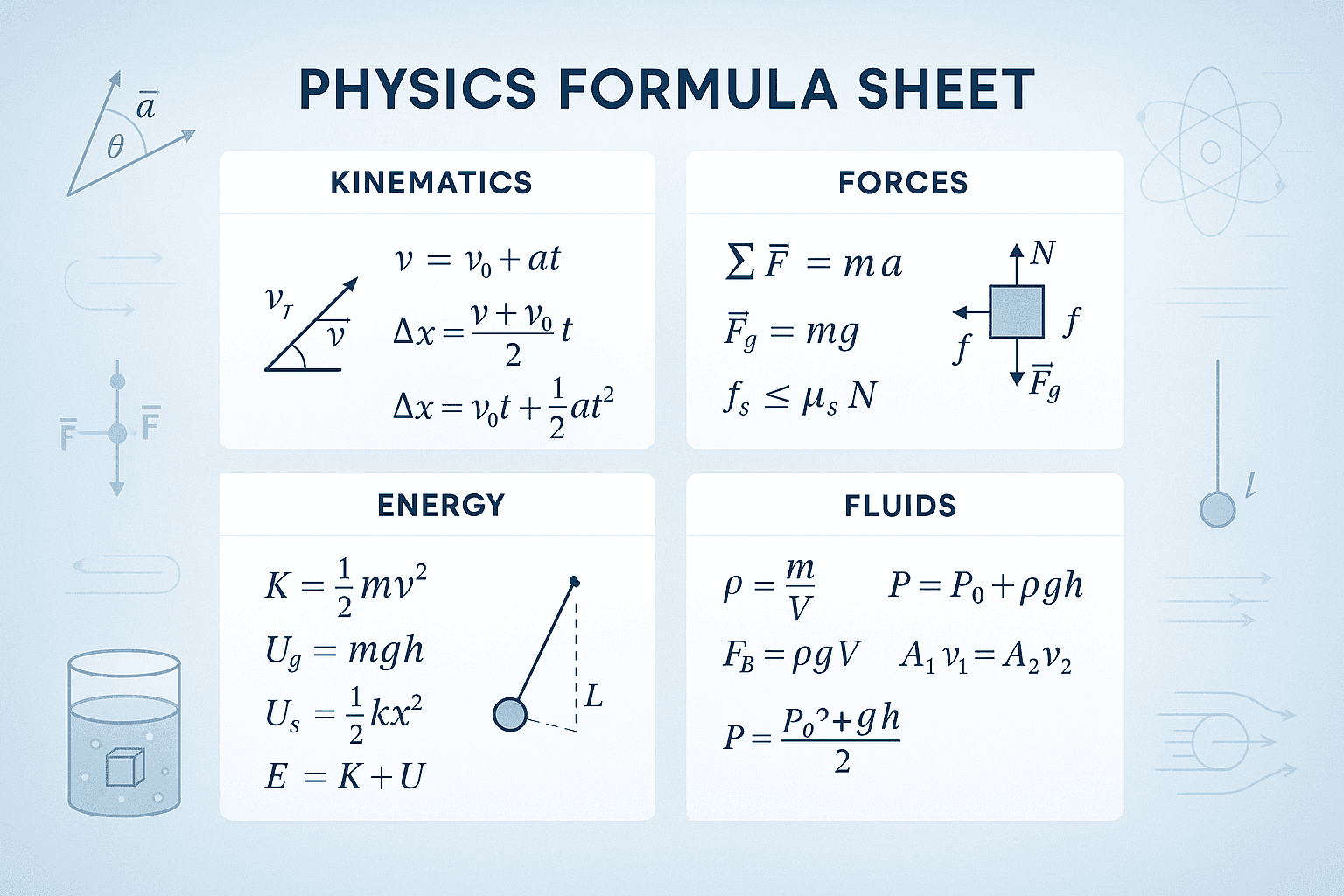
The multiple-choice section dropped from 50 questions to 40, and you now get 80 minutes to complete them. That works out to 2 minutes per question instead of the old 1 minute 48 seconds. It doesn't sound like much, but that extra breathing room matters on a conceptual exam where most questions require you to reason through a scenario rather than just plug into a formula. You may also find our resource on last minute physics formula sheet the only helpful.
Two other MCQ changes worth noting: multi-select questions are gone entirely (no more "select two" questions where you need both correct to earn the point), and each question now has 4 answer choices instead of 5. Both changes work in your favor.
New FRQ Types You Haven't Seen Before
The free-response section went from 5 questions to 4, but you now have 100 minutes instead of 90. That gives you roughly 25 minutes per FRQ — significantly more time to show your work and explain your reasoning.
The question types themselves are new. College Board introduced two formats that weren't on previous exams:
- Math Routines — These test whether you can set up and execute a multi-step calculation correctly. Think of it as a structured problem where showing your algebraic reasoning matters as much as the final answer.
- Qualitative/Quantitative Translation — These ask you to move between a conceptual explanation and a mathematical representation. For example, you might need to explain why a physical situation behaves a certain way and then express that reasoning as an equation or graph.
These replace some of the older experimental design and paragraph-length response formats. The shift rewards students who can connect concepts to math — not just do one or the other.
The Exam Is Now Hybrid Digital
AP Physics 1 uses the Bluebook testing app for the multiple-choice section. You'll read and answer MCQs on a school-provided device. However, free-response questions are still handwritten in a paper exam booklet. You'll view the FRQ prompts on screen but write your solutions on paper that gets collected and scored.
This hybrid format means you need to be comfortable reading physics problems on a screen (diagrams, graphs, and all) while doing your scratch work and final answers on paper. If you haven't practiced in this split format yet, do a few timed sessions where you read problems from a screen and write solutions by hand.
The Numbers: Why This Exam Is More Beatable Than You Think
Here's something most students don't know: the 2025 AP Physics 1 results were dramatically better than 2024.
In 2024, only 47% of students passed (scored 3 or higher) and just 10% earned a 5. In 2025 — the first year with the new format — the pass rate jumped to 67% and the score-5 rate nearly doubled to about 20%. That's one of the largest year-over-year improvements of any AP exam.
Why the jump? The new format gives you more time per question and eliminates the punishing multi-select format. Students who understand the physics and can explain their reasoning clearly are being rewarded more than before.
Get expert AP Physics support → This doesn't mean the exam is easy. It means the format is fairer. If you prepare strategically, the updated exam actually plays to your advantage.
Where Your Points Come From: Unit Weights
Not all units are created equal on this exam. Here's how College Board weights them:
| Unit | Topic | Exam Weight |
|---|---|---|
| 1 | Kinematics | 10–15% |
| 2 | Force and Translational Dynamics | 18–23% |
| 3 | Work, Energy, and Power | 18–23% |
| 4 | Linear Momentum | 10–15% |
| 5 | Torque and Rotational Dynamics | 10–15% |
| 6 | Energy and Momentum of Rotating Systems | 5–8% |
| 7 | Oscillations | 5–8% |
| 8 | Fluids | 10–15% |
Units 2 and 3 together make up nearly half the exam. If you're short on study time, these two units give you the highest return on investment. Forces, Newton's laws, work-energy theorem, and conservation of energy aren't just heavily tested — they're the conceptual foundation that makes every other unit easier to understand.
An 11-Week Scoring Strategy (Starting Now)
With the exam on May 5, 2026, you have roughly 11 weeks. Here's how to use them:
Weeks 1–3: Lock Down the Big Three (Units 1–3)
Kinematics, forces, and energy make up approximately 40–50% of your exam. Spend the first three weeks making sure you can solve any problem in these units without hesitation. Focus on:
- Free body diagrams (every force problem starts here)
- Kinematic equations and when to use each one
- Work-energy theorem and conservation of energy problems
- Newton's second and third law applications, especially on inclined planes and pulley systems
Don't just solve problems — practice explaining your reasoning out loud. The new FRQ types specifically test whether you can articulate why something happens physically, not just calculate what happens.
Weeks 4–6: Build Out Momentum, Rotation, and Fluids (Units 4–5, 8)
These three units together account for 30–45% of the exam. Momentum and rotational dynamics are where many students start losing points because the problems combine multiple concepts.
Find expert AP Physics tutoring → Pay special attention to fluids. Since this unit is new to Physics 1, College Board will almost certainly include at least one FRQ that tests it directly. Make sure you're comfortable with:
- Pressure at depth and Pascal's principle
- Buoyancy and Archimedes' principle
- Continuity equation and Bernoulli's equation
- Connecting fluid concepts to energy conservation
Weeks 7–9: Full Practice Tests Under Real Conditions
Switch from topic review to full-length practice. Use official College Board released exams and FRQs. Simulate the hybrid format: read problems on your laptop, write answers on paper. Time yourself strictly — 80 minutes for MCQ, 100 minutes for FRQ.
After each practice test, don't just check your answers. For every question you got wrong, write one sentence explaining why you got it wrong. Was it a concept gap, a careless error, or a time management issue? This single habit is what separates students who plateau at a 3 from those who push to a 5.
Weeks 10–11: Targeted Review and FRQ Drilling
In the final two weeks, stop doing full practice tests. Instead, drill the specific FRQ types that gave you the most trouble. Focus on the new math routines and qualitative/quantitative translation questions. Practice writing clear, concise explanations — College Board readers spend about 2 minutes per response, so your reasoning needs to be obvious, not buried. To master the explanatory writing this format requires, learn how to structure clear analytical responses.
Review the formula sheet one more time. Know what's on it (so you don't waste time memorizing those equations) and what's not (so you know what you need to have in your head).
5 Mistakes That Cost Students a 5
After working with AP Physics students at every score level, these are the patterns we see most often:
1. Ignoring fluids because "it's new." Students who deprioritize fluids because their teacher covered it last are gambling with 10–15% of their score. One FRQ on buoyancy or Bernoulli's equation that you can't answer is the difference between a 4 and a 5.
2. Solving without explaining. The new FRQ format specifically rewards qualitative reasoning. Writing only equations without explaining what they mean physically will cost you points, even if your math is correct. Always state the principle you're applying and why it applies to this situation.
3. Skipping free body diagrams. On force problems, students who jump straight to F=ma without drawing a complete free body diagram make sign errors, forget forces, and lose points on the setup — which is often worth more than the final answer.
4. Not practicing the hybrid format. Reading a problem on screen and solving on paper is a different cognitive experience than doing everything on paper. Students who first encounter this split during the actual exam lose time to the adjustment. Practice it beforehand.
5. Spending too long on one MCQ. With 2 minutes per question, it's tempting to grind on a tough problem. But there's no penalty for guessing, and every question is worth the same. If you're stuck after 90 seconds, eliminate what you can, pick your best answer, and move on.
Master the 2026 Exam Format with Targeted Support
The redesigned AP Physics 1 exam rewards conceptual understanding, clear reasoning, and strategic time management. Work with an AP Physics tutor who understands the 2026 format inside and out → Our tutors specialize in the new FRQ types, can coach you through the hybrid testing experience, and help you build the physics intuition that separates 4s from 5s. Whether you need help mastering the fluids unit, connecting concepts to math, or developing exam-day strategies, we can match you with the right person.
FAQs
What are the major changes to AP Physics 1 for 2026?
The College Board revised AP Physics 1 for the 2024-2025 academic year, with significant changes continuing to be implemented through 2026, including a refined focus on essential physics concepts and streamlined content areas. The exam emphasises deeper understanding of core principles like Newton's laws, energy and momentum conservation, and oscillatory motion rather than encyclopedic coverage of every physics topic. The FRQ section now includes more authentic laboratory and experimental design questions that mirror actual physics practice, moving beyond traditional calculation-focused problems. Students taking AP Physics 1 in 2026 should focus on conceptual understanding, experimental reasoning, and the ability to apply physics principles to novel situations rather than memorizing extensive content lists. Explore our detailed guide on solving physics problems for more tips.
How do the 2026 AP Physics 1 changes affect exam preparation?
Students should emphasise understanding the foundational principles underlying physics rather than memorising formulas and problem-solving algorithms, since the revised exam tests deeper conceptual knowledge. Practical laboratory experience becomes more valuable than ever, as exam questions increasingly assess your ability to design experiments, interpret data, and draw conclusions—skills developed through hands-on lab work. College Board released updated practice materials reflecting the new format, so outdated practice materials may not accurately represent current exam expectations. Working exclusively with 2025 and 2026 practice materials ensures your preparation aligns with the actual examination your students will face rather than potentially outdated resources.
Which content areas have the most significant changes in the 2026 AP Physics 1 exam?
Newton's laws and forces remain central, though questions increasingly ask students to apply these principles to complex, realistic scenarios rather than simple textbook problems. Energy conservation and work-energy connections have been refined to emphasise the relationship between energy concepts and force interactions. Circular motion and universal gravitation remain important but with less emphasis on purely mathematical applications. Oscillations and waves have been reorganised to clarify which concepts belong to AP Physics 1 versus AP Physics 2, reducing content ambiguity. Reviewing the official College Board course description ensures you're clear about exactly what's assessed in AP Physics 1 versus AP Physics 2, preventing wasted effort on topics assigned to different courses. For more on this, see our guide on a level physics circular motion centripetal force.
What laboratory skills are now emphasised on the 2026 AP Physics 1 exam?
The revised exam increasingly tests your ability to design experiments that test hypotheses, not merely follow prescribed lab procedures—you should understand how to control variables, identify dependent and independent variables, and eliminate confounding factors. Data analysis skills including uncertainty assessment, graphing, and drawing conclusions from data now feature prominently on both MCQ and FRQ sections. You should be able to critique experimental designs, identifying potential sources of error and proposing improvements. Understanding how to use laboratory equipment properly and troubleshoot when results don't match predictions demonstrates the practical physics knowledge the College Board now values alongside theoretical understanding.
How should students approach the revised AP Physics 1 FRQ questions?
Read each question carefully to understand whether it's asking for a calculation, experimental design, data analysis, or conceptual explanation—different questions require different types of responses. Show your reasoning and explain your approach throughout, since the College Board awards significant partial credit for correct reasoning even if final numerical answers are incorrect. When questions ask you to design an experiment, describe specific procedures, identify variables, and explain how you'd collect and analyse data to answer the question. Include diagrams and free-body diagrams where relevant, as visual representations demonstrate understanding and often make complex reasoning clearer than text alone. Label axes and include units on graphs, as these details show careful scientific thinking and attention to detail.
What study approach best prepares students for success on the 2026 AP Physics 1 exam?
Engage actively with physics concepts through laboratory work and hands-on problem-solving rather than passive reading or note-taking, since the revised exam tests your ability to apply physics thinking in realistic contexts. Use College Board-released practice materials exclusively, ensuring your preparation reflects 2026 exam formats and content emphasis rather than outdated resources. Focus on fewer concepts understood deeply rather than broad coverage of topics, as conceptual understanding enables you to solve novel problems on exam day. Explain physics concepts aloud and teach them to peers, as articulating your understanding often reveals gaps that studying alone might miss. For comprehensive exam preparation → and personalised guidance tailored to the 2026 changes, explore tutoring support and read our detailed guide on physics study strategies and guaranteed success approaches. Learn more in our guide on choose physics IA topics avoid common mistakes.
Find Your AP Physics Tutor → Our AP Physics tutors include former AP readers who know exactly how the exam is scored. They can identify your specific weak points, build a study plan around the updated format, and help you practice the new FRQ types with real-time feedback.