AP Physics Tutor: How to Find Expert Help for AP Physics 1, 2, and C
Finding the right AP Physics tutor in 2026 depends on which AP Physics course your child is taking. AP Physics 1, AP Physics 2, AP Physics C: Mechanics, and AP...
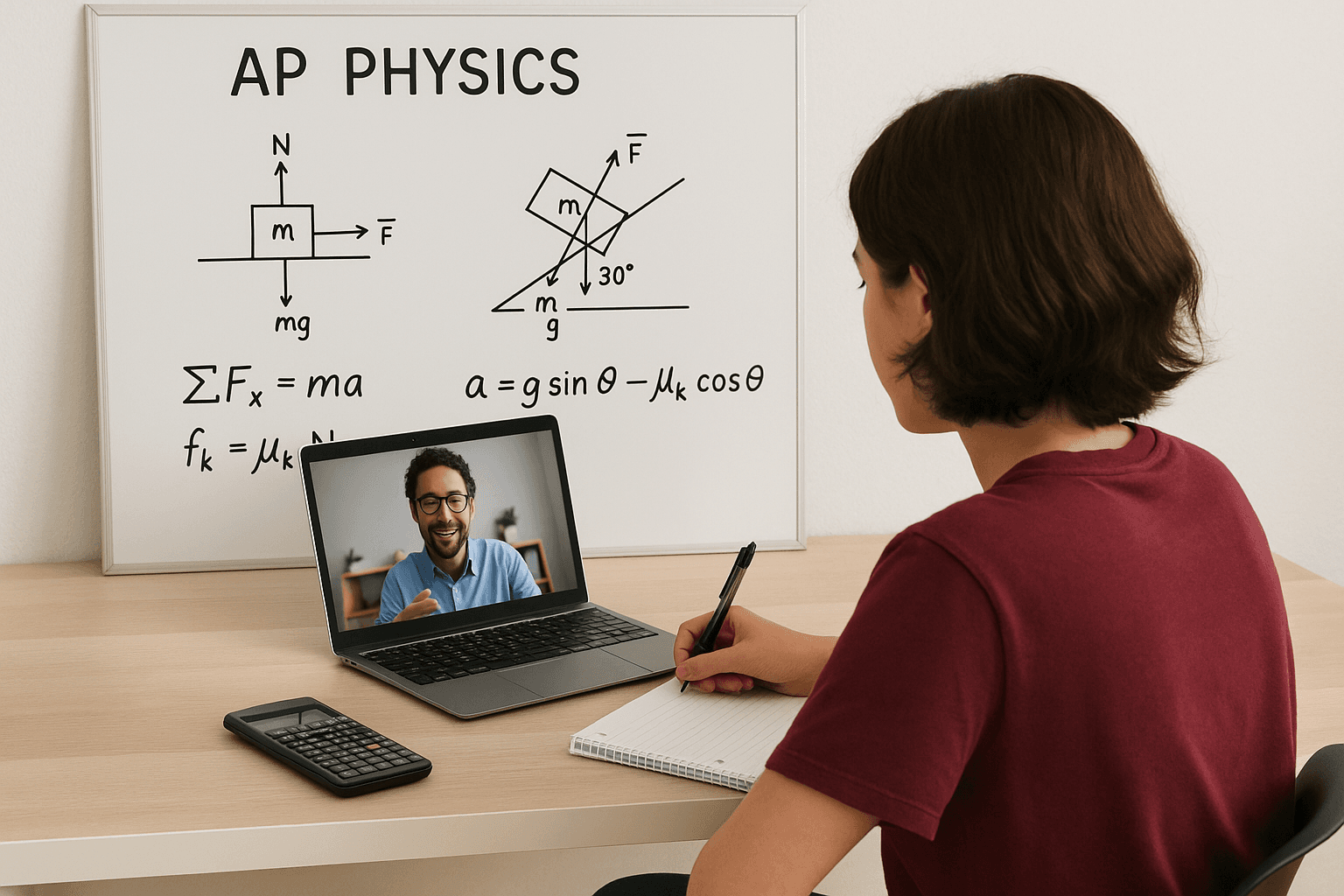
Finding the right AP Physics tutor in 2026 depends on which AP Physics course your child is taking. AP Physics 1, AP Physics 2, AP Physics C: Mechanics, and AP Physics C: Electricity and Magnetism are four distinct courses with different content, math requirements, and exam formats. The best AP Physics tutors specialise in the specific course your child needs help with.
Key Takeaways
- AP Physics spans four separate courses; make sure your tutor has experience with the specific one your child is taking
- AP Physics 1 has one of the lowest pass rates of any AP exam (around 45%); specialist tutoring makes a measurable difference
- AP Physics C requires calculus; a strong tutor should be comfortable teaching the physics-calculus integration, not just the physics concepts
- Online AP Physics tutoring costs $50-$130/hr and gives access to university-level physics educators nationwide
Need help now? Get matched with an AP Physics tutor in 24 hours.
Understanding the Four AP Physics Courses
Before hiring a tutor, you need to know which course your child is enrolled in:
- AP Physics 1 (Algebra-Based): Covers mechanics, waves, and basic electricity. No calculus required. This is the most commonly taken AP Physics course and has one of the lowest pass rates of any AP exam.
- AP Physics 2 (Algebra-Based): Covers thermodynamics, fluid mechanics, optics, electricity and magnetism, and modern physics. Also algebra-based. Less commonly offered.
- AP Physics C: Mechanics: Covers mechanics using calculus (derivatives and integrals). Taken by students planning to study engineering or physical sciences in college.
- AP Physics C: Electricity and Magnetism (E&M): Covers electrostatics, circuits, magnetism, and electromagnetic induction using calculus. The most mathematically demanding of the four.
A tutor who is excellent at AP Physics C: Mechanics may not be the right fit for AP Physics 1, which requires a completely different teaching approach (conceptual reasoning without calculus).
Why AP Physics Students Need a Specialist Tutor
AP Physics is consistently rated among the most difficult AP courses by students. The reasons are specific:
- Conceptual reasoning, not just calculation. AP Physics exams (especially Physics 1) emphasise qualitative reasoning and written justifications. Students who can solve numerical problems but cannot explain why the answer makes sense physically will lose significant marks.
- Free-response demands. AP Physics free-response questions require students to design experiments, derive relationships, and construct arguments. These skills require coached practice, not just content review.
- Math integration (Physics C). AP Physics C requires students to apply calculus to physical situations in real time. Many students have learned calculus separately but cannot use it fluently in physics contexts. A tutor bridges this gap.
- Low pass rates. AP Physics 1 has a pass rate around 45%, meaning more than half of test-takers score below a 3. The difficulty is real, and targeted tutoring is one of the most effective ways to overcome it.
What Makes a Great AP Physics Tutor
Course-Specific Teaching Experience
This is non-negotiable. Ask: "Have you taught AP Physics 1 specifically?" or "Have you taught AP Physics C: E&M?" The courses differ significantly in content, math level, and exam format. A tutor experienced in one may not be effective for another.
Strong Problem-Solving Pedagogy
The best AP Physics tutors do not just show your child how to solve a problem. They teach a systematic approach: draw a diagram, identify the relevant principles, set up the equations, solve, and check the answer for physical reasonableness. This transferable problem-solving framework is what separates a 3 from a 5.
Ability to Build Conceptual Understanding
AP Physics 1 and 2 place heavy emphasis on conceptual reasoning. A tutor who jumps straight to equations without building physical intuition is not preparing your child for the exam. Look for someone who uses demonstrations, analogies, and qualitative questions to build understanding before introducing math.
AP Reader or Scoring Experience
AP readers (who score the free-response section) understand exactly how rubrics are applied. They know which common mistakes cost points and which approaches earn full marks. This insider knowledge is invaluable for exam preparation.
Unsure which tutor fits? Our Client Success Manager can help you find the right AP Physics tutor.
How Much Does AP Physics Tutoring Cost?
Rates for one-on-one AP Physics tutoring in 2026:
| Tutor Type | Typical Hourly Rate |
|---|---|
| College student (physics/engineering major, scored 5) | $30-$50/hr |
| Experienced AP Physics teacher | $60-$100/hr |
| University professor or AP reader | $90-$130/hr |
AP Physics C tutors often charge at the higher end of the range because the calculus-based courses require more advanced expertise.
Online vs In-Person AP Physics Tutoring
Online tutoring works well for AP Physics, despite its hands-on reputation. The exam itself is entirely written (multiple choice + free response), and the core skills being taught (problem-solving, conceptual reasoning, exam technique) all translate well to a virtual format.
Advantages of online AP Physics tutoring:
- Access to university-level physics educators nationwide. Strong AP Physics tutors, especially for Physics C, are concentrated at research universities. Online removes that barrier.
- Screen sharing for problem walkthroughs. Tutors can work through problems step by step on a digital whiteboard, with the student following along.
- Recorded sessions. Physics problems benefit from rewatching. A recorded session where the tutor explains a complex mechanics problem is a valuable revision resource.
- Flexible scheduling. AP students are typically juggling multiple AP courses and extracurriculars.
When to Start AP Physics Tutoring
- September-November: Ideal if your child is already struggling with the foundational concepts (kinematics and forces in Physics 1, electrostatics in Physics C: E&M). Physics builds cumulatively, and early gaps compound.
- January-February: The most common time parents seek help. Mid-year is when the content becomes more complex (rotational motion, circuits, electromagnetic induction) and many students need support.
- March-April (exam prep): Focused review with timed free-response practice, targeted content review, and strategy coaching. A good tutor can produce significant improvement in 8-12 sessions.
How ++tutors Can Help
At ++tutors, our AP Physics tutors include current AP teachers, university physics lecturers, and AP readers. We match students based on their specific course (Physics 1, 2, C: Mechanics, or C: E&M), current performance level, and areas of difficulty.
Our matching takes under 24 hours. You will speak with a Client Success Manager who understands the AP curriculum, and they will recommend 2-3 tutors tailored to your child's needs. No commitment after the trial session. Money-back guarantee.
See how our matching process works.
Frequently Asked Questions
Which AP Physics course is the hardest?
AP Physics C: Electricity and Magnetism is widely considered the most difficult because it combines abstract physics concepts with calculus-level mathematics. AP Physics 1, while algebra-based, has the lowest pass rate because it tests deep conceptual understanding that students often underestimate.
Can my child take AP Physics C without taking AP Physics 1 first?
Yes. AP Physics C: Mechanics and AP Physics 1 cover overlapping content (mechanics), but Physics C uses calculus. Students with strong math backgrounds can go directly to Physics C. Your tutor can help assess readiness.
How many hours of AP Physics tutoring are needed?
Most students benefit from 10-20 hours of focused tutoring spread over 2-4 months. Students preparing for Physics C exams or those with significant content gaps may need closer to 25-30 hours.
Is AP Physics harder than IB Physics?
They are different. AP Physics 1 is conceptually rigorous but algebra-based. IB Physics HL includes a broader content range and an Internal Assessment. AP Physics C requires calculus, which IB Physics does not. A tutor experienced in your child's specific programme is what matters most.
Find Your AP Physics Tutor in 24 Hours
Get matched with an AP-certified teacher or university physics educator tailored to your course and level. 4.9★ rated by 500+ students. Money-back guarantee.
Get Matched Now →