How to Read Your IB Grades: The Complete 1-7 Scale
The IB Diploma Programme uses a 1-7 grading scale that works differently from the letter grades or percentages you might be used to. A 7 isn't simply "100%" and...
Key Takeaways
- Every IB Diploma subject is graded on a scale from 1 (lowest) to 7 (highest).
- The maximum IB Diploma score is 45 points, calculated from three components:.
- This is the part most students and parents find confusing.
- Different countries and university systems interpret IB grades differently:.
- "A 4 is a failing grade." It's not.
Need Personalised Guidance?
Every IB Diploma subject is graded on a scale from 1 (lowest) to 7 (highest). This step-by-step guide walks you through the full process, with practical examples and expert tips at every stage. Below, we break down the proven approach that top IB students use.
Frequently Asked Questions
What is the IB Diploma Programme?
The International Baccalaureate Diploma Programme is a two-year educational framework for students aged 16-19. It includes six subject groups, the core components (TOK, Extended Essay, CAS), and emphasizes critical thinking, research skills, and international-mindedness.
For more on this topic, explore our guide on How to Read Ib Grades a Simple Guide for Parents with Examples.
How is the IB Diploma scored?
The IB Diploma is scored out of 45 points: up to 7 points each in six subjects (maximum 42) plus up to 3 bonus points from the TOK essay and Extended Essay. A minimum of 24 points is required to receive the diploma.
What are the benefits of the IB programme?
The IB develops critical thinking, research skills, time management, and international perspectives. Universities worldwide recognize the IB Diploma, and studies show IB students often perform well in higher education due to the programme's rigorous preparation.
How do I manage the IB workload?
Create a balanced study schedule, use planning tools, prioritize tasks by deadline and importance, and break large assignments into smaller steps. Regular review prevents last-minute cramming and reduces stress.
The IB Diploma Programme uses a 1-7 grading scale that works differently from the letter grades or percentages you might be used to. A 7 isn't simply "100%" and a 4 isn't a "D." Each grade represents a level of achievement defined by specific criteria, and the boundaries shift between exam sessions based on difficulty and global performance. Understanding how IB grades actually work — how they're calculated, what they mean for your diploma, and how universities interpret them — is essential whether you're a student checking results or a parent trying to make sense of the numbers.
This guide explains the entire system from individual subject grades through to total diploma points.
Navigating IB IB can feel overwhelming, especially if it's your first time. If you'd like personalised guidance from someone who's helped hundreds of IB students, our tutors are here to help. Tell us what you need →
The 1-7 Subject Grading Scale
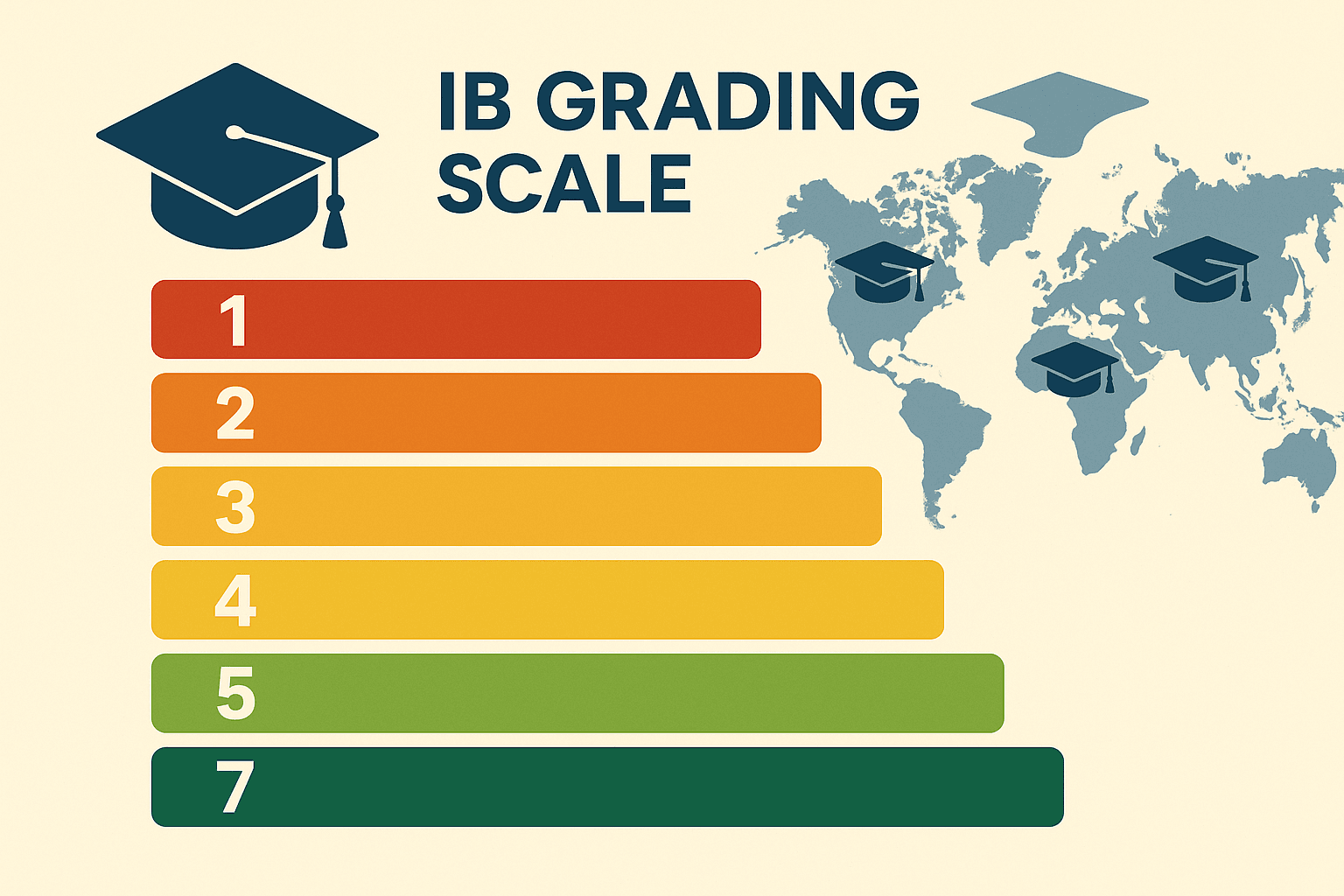
Every IB Diploma subject is graded on a scale from 1 (lowest) to 7 (highest). Here's what each grade level represents:
| Grade | Descriptor | What It Means in Practice |
|---|---|---|
| 7 | Excellent | Exceptional understanding and application. Consistently demonstrates sophisticated analysis and critical thinking. Roughly the top 5-15% of candidates globally, depending on the subject. |
| 6 | Very good | Strong command of the subject. Minor gaps in understanding but consistently high-quality work. Equivalent to a strong A in many national systems. |
| 5 | Good | Sound understanding with some areas of strength. Can analyse and apply knowledge effectively in most contexts. |
| 4 | Satisfactory | Adequate understanding of the subject. Can demonstrate basic knowledge and some analytical ability. The minimum grade most universities consider acceptable. |
| 3 | Mediocre | Limited understanding. Struggles with analysis and application. May indicate significant gaps in foundational knowledge. |
| 2 | Poor | Very limited understanding. Difficulty demonstrating basic subject knowledge. |
| 1 | Very poor | Minimal evidence of understanding. Essentially no meaningful engagement with the course material. |
Key point: These are criterion-referenced grades, not norm-referenced. The IB doesn't force a bell curve — theoretically, every student could score a 7 if they meet the criteria. In practice, grade boundaries are set after each session using a combination of statistical analysis, examiner reports, and comparison with previous years.
How Your Total Diploma Score Works
The maximum IB Diploma score is 45 points, calculated from three components:
For more on this topic, explore our guide on Things No One Will Tell You About What to Expect at University Part Ii.
Subject grades (max 42 points): You take 6 subjects, each graded 1-7. Three subjects at Higher Level (HL) and three at Standard Level (SL). All six count equally toward your total: 6 subjects × 7 points = 42 maximum.
Core component bonus (max 3 points): Your Theory of Knowledge (TOK) essay and Extended Essay (EE) are each graded A-E and combined using a matrix to award 0-3 additional points. An A in both TOK and EE earns 3 bonus points. A D or E in either may earn 0.
Total: 42 + 3 = 45 points maximum.
Here's the TOK/EE bonus points matrix:
| EE: A | EE: B | EE: C | EE: D | EE: E | |
|---|---|---|---|---|---|
| TOK: A | 3 | 3 | 2 | 2 | Failing |
| TOK: B | 3 | 2 | 2 | 1 | Failing |
| TOK: C | 2 | 2 | 1 | 0 | Failing |
| TOK: D | 2 | 1 | 0 | 0 | Failing |
| TOK: E | Failing | Failing | Failing | Failing | Failing |
"Failing" means: If you receive an E in either TOK or EE, you will not be awarded the diploma regardless of your subject grades.
Diploma Requirements: What You Need to Pass
Earning the IB Diploma requires more than just a total score. You must meet all of these conditions:
Minimum total: 24 points out of 45 (across all subjects plus TOK/EE bonus).
HL minimum: At least 12 points across your three Higher Level subjects (average of 4 per HL subject).
SL minimum: At least 9 points across your three Standard Level subjects (average of 3 per SL subject).
No grade of 1: A grade of 1 in any subject means automatic diploma failure.
Maximum two 2s: You can have at most two subjects graded 2. More than two 2s means no diploma.
Maximum three 3s (or below): No more than three subjects graded 3 or below across HL and SL combined.
Core completion: You must complete CAS (Creativity, Activity, Service) requirements. An E in either TOK or the Extended Essay is a failing condition.
Academic honesty: No malpractice findings. A confirmed case of plagiarism or cheating can void the diploma.
Students who don't meet diploma requirements still receive IB Course Results — individual subject grades for each course completed. These are recognised by many universities for credit purposes, even without the full diploma.
How Grade Boundaries Are Set
This is the part most students and parents find confusing. IB grade boundaries are not fixed percentages — they change every exam session.
After each May and November session, the IB sets grade boundaries through a process that involves statistical analysis of how all candidates performed worldwide, senior examiner review of actual student work samples against published grade descriptors, comparison with previous sessions to maintain standards, and assessment of whether particular exam papers were harder or easier than expected.
This means a raw score of 72% might earn a 7 in one session but only a 6 in another, depending on the overall difficulty. The IB publishes grade boundaries after each session, but they aren't available beforehand — you can't know during the exam exactly what raw score you need.
What this means for you: Don't obsess over predicting exact boundaries. Focus on consistently meeting the grade descriptors for your target grade. If your work aligns with what the IB considers "excellent" (grade 7 descriptor), you'll score a 7 regardless of where the boundary falls.
What the Numbers Look Like Globally
In the May 2025 session, over 202,000 students worldwide received their IB DP results:
| Metric | May 2025 | May 2024 |
|---|---|---|
| Global average score | 30.58 / 45 | 30.32 / 45 |
| Pass rate (diploma awarded) | 81.26% | 80% |
| Average grade per subject | 4.89 / 7 | 4.85 / 7 |
These numbers tell you several things. The average diploma score of around 30 means most students are earning grades of 4-5 across their subjects. Around 1 in 5 diploma candidates doesn't receive the diploma (failing to meet one or more requirements). The global average has been gradually increasing — from 29.24 in May 2023 to 30.58 in May 2025.
A score of 38+ is generally considered highly competitive (roughly top 10-15% of candidates). A score of 40+ places you among the top achievers globally. A perfect 45 is achieved by fewer than 1% of candidates in any session.
How Universities Read IB Grades
Different countries and university systems interpret IB grades differently:
You might also find these guides helpful: Navigating Ib Predicted Grades a Parents Compass and How to Overcome Low Predicted Ib Grades.
United Kingdom: UK universities typically make offers based on total IB points (e.g., "36 points including 6, 6, 5 at HL") or individual HL grades. The UCAS tariff converts IB grades to UCAS points for comparison with A-Level applicants. HL 7 = 56 UCAS points, HL 6 = 48 UCAS points.
United States: US universities generally view the IB Diploma holistically alongside GPA and standardised test scores. Many award college credit for HL scores of 5, 6, or 7 — policies vary by institution. Some US colleges also award credit for SL scores of 5+.
Canada: Canadian universities commonly require 24-30+ points for admission, with competitive programmes asking for 32-38+. Many offer advanced standing or credit for HL 5+.
Europe: Requirements vary widely. Some European universities accept the IB Diploma directly (24+ points), while others, particularly in Germany and the Netherlands, have specific subject and grade requirements.
Australia: Australian universities convert IB points to an ATAR (Australian Tertiary Admission Rank) equivalent. A score of 45 IB points typically equates to a 99.95 ATAR.
The common thread: Almost everywhere, Higher Level grades carry more weight than Standard Level. A 7 at HL is significantly more valuable for university admissions than a 7 at SL.
Predicted Grades vs Final Grades
IB predicted grades are submitted by your teachers to universities before your final exams. They matter enormously for applications — particularly in the UK, where conditional offers are based on predicted grades.
The relationship between predicted and final grades varies. Research suggests that IB predicted grades are accurate about 40-50% of the time, more likely to be over-predicted than under-predicted, and can vary by up to 2-3 points per subject in some cases.
What this means: Don't assume your predicted grade is locked in. If your predicted grades are lower than you need for university offers, focus your remaining study time on the subjects where improvement has the biggest impact. If your predicted grades are higher than your current performance, that's a warning sign — you need to close the gap before May.
Common Grading Misconceptions
"A 4 is a failing grade." It's not. A 4 is "satisfactory" and is the minimum grade many universities accept. You can earn the diploma with grades of 4 across all subjects (total: 24) as long as you meet the HL/SL minimums and core requirements.
"Grade boundaries are the same every year." They're not. Boundaries shift between sessions based on exam difficulty and global performance. A score that earned a 7 in May 2024 might not earn a 7 in May 2026 if the exams were easier.
"HL and SL grades mean the same thing." They don't, especially for university admissions. A 6 at HL demonstrates significantly more depth than a 6 at SL. Universities weigh HL grades more heavily, and credit/exemption policies almost always specify HL grades.
"The IB is graded on a curve." Not exactly. The IB uses criterion-referenced assessment — grades are based on meeting specific descriptors, not on your rank relative to other students. However, the boundary-setting process does consider the distribution of scores, which introduces some normative elements.
How to Improve Your IB Grades
If your current grades are below where you need them, targeted action in the right areas can make a real difference. Internal Assessments (IAs) are teacher-marked and moderated — they're the one component where you can draft, revise, and perfect your work before submission. Many students leave IA marks on the table by not understanding the rubric criteria.
For exam preparation, focus on past papers and markschemes specific to your subjects. The IB publishes detailed markschemes that show exactly how marks are allocated — studying these reveals the difference between a 5-mark answer and a 7-mark answer.
Our IB tutors include current and former IB examiners who have marked thousands of papers. They know what the markschemes reward, which IA structures score highest, and how to close the gap between your current grade and your target. If you need to move from a 5 to a 7 in a specific subject, targeted examiner-level support is the most efficient path.
Related: IB Psychology Paper 3: Strategies for the Final May 2026 Exam | IB Subjects Page