IB Chemistry HL vs SL: Key Differences and How to Choose in 2025
IB Chemistry HL vs SL: Key Differences and How to Choose in 2025 Choosing between IB Chemistry HL and SL stands as one of the most crucial decisions for science-oriented IB students. While both levels offer strong foundations in chemical principles, Chemistry HL demands deeper conceptual understanding and advanced problem-solving skills. The choice between these […]
Key Takeaways
- The fundamental structure of IB Chemistry builds upon two key organizing concepts: structure and reactivity [1].
- The assessment structure in IB Chemistry represents an exciting evolution in how students demonstrate their mastery of chemical concepts.
- Get ready to dive into the exciting world of hands-on chemistry! The IB Chemistry program offers an incredible journey of skill development that goes far beyond theoretical knowledge.
- The exciting world of university admissions and career opportunities awaits IB Chemistry students! Let's explore how your choice between HL and SL can shape your future path.
- Let's unlock the secrets to mastering IB Chemistry with proven strategies that work for both HL and SL students! These exciting approaches will help you conquer your chemistry journey with confidence .
IB Chemistry HL vs SL: Key Differences and How to Choose in 2025
Choosing between IB Chemistry HL and SL stands as one of the most crucial decisions for science-oriented IB students.
While both levels offer strong foundations in chemical principles, Chemistry HL demands deeper conceptual understanding and advanced problem-solving skills.
The choice between these two paths can significantly impact your university options and future career opportunities.
Many students wonder if they’re ready for the rigorous demands of Chemistry HL, or if SL better suits their academic goals.
This comprehensive guide explores the key differences between both levels, from curriculum depth to assessment requirements.
By the end, you’ll have a clear understanding of what each level entails, helping you make an informed decision that aligns with your academic strengths and future aspirations. For more on this, see our guide on writing chemistry lab reports.
Navigating IB Chemistry can feel overwhelming, especially if it's your first time. If you'd like personalised guidance from someone who's helped hundreds of IB students, our IB Chemistry tutors are here to help. Tell us what you need →
Core Curriculum Differences
The fundamental structure of IB Chemistry builds upon two key organizing concepts: structure and reactivity. These concepts form the foundation for both Standard Level (SL) and Higher Level (HL) courses, though their treatment varies significantly in depth and scope. You may also find our resource on balancing redox reactions helpful.
Content Coverage and Depth
The core curriculum presents a marked distinction between SL and HL approaches. While both levels share the same fundamental topics, HL students explore each concept with greater analytical rigor and complexity. The course emphasizes linking theoretical knowledge with practical understanding, connecting factual, procedural, and metacognitive aspects of chemistry [3].
Teaching Hours and Time Commitment
The time allocation between the two levels reflects their differing intensities:
- Standard Level: 110 teaching hours
- Higher Level: 180 teaching hours
This substantial difference in teaching hours allows HL students to not only cover more material but also engage in deeper analysis and practical applications. The faster pace of HL classes demands consistent attention and preparation, as catching up can become challenging if students fall behind.
Additional Topics in HL Chemistry
Higher Level Chemistry includes several advanced topics not covered in the SL curriculum. The Additional Higher Level (AHL) content comprises 60 teaching hours [5] and includes:
- Advanced Atomic Structure (2 hours)
- Transition Metals (4 hours)
- Extended Chemical Bonding (7 hours)
- Advanced Thermochemistry (7 hours)
- Complex Kinetics (6 hours)
- Equilibrium Studies (4 hours)
- Advanced Acids and Bases (10 hours)
- Redox Processes (6 hours)
- Comprehensive Organic Chemistry (12 hours)
- Advanced Measurement Analysis (2 hours)
A significant change in the 2023 syllabus is the removal of optional topics (materials, biochemistry, energy, and medicinal chemistry), with some content integrated into either standard or higher-level coursework [3]. This restructuring allows for more focused study and deeper understanding of core concepts rather than breadth alone.
Assessment Structure Comparison
The assessment structure in IB Chemistry represents an exciting evolution in how students demonstrate their mastery of chemical concepts. Let’s explore the fascinating way your chemistry knowledge will be evaluated! Learn more in our guide on mastering organic chemistry.
Exam Format and Duration
The external assessment structure has undergone significant changes, making it more streamlined and focused. Both SL and HL students now sit for two examination papers instead of three. Here’s what makes each level unique:
Standard Level (SL):
- Paper 1 (1.5 hours): Multiple-choice and data analysis questions worth 36% of final grade [7]
- Paper 2 (1.5 hours): Short-answer and extended-response questions worth 44% [7]
Higher Level (HL):
- Paper 1 (2 hours): More complex multiple-choice and data analysis questions worth 36%
- Paper 2 (2.5 hours): Comprehensive short-answer and extended-response questions worth 44%
Internal Assessment Requirements
The internal assessment, now called “The Scientific Investigation,” brings an exciting collaborative dimension to your chemistry journey! It accounts for 20% of your final grade and involves:
- A 10-hour investigation period
- Maximum word count of 3,000 words
- Opportunity to work in small groups while maintaining individual research questions
Grading and Marking Criteria
The assessment follows four main objectives that showcase your chemical expertise:
- Knowledge demonstration of terminology, facts, and methodologies
- Understanding and application of concepts
- Analysis and evaluation of procedures and data
- Demonstration of investigative skills
The internal assessment report is evaluated based on four equally weighted criteria, each worth 6 marks, totaling 24 marks. What’s particularly exciting is that 50% of the marks are now allocated to Conclusion and Evaluation, emphasizing higher-order thinking skills.
The grading system uses a 1-7 scale, with 7 representing the highest achievement. A score of 5 or above is considered good, while 4 demonstrates satisfactory performance [12].
Skills Development and Learning Outcomes
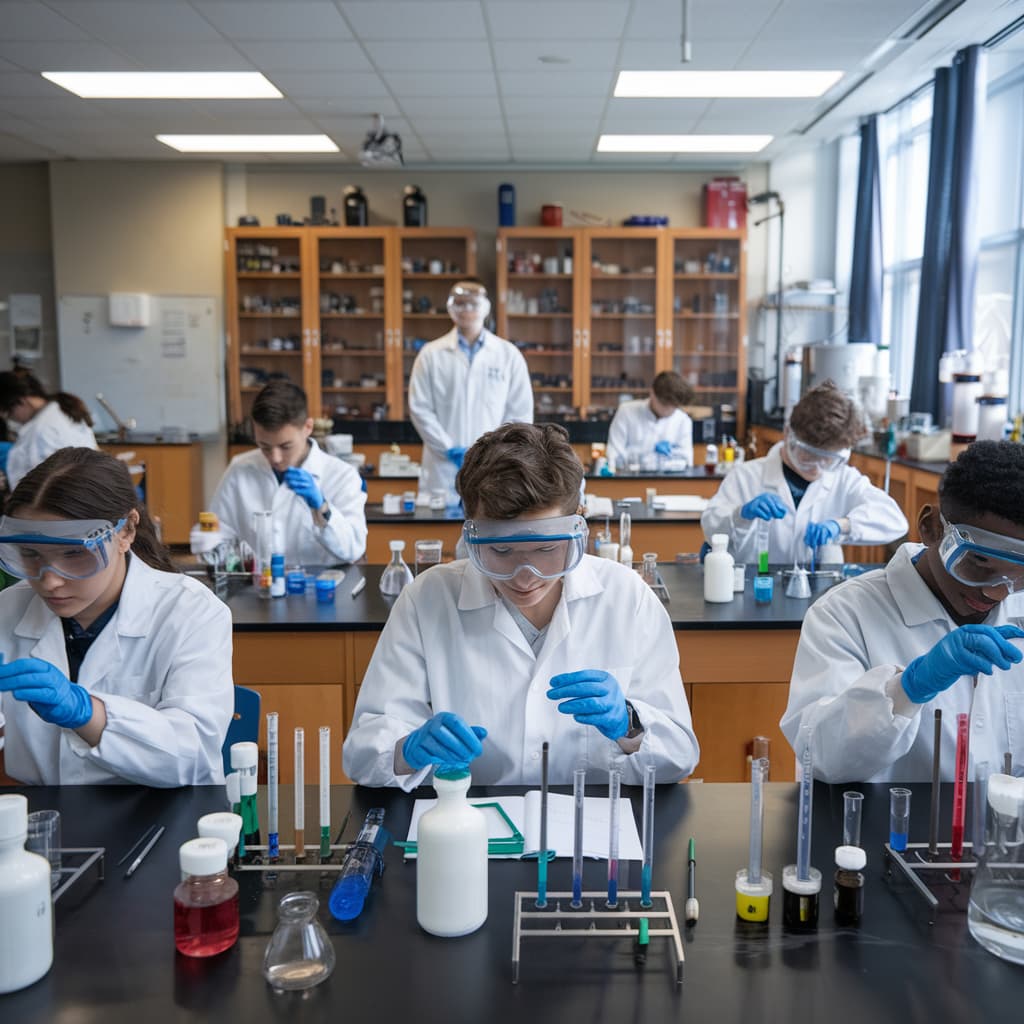
Get ready to dive into the exciting world of hands-on chemistry! The IB Chemistry program offers an incredible journey of skill development that goes far beyond theoretical knowledge.
Laboratory and Practical Skills
The practical component is absolutely thrilling! Both SL and HL students engage in extensive laboratory work, with HL students dedicating 60 hours to practical activities compared to 40 hours for SL students. This hands-on experience includes:
- Conducting scientific investigations
- Mastering experimental techniques
- Using advanced laboratory equipment
- Developing safety protocols
- Participating in collaborative science projects
What’s particularly exciting is the 10-hour collaborative sciences project that lets you work with peers to solve real-world problems across various science subjects!
Mathematical and Analytical Abilities
Get ready to sharpen your mathematical prowess! The program develops crucial analytical skills through:
Both SL and HL require strong mathematical foundations, but HL students dive deeper into advanced concepts like logarithms and basic calculus, especially in topics like chemical kinetics and thermodynamics. You’ll master the art of:
- Data interpretation and presentation
- Problem-solving techniques
- Critical analysis of experimental results
- Statistical evaluation methods
Research and Investigation Capabilities
Here’s where your scientific creativity truly shines! The program emphasizes developing robust research skills through independent investigations. You’ll have the exciting opportunity to:
The scientific investigation allows you to formulate your own research questions and conduct independent research. This 10-hour investigation lets you demonstrate your understanding of scientific methodology while applying knowledge to real-world problems.
What makes this even more exciting is that students can now work in small groups while maintaining individual research approaches [12]. This collaborative aspect enhances your ability to:
- Design and model solutions to local and global problems
- Develop technology skills in scientific contexts
- Communicate and collaborate effectively
- Evaluate and synthesize scientific information
The practical approach culminates in an interdisciplinary collaborative sciences project that addresses real-world problems, making chemistry come alive beyond the classroom!
University and Career Implications
The exciting world of university admissions and career opportunities awaits IB Chemistry students! Let’s explore how your choice between HL and SL can shape your future path.
Global University Requirements
Your IB Chemistry choice can open incredible doors in higher education! Many universities worldwide recognize IB Chemistry HL as equivalent to freshman/sophomore year chemistry courses. Here’s what makes it even more exciting:
- Universities like Notre Dame award credit for HL scores of 6 or 7
- The University of California system grants 8 quarter units for HL exams with scores of 5 or higher
- Some universities offer advanced placement or exemption from introductory courses for both HL and SL students
Career Path Considerations
Get ready to discover the amazing career possibilities that await you! According to the Royal Society of Chemistry, more than 96% of manufactured goods have direct ties to the chemical industry [3]. Here are some thrilling career paths you can pursue:
Healthcare and Medicine: Medical schools often require strong chemistry foundations, especially for specializations in pharmacology or toxicology [19].
Environmental Science: This rapidly growing field needs chemistry experts for:
- Developing sustainable materials
- Monitoring and analyzing pollutants
- Creating innovative energy production methods [19]
Materials Science: Your chemistry knowledge could revolutionize:
- Construction materials development
- Electronics advancement
- New composite creation [19]
Subject Combinations and Prerequisites
Making strategic subject choices is crucial! Here’s what you need to know:
For medical programs in countries like India, Pakistan, and Scandinavian nations, you’ll need three science subjects (biology, chemistry, physics, or mathematics). Important considerations include:
- Many universities have specific HL subject requirements for particular courses [21]
- Some top-tier institutions specifically look for HL in science courses, especially for programs at Oxford, Cambridge, or Ivy League universities [19]
- Your subject combination should align with your target university’s prerequisites while maintaining a balanced workload [21]
Remember, universities often prioritize exceptional performance in HLs over total points. For instance, a student with 38 total points but 7s in all HLs might be preferred over one with 40 points but lower HL grades [21]!
If this is feeling like a lot to take in, that's completely normal. Many students find it helpful to work with an experienced IB tutor who can provide clarity tailored to their situation. Get in touch →
Student Success Strategies
Let’s unlock the secrets to mastering IB Chemistry with proven strategies that work for both HL and SL students! These exciting approaches will help you conquer your chemistry journey with confidence and enthusiasm.
Study Techniques for Each Level
Success in IB Chemistry demands a strategic approach! Students who achieve top scores typically dedicate 6-10 hours per week to focused revision [22]. Here’s your winning formula for success:
- Active Learning: Create visual aids, flowcharts, and mind maps to connect different concepts
- Problem-Solving Practice: Regular attempts at different question types
- Conceptual Understanding: Focus on underlying principles rather than memorization
- Collaborative Learning: Form study groups to discuss complex topics
- Practical Application: Actively participate in lab work to reinforce theoretical concepts
For HL students specifically, the key is maintaining consistency with 30-60 minutes of daily study across six days per week. This approach helps build momentum and prevents last-minute cramming!
Time Management Tips
Time management isn’t just about studying more—it’s about studying smarter! Here’s your exciting 4-step strategy for success:
- Monthly Planning: Mark assignment due dates in red, warning dates in orange, and starting dates in blue
- Weekly Structure: Allocate specific times for each chemistry topic and practical work
- Daily Focus: Complete assignments right after lessons while the content is fresh
- Strategic Breaks: Use the Pomodoro Technique with 25-minute focused study sessions followed by 5-minute breaks [26]
Pro Tip: Start your assignments early! Getting a head start of one or two hours on schoolwork prevents playing catch-up later.
Resource Utilization
Get ready to supercharge your learning with these amazing resources! The key to success lies in using a variety of study materials strategically:
Digital Resources: Revision Village offers comprehensive study materials, including question banks, practice exams, and past papers. Their mobile app makes learning on the go easier than ever!
Practical Work: Dedicate time to experimental programs as they reinforce theoretical concepts and develop essential skills. The practical component allows you to:
- Experience a range of tasks from closed to open inquiry
- Use simulations and modeling
- Incorporate technology appropriately
Collaborative Learning: Working with peers can transform your understanding! Form study groups to:
- Discuss complex topics
- Share insights and resources
- Gain fresh perspectives
Important: When struggling with specific topics, don’t hesitate to seek help from teachers or peers early on. This proactive approach prevents small misunderstandings from becoming major obstacles!
Remember, success in IB Chemistry comes from consistent effort and smart resource utilization. By implementing these strategies and maintaining regular practice sessions, you’re setting yourself up for an exciting journey toward achieving your chemistry goals!
Conclusion
The choice between IB Chemistry HL and SL represents a significant decision that shapes academic paths and future careers. Both levels offer strong foundations in chemical principles, though HL demands 180 teaching hours compared to SL’s 110 hours, allowing deeper exploration of advanced topics and complex problem-solving scenarios. Explore our detailed guide on Le Chatelier's principle for more tips.
Assessment structures for both levels maintain high standards through two examination papers and an internal investigation. HL students face more challenging questions and longer examination times, reflecting the advanced nature of their coursework. The practical component, particularly the 10-hour scientific investigation, builds essential laboratory skills and research capabilities across both levels.
University recognition varies significantly, with many prestigious institutions offering course credits or advanced placement for HL students who achieve scores of 5 or higher. Career opportunities span healthcare, environmental science, and materials development, though HL chemistry often provides additional advantages for competitive programs and research-focused roles.
Success in either level depends on consistent effort, smart resource utilization, and effective time management. Students who dedicate 6-10 hours weekly to focused study, actively participate in practical work, and maintain regular revision schedules typically achieve their desired outcomes.
The final decision between HL and SL should align with your academic strengths, university goals, and intended career path. While HL offers broader opportunities and deeper understanding, SL provides a solid foundation for many science-related fields. Your choice should reflect not just your capabilities, but also your passion for chemical sciences and long-term academic aspirations.
References
[1] – https://www.ibo.org/programs/diploma-program/curriculum/sciences/chemistry/
[2] – https://www.crimsoneducation.org/ca/blog/ib-chemistry/
[3] – https://helloblen.com/blog/3446-unlocking-the-world-of-career-opportunities-with-ib-chemistry
[4] – https://www.crimsoneducation.org/nz/blog/ib-chemistry/
[5] – https://www.savemyexams.com/learning-hub/exam-guides/ib-chemistry/
[6] – https://www.ibo.org/globalassets/new-structure/recognition/pdfs/dp_sciences_chemistry_subject-brief_jan_2022_e.pdf
[7] – https://kisacademics.com/blog/the-ultimate-guide-to-ib-chemistry/
[8] – https://www.crimsoneducation.org/uk/blog/ib-chemistry/
[9] – https://sites.google.com/view/ibchemistry/internal-assessment
[10] – https://www.ibo.org/university-admission/latest-curriculum-updates/chemistry-updates/
[11] – https://thinkib.net/chemistry/page/45925/major-changes-for-the-2023-program-
[12] – https://helloblen.com/blog/3454-navigating-the-depths-of-ibdp-chemistry-fe2025
[13] – https://teachchemistry.org/periodical/issues/november-2019/ap-or-ib-what-s-the-difference
[14] – https://www.crimsoneducation.org/tw-en/blog/ib-chemistry/
[15] – https://knowledgeum.in/ib-diploma-program/ib-chemistry-a-comprehensive-guide-to-standard-and-higher-levels
[16] – https://blog.collegevine.com/ultimate-guide-to-ib-chemistry-hl-exam
[17] – https://advising.nd.edu/first-year-and-incoming-students/requirements-and-credits/advanced-credit-and-placements/ib-hl-exam-credit/
[18] – https://admission.universityofcalifornia.edu/admission-requirements/ap-exam-credits/ib-credits.html
[19] – https://www.tutorchase.com/blog/ib-chemistry-a-complete-guide
[20] – https://www.ibo.org/programs/diploma-program/curriculum/example-subject-choices/
[21] – https://lanterna.com/blog/hl-vs-sl-which-to-choose/
[22] – https://helloblen.com/blog/3471-mastering-ib-chemistry-how-to-score-a-7
[23] – https://www.crimsoneducation.org/us/blog/ib-chemistry/
[24] – https://www.linkedin.com/pulse/8-ways-score-7-points-ib-chemistry-sl-hl-tried-tested-ananya-gupta
[25] – https://www.thestudentroom.co.uk/showthread.php?t=3777855
[26] – https://www.revisiondojo.com/blog/how-many-hours-should-i-study-for-ib-science
Need Personalised Guidance?
Every student's situation is different. Our tutors can help you understand your options, plan your next steps, and make informed decisions about your IB journey. Find your tutor →
Frequently Asked Questions
What are the best resources for IB Chemistry revision?
Top resources include the Oxford/Pearson textbook, past paper question banks, the IB Chemistry data booklet, and online platforms. Combine textbook reading with active practice for the best results.
How is the IB Chemistry exam structured?
IB Chemistry has three papers: Paper 1 (multiple choice), Paper 2 (structured/extended response), and Paper 3 (data-based and option questions for HL). Each paper tests different skills and knowledge areas.
What grade do I need in IB Chemistry for university?
Requirements vary by university and program. Most competitive science programs expect a 6 or 7 at HL, while SL scores of 5-6 are typically sufficient for non-science programs.
How do I balance IB Chemistry with other subjects?
Create a weekly study schedule that allocates specific time blocks for each subject. Use active recall and spaced repetition for Chemistry to maximize retention without spending excessive time on any single topic.