IB vs AP — Which Is Right for Your Child?
Parents at international schools face a pivotal decision: should their child pursue the International Baccalaureate (IB) or Advanced Placement (AP)? Both progra...
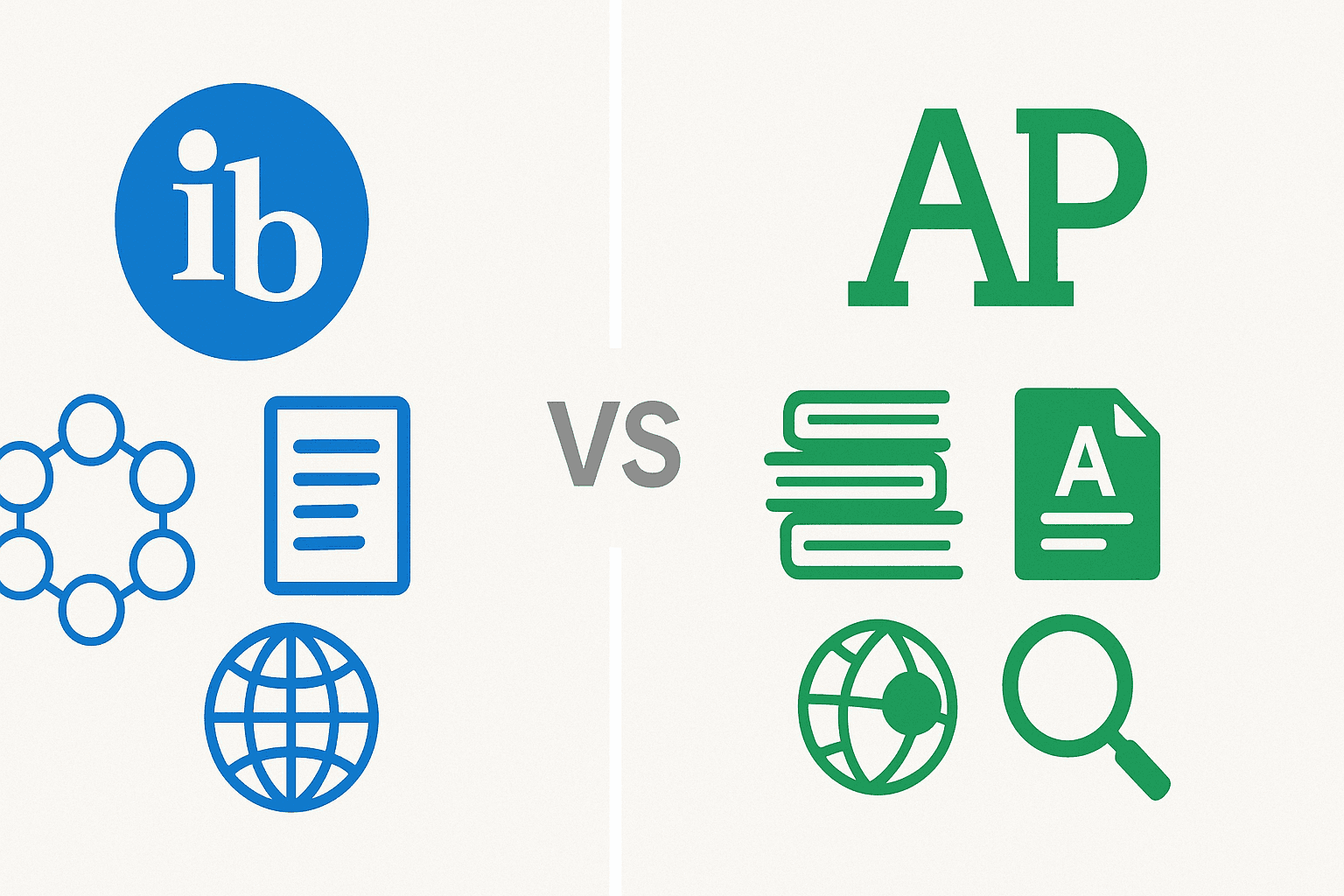
Parents at international schools face a pivotal decision: should their child pursue the International Baccalaureate (IB) or Advanced Placement (AP)? Both programmes are rigorous, widely recognised, and respected by universities worldwide. Yet they're fundamentally different in structure, assessment methods, and what they develop in students. This guide breaks down the key differences to help you make an informed choice for your family.
Quick Comparison at a Glance
| Aspect | IB Diploma | AP |
|---|---|---|
| Structure | Full diploma (6 subjects + core) | Individual courses (take any number) |
| Subject Balance | Breadth required (sciences, humanities, languages) | Specialisation possible |
| Assessment | Internal assessments + final exams (40% + 60%) | One exam per subject in May |
| Grading Scale | 1-7 per subject, max 45 points total | 1-5 per exam |
| Passing Grade | 24 points minimum | 3 or higher typically needed for credit |
| Exam Fees | ~$120 per subject | ~$98 per exam |
| Duration | 2 years (compulsory) | Flexible |
| University Credit | Varies by institution | Yes, with scores of 3+ at most US universities |
How IB Works
The International Baccalaureate Diploma Programme is a comprehensive, 2-year qualification designed to develop critical thinkers and globally minded learners. Students take six subjects across groups: Studies in Language, Language Acquisition, Individuals & Societies, Sciences, Mathematics, and The Arts.
Three subjects are taken at Higher Level (HL) — demanding deeper content, 240 teaching hours — and three at Standard Level (SL) — 150 hours. This ensures students develop both depth and breadth. Alongside subjects, all IB students complete three core components: Theory of Knowledge (TOK), an Extended Essay (EE), and Creativity, Activity, Service (CAS).
Assessment combines internal assessments (IA) — coursework, projects, and portfolios graded by teachers and moderated externally — with final exams in May. Each subject is graded 1-7, and the core can add up to 3 bonus points. The maximum score is 45 points; a minimum of 24 is needed to earn the diploma.
How AP Works
Advanced Placement is a series of independent courses and exams, each scored separately. There are 38 AP subjects available — ranging from AP Calculus and Biology to AP Art History and Psychology — giving students genuine flexibility. Unlike IB, there's no prescribed formula: a student can take one AP course or fifteen.
Each AP course culminates in a single standardised exam in May, lasting 2-3 hours, comprising multiple-choice questions and free-response questions (FRQs). Exams are scored on a scale of 1-5, with a score of 3 or higher generally considered "passing" and eligible for college credit at most US universities. There is no coursework component — the exam is the sole assessment.
AP is ideal for students who want to signal mastery in specific subjects. A student passionate about computer science and chemistry can take AP Computer Science A and AP Chemistry without needing to balance unrelated subjects.
Which One Do Universities Prefer?
Short answer: neither. Top universities accept both, and success in either programme is more important than which you choose.
In the United States, AP is familiar to admissions officers because it's domestic and widespread. A strong AP profile carries weight at selective universities. However, the IB Diploma is increasingly recognised and respected for its rigour. Many US universities grant college credit for IB Higher Level scores of 5 or above. Harvard, MIT, Stanford, and Yale all openly welcome IB applicants.
In the United Kingdom and Europe, the IB Diploma is exceptionally well-regarded. UK universities, including Oxford and Cambridge, have specific IB point requirements (often 38-40 points for top schools) and value the Extended Essay and TOK. AP is less commonly seen in the UK system, though it's gaining recognition. Australian and Canadian universities accept both.
The universal principle: a student with strong grades in either programme, supported by solid test scores, will be competitive.
Which Is Right for Your Child?
Choose IB if your child is well-rounded and enjoys multiple disciplines, thrives with structure and long-term projects, plans to apply to universities outside the US, values developing critical thinking broadly, and is willing to commit 2 years to a full programme.
Choose AP if your child has clear academic strengths or passions (e.g., STEM-focused), prefers specialisation over breadth, attends a US-curriculum school where AP is the natural pathway, is motivated by exam-based assessment, and targets primarily US universities.
Consider both if your school offers a dual pathway, your child is exceptionally motivated, or you're unsure and want to delay the decision until Year 10/11.
Can a Student Do Both IB and AP?
Yes — but it's rare and demands exceptional time management. Some international schools allow students to take IB core requirements (TOK, EE, CAS) while supplementing with AP exams in subjects outside the IB curriculum. For example, a student might complete the IB Diploma in six subjects and self-study AP Psychology or AP Computer Science to strengthen their university profile.
A few students have pursued AP exams independently while completing IB, using tutoring support to manage the additional study load. This approach is most viable for motivated students at schools with flexible policies. However, most students find one programme sufficient.
How ++tutors Helps with Both
Whether your child is navigating IB or AP, expert tutoring makes the difference. Our tutors are certified teachers and examiners with deep knowledge of both programmes. We provide targeted support across all IB subjects and all major AP courses.
A free assessment with one of our education specialists can help clarify which pathway is right for your child, and ongoing tutoring ensures they're prepared to excel.