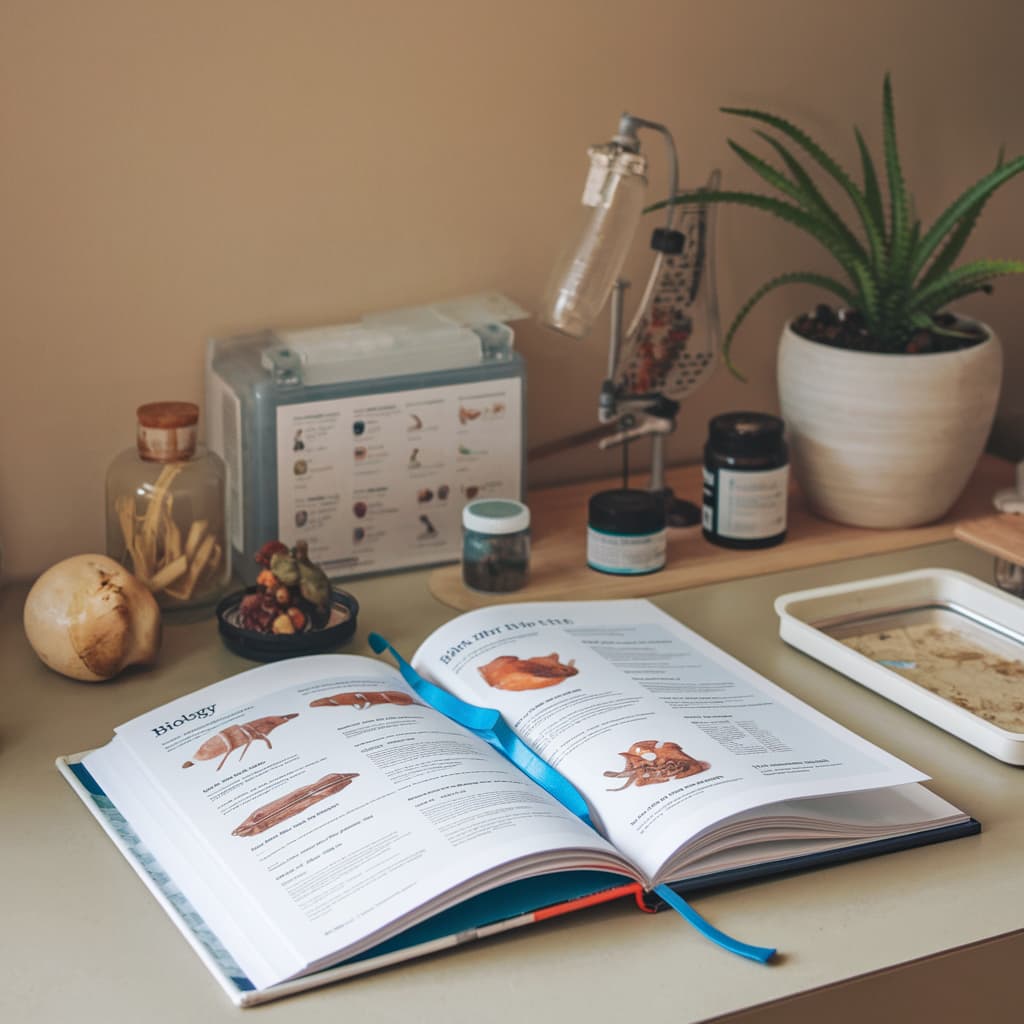
How to Study Biology Like a Top Student: The Science-Backed Method
How to Study Biology Like a Top Student: The Science-Backed Method A mere 12.8% of A-Level Biology students earn an A* grade. This makes Biology one of the toughest subjects to excel in. Mathematics paints a different picture with 22.8% of students achieving an A*, which shows Biology is substantially more challenging. The best way […]
How to Study Biology Like a Top Student: The Science-Backed Method
A mere 12.8% of A-Level Biology students earn an A* grade. This makes Biology one of the toughest subjects to excel in. Mathematics paints a different picture with 22.8% of students achieving an A*, which shows Biology is substantially more challenging.
The best way to study biology is vital to academic success. Biology ranks as the third most popular choice with 63,765 students. The sheer volume of content can feel daunting, but here’s the silver lining – the right study strategies can boost your understanding and retention dramatically.
Students who struggle with complex biological concepts or aim for top grades can benefit from our proven, science-backed methods. These methods will help you study biology effectively. Successful biology students use active learning techniques and strategic note-taking approaches to master this challenging subject.
Your biology study routine needs a revolution? Let’s tuck into the methods that actually work.
Understanding How Your Brain Learns Biology
Biology becomes easier to learn when you understand how your brain processes and retains information. Changes between electrically active nerve cells (neurons) and their connections (synapses) are the foundations of learning [1].
The Science of Memory Formation
Your brain forms memories through lasting changes in neuron connections’ strength, a process called synaptic plasticity [1]. Neural connections grow stronger with repeated use during biology study sessions, while unused pathways fade [2]. Your brain can also produce new neurons in the hippocampus, which handles memory formation [1].
Active Recall vs Passive Review
The way you participate with biology content shapes how well you remember it. Active recall pulls information from your brain, while passive review just involves reading or highlighting notes [3]. Research shows clear results:
- Active recall builds stronger memories and shows what you don’t know yet [4]
- Passive review ranks among the least productive ways to learn, despite its popularity [4]
- Self-testing builds stronger neural pathways than going through notes again [3]
Spacing Effect in Biology Learning
The timing of study sessions plays a significant role in retention. Students learn better by spreading out their study time instead of cramming. To name just one example, a meteorology study showed students who took a review quiz eight days after their lecture did better on the final test than those who reviewed just one day later [5].
Biological mechanisms explain the spacing effect. Each study session triggers CREB (cyclic AMP response element-binding protein), which strengthens neuron connections [5]. Time between study sessions lets these proteins work properly to build lasting memories [6].
Creating Your Biology Study System
Your brain’s ability to absorb biology concepts varies throughout the day. Research shows you learn best between 10 am and 2 pm, with another productive window from 4 pm to 10 pm [7].
Setting Up Your Study Schedule
A consistent weekly schedule helps you handle challenging biology coursework. You should spend 2-3 hours studying for each credit hour. This means a 4-credit biology course needs 8-12 hours of weekly study time [8]. You can find your most productive hours by monitoring your energy levels for a few days [7].
Organizing Different Types of Biology Content
The Biology Concept Framework (BCF) gives you a well-laid-out way to organize course material. This system creates a hierarchy that puts details in context and links related concepts [9]. The framework helps you:
- Identify key concepts and their relationships
- Place specific details within broader contexts
- Cross-reference interconnected biological systems
Building Review Cycles
Strong retention comes from structured review cycles. Research shows that students in introductory biology courses benefit from well-structured learning, including weekly practice and quizzes [10]. Breaking larger assignments into smaller tasks with specific deadlines helps maintain steady progress [11].
Schedule your review sessions during your peak hours and keep your calendar updated with deadlines and commitments [8]. This organized approach lets you dive deeper into complex biological concepts while keeping a balanced study routine.
Mastering Biology Note-Taking
Students who take biology notes in a well-laid-out way understand complex scientific information better. Studies show their grades go up by 12% [12].
Cornell Method for Biology Notes
The Cornell method splits your page into three parts. You get a narrow left column for questions, a wider right column for lecture notes, and space at the bottom for summaries [13]. Biology students find this system really helpful. They can write questions in the left margin while they study. This helps them spot gaps in their knowledge and makes great review materials [13].
Mind Mapping Complex Biological Systems
Mind maps work great for seeing how biological processes connect. They work differently from regular notes. You put the main idea in the middle and let related concepts branch out [14]. Concept maps are another option. They use labeled arrows to show how biological processes connect. This makes them perfect for understanding things like cellular respiration or genetic inheritance [15]. Students can handle large amounts of information better with these visual methods [12].
Digital Tools for Biology Notes
Biology students now have many digital note-taking options. Here are the main tools that make biology notes better:
- Evernote: Works best for organizing notes into notebooks and adding pictures and videos [16]
- OneNote: Lets you write by hand and add diagrams [16]
- Notion: Makes shared pages and databases for studying in groups [16]
These digital tools let you write on PDF documents, add pictures, and keep your notes synced on all your devices [17]. The best results come from mixing old-school and digital methods to learn biological concepts.
Implementing Active Learning Strategies
Active learning is the life-blood of successful biology study. Research shows it helps students perform better in science fields [18].
Teaching Concepts to Others
Students who explain biological concepts to their peers build stronger understanding and discover gaps in their knowledge. Group teaching activities lead to better retention rates and analytical skills [19]. We organized complex information into clear, teachable units through this method.
Creating Practice Questions
Self-testing is one of the best ways to become skilled at biological concepts. Students who create their own practice questions develop a deeper grasp of the material [20]. A strategic way to create practice questions has these elements:
- Focusing on core biological processes
- Incorporating visual elements like diagrams
- Connecting different concepts within topics
- Testing understanding at multiple levels
Hands-on Learning Activities
Physical interaction with biological concepts builds lasting neural connections. Virtual simulations are practical alternatives when traditional labs aren’t possible [1]. Field-based activities are a great way to get hands-on experience with complex biological systems [21]. The combination of virtual and physical learning activities creates a detailed understanding of biological processes.
Interactive models and demonstrations, like the kinesthetic physical model for cardiopulmonary physiology, help students understand abstract concepts [21]. Outdoor learning experiences give unique chances to observe biological processes firsthand. Virtual simulations let students retry experiments as needed and reinforce their understanding through repeated practice [1].
Conclusion
Learning biology just needs a scientific approach to studying. Research shows that combining well-laid-out study systems with active learning strategies boosts understanding and retention of complex biological concepts by a lot.
Your success in biology comes from understanding how your brain processes information. Active recall, spaced repetition, and strategic note-taking create stronger neural connections than traditional passive review methods.
Students who use these science-backed study techniques see clear improvements in their grades and comprehension. Well-structured note-taking systems, hands-on activities, and teaching others make challenging biological concepts clearer and more manageable.
Note that excellence in biology comes from consistent practice rather than last-minute cramming. These techniques can be adapted to your learning style, and your understanding of biological systems will grow stronger with each study session.
References
[1] – https://gizmos.explorelearning.com/resources/insights/teachingstrategies-for-biology
[2] – https://qbi.uq.edu.au/memory/how-are-memories-formed
[3] – https://irisreading.com/what-is-active-recall-and-passive-recall/
[4] – https://www.osmosis.org/blog/active-recall-the-most-effective-high-yield-learning-technique
[5] – https://www.brainfacts.org/thinking-sensing-and-behaving/learning-and-memory/2021/the-neuroscience-behind-the-spacing-effect-030421
[6] – https://pmc.ncbi.nlm.nih.gov/articles/PMC8759977/
[7] – https://www.lecturio.com/blog/the-best-time-to-study-use-your-biological-prime-time/
[8] – https://libguides.kirtland.edu/c.php?g=1155275&p=8432624
[9] – https://pmc.ncbi.nlm.nih.gov/articles/PMC437643/
[10] – https://pmc.ncbi.nlm.nih.gov/articles/PMC9753709/
[11] – https://uwaterloo.ca/future-students/missing-manual/student-life/time-management-secrets-science-students
[12] – https://www.edrawmind.com/article/biology-concept-map-examples.html
[13] – https://itsnotrocketscienceclassroom.com/2021/09/how-to-use-cornell-notes/
[14] – https://lucidspark.com/blog/visual-note-taking-for-students-and-teachers
[15] – https://edrawmind.wondershare.com/mind-map/biology-mind-map.html
[16] – https://scholarly.so/blog/note-writing-for-biology-a-comprehensive-guide
[17] – https://www.biology.cam.ac.uk/undergrads/InfoCurrentStudent/note-taking
[18] – https://www.ibiology.org/active-learning-biology-education/
[19] – https://www.lifescied.org/doi/10.1187/cbe.20-04-0068
[20] – https://www.biologycorner.com/quizzes/
[21] – https://www.researchgate.net/publication/353709556_Active_Learning_Strategy_on_Higher_Education_Biology_Learning_A_Systematic_Review