5 Common AP Chemistry FRQ Mistakes and How to Fix Them
Free response questions account for a full 50% of your AP Chemistry exam score, yet most students lose points on avoidable mistakes that have nothing to do with...
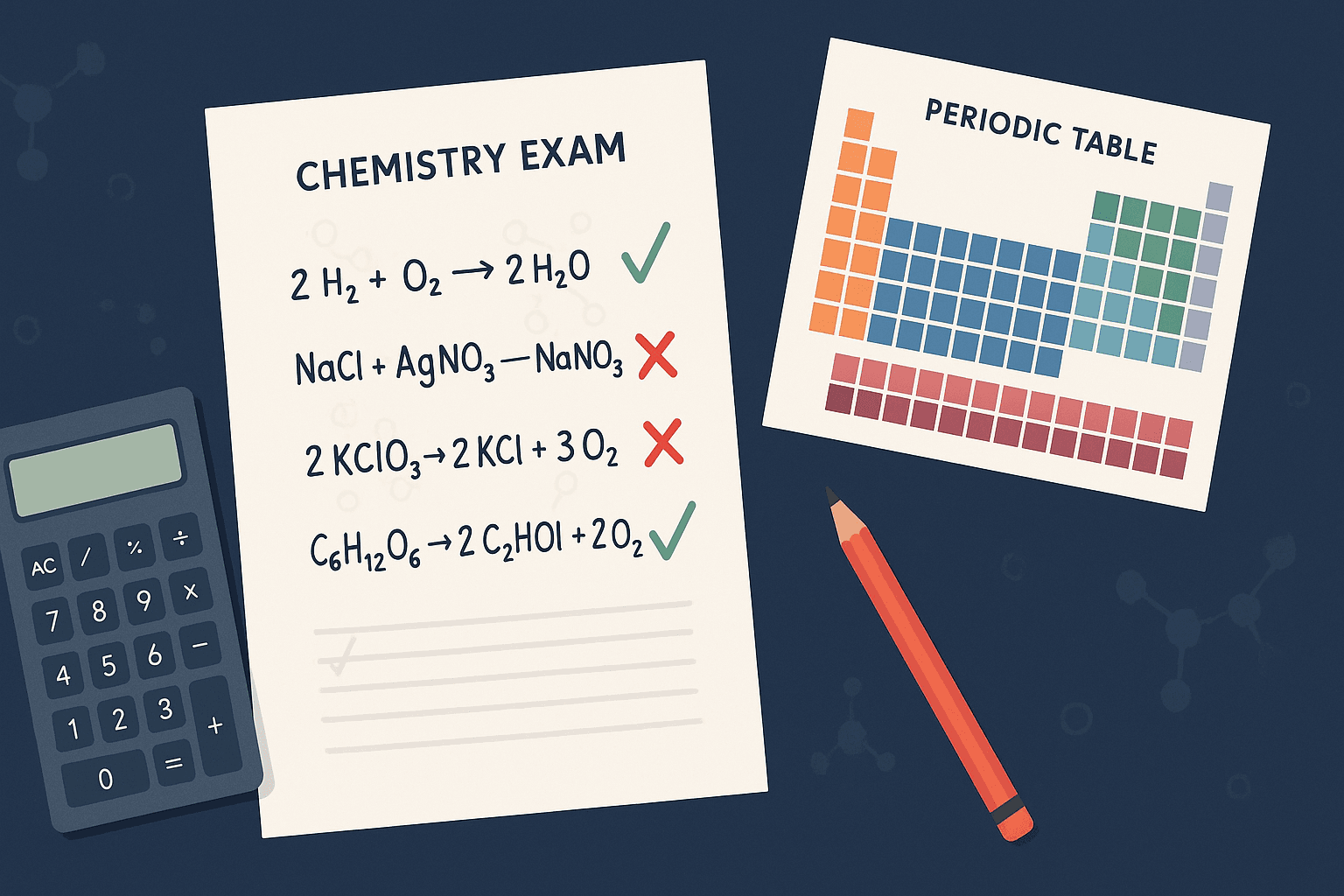
Free response questions account for a full 50% of your AP Chemistry exam score, yet most students lose points on avoidable mistakes that have nothing to do with chemistry understanding. You might nail the concept of equilibrium or know your redox reactions cold, but a small error in how you present your work can cost you a point — or worse, multiple points. This guide covers the 5 most common errors our AP Chemistry tutors see in student responses, plus exactly how to fix them before exam day.
What Are AP Chemistry FRQs?
The AP Chemistry exam includes 7 free response questions that you'll answer over 105 minutes. You get three long-form questions worth up to 10 points each, and four short-form questions worth 4 points each. Together, these questions test not just whether you know chemistry, but whether you can communicate your understanding clearly and completely — which is why the College Board's rubrics are brutally specific about what earns credit.
Mistake #1: Not Showing Your Work on Calculation Problems
What students do wrong: You look at a problem like "Calculate the molarity of a solution made by dissolving 5.85 g of NaCl in water to a final volume of 250 mL" and jump straight to plugging numbers into a calculator. You write: "M = 0.4 M" and move on, thinking the math is straightforward and the answer speaks for itself.
Why it costs marks: The College Board rubric for calculation problems gives credit for the process, not just the final answer. If you write only "0.4 M," you've earned zero points even if your answer is correct — because the grader has no way to know if you understood dimensional analysis, converted units correctly, or just guessed. But if you show your dimensional analysis and get a wrong answer, you'll likely earn 1 or 2 points for correct methodology.
How to fix it: Always show the formula, the values you're plugging in, and the dimensional analysis. For the NaCl problem above, write: Molarity = moles / volume (L). Moles of NaCl = 5.85 g x (1 mol / 58.5 g) = 0.1 mol. Volume = 250 mL = 0.250 L. M = 0.1 mol / 0.250 L = 0.4 M. Now, even if you made an arithmetic error, you'd still earn most of the points.
Mistake #2: Ignoring Significant Figures
What students do wrong: You calculate the density of a sample using a mass of 12.45 g and a volume of 6.2 mL, and you write: "density = 2.008064 g/mL" or conversely, you round aggressively to "density = 2 g/mL" without thinking about the rules.
Why it costs marks: The College Board deducts points for incorrect significant figures on nearly every quantitative FRQ. Your mass (12.45 g) has 4 sig figs, but your volume (6.2 mL) has only 2. Your answer must have 2 sig figs: 2.0 g/mL. Reporting 2.008 or 2 both cost you a point. Over multiple questions, that adds up fast.
How to fix it: Before you start a calculation, identify the sig figs in each given value. The answer is limited by the least precise measurement. Write: "Sig figs: mass has 4, volume has 2, so answer must have 2 sig figs." This takes 10 extra seconds and shows the grader you're thinking critically about precision. Carry extra digits during intermediate steps and round only at the end.
Mistake #3: Weak Justifications in Equilibrium Questions
What students do wrong: You see a question like "The system below is at equilibrium. A chemist adds more CO2. Predict how the equilibrium will shift and justify your answer." You write: "The equilibrium will shift to the left. Adding CO2 increases the pressure." Done.
Why it costs marks: The College Board rubric for equilibrium questions explicitly requires you to apply Le Chatelier's principle with reference to the specific stress. Saying "pressure increases" is vague — it's not clear you understand why the system responds the way it does.
How to fix it: Always name the principle and show the causal chain: "Adding CO2 increases the concentration of a reactant. By Le Chatelier's principle, the system shifts left (toward reactants) to counteract the stress and re-establish equilibrium." For temperature changes, explain: "Increasing temperature favours the endothermic direction to absorb excess heat."
Mistake #4: Incomplete Lab Design Questions
What students do wrong: A lab design question asks: "Describe an experiment to determine how the rate of reaction depends on the concentration of HCl." You write: "Measure how long it takes for the HCl to react. Change the concentration and measure the time again."
Why it costs marks: The College Board rubric for lab design gives credit for identifying variables (independent, dependent, control), describing procedure, and addressing reliability. Your response above lacks all of these.
How to fix it: Write a complete lab design addressing each element: Independent variable (concentration of HCl — 0.1 M, 0.5 M, 1.0 M, 2.0 M), Dependent variable (time to reach visible endpoint, measured with stopwatch), Control (trial with fixed concentration for baseline), Procedure (step-by-step mixing and timing), Reliability (three trials per concentration, calculate mean).
Mistake #5: Not Answering All Parts of Multi-Part Questions
What students do wrong: A FRQ has parts (a), (b), (c), and (d). You write a thorough answer to parts (a) and (b), then glance at the clock with 2 minutes left and skip parts (c) and (d).
Why it costs marks: Each part of a multi-part question is scored independently. Skipping part (c) costs you 2-3 points. And part (c) might actually be easier than part (b), or it might rely on a previous answer.
How to fix it: Read all parts of a multi-part question before you start. Allocate your time fairly: 5-7 minutes per part. Write something for every part, even if it's incomplete. A partial answer earns some credit; no answer earns none. If you get stuck on part (b), move to part (c) — you can always return.
Bonus Tip: How to Practice FRQs Effectively
The College Board publishes released FRQ questions and official scoring guidelines for every year dating back decades. Instead of just reading a question and thinking about the answer, write it out by hand in timed conditions. After 25 minutes, stop and compare your response to the official scoring guidelines. Note exactly where you lost points. Spend your last two weeks before the exam doing at least one full practice test under timed conditions using released FRQs.
Need Expert Help?
The 5 mistakes above are all fixable with the right guidance and practice. Our ++tutors AP Chemistry specialists are certified teachers who know the FRQ rubrics inside out — they've graded AP exams and understand exactly what the College Board is looking for.
A free assessment is the perfect place to start. You'll meet an expert AP tutor who can identify your specific weak spots and guide you toward a 4 or 5.