AP Chemistry: Acids, Bases, and Buffers — The Quick Review
AP Chemistry: Acids, Bases, and Buffers — The Quick Review Unit 8 (Acids and Bases) accounts for 11-15% of the AP Chemistry exam, making it one of the highest-w...
Key Takeaways
- Before diving into concepts, here are the equations that drive every calculation in this unit.
- For any weak acid or base equilibrium calculation, set up an ICE (Initial, Change, Equilibrium) table.
- The AP exam tests your understanding of why some acids are stronger than others.
- Buffer capacity describes how much strong acid or base a buffer can absorb before the pH changes significantly.
- An acid-base indicator is a weak acid whose conjugate base has a different color.
Need Personalised Guidance?
For more on this topic, explore our guide on Things No One Will Tell You About What to Expect at University Part Ii. This guide covers every key aspect you need to understand.
Frequently Asked Questions
What are the best resources for IB Chemistry revision?
Top resources include the Oxford/Pearson textbook, past paper question banks, the IB Chemistry data booklet, and online platforms. Combine textbook reading with active practice for the best results.
For more on this topic, explore our guide on Things No One Will Tell You About What to Expect at University Part Ii.
How is the IB Chemistry exam structured?
IB Chemistry has three papers: Paper 1 (multiple choice), Paper 2 (structured/extended response), and Paper 3 (data-based and option questions for HL). Each paper tests different skills and knowledge areas.
What grade do I need in IB Chemistry for university?
Requirements vary by university and program. Most competitive science programs expect a 6 or 7 at HL, while SL scores of 5-6 are typically sufficient for non-science programs.
How do I balance IB Chemistry with other subjects?
Create a weekly study schedule that allocates specific time blocks for each subject. Use active recall and spaced repetition for Chemistry to maximize retention without spending excessive time on any single topic.
Unit 8 (Acids and Bases) accounts for 11-15% of the AP Chemistry exam, making it one of the highest-weighted units. It's also one of the most calculation-intensive — you'll face pH calculations, equilibrium problems, buffer questions, and titration analysis on both the MCQ and FRQ sections. This review covers the essential concepts, equations, and problem-solving approaches you need for the 2026 exam.
Navigating AP Chemistry can feel overwhelming, especially if it's your first time. If you'd like personalised guidance from someone who's helped hundreds of AP students, our AP Chemistry tutors are here to help. Tell us what you need →
Key Equations You Need
Before diving into concepts, here are the equations that drive every calculation in this unit. These are provided on the AP Chemistry equation sheet, but you need to know when and how to use each one:
pH and pOH: pH = -log[H⁺], pOH = -log[OH⁻], pH + pOH = 14 (at 25°C), [H⁺][OH⁻] = Kw = 1.0 × 10⁻¹⁴
Acid dissociation: Ka = [H⁺][A⁻]/[HA] (for weak acid HA ⇌ H⁺ + A⁻)
Base dissociation: Kb = [BH⁺][OH⁻]/[B] (for weak base B + H₂O ⇌ BH⁺ + OH⁻)
Relationship between Ka and Kb: Ka × Kb = Kw (for a conjugate acid-base pair)
Henderson-Hasselbalch equation: pH = pKa + log([A⁻]/[HA])
Percent ionization: % ionization = ([H⁺] at equilibrium / initial [HA]) × 100
Strong vs Weak Acids and Bases
Strong acids dissociate completely in water. The six strong acids you must know: HCl, HBr, HI, HNO₃, H₂SO₄ (first proton only), HClO₄. For strong acids, [H⁺] = [acid] directly. If you have 0.10 M HCl, the pH is simply -log(0.10) = 1.00.
Strong bases also dissociate completely. Know these: LiOH, NaOH, KOH, RbOH, CsOH, Ca(OH)₂, Sr(OH)₂, Ba(OH)₂. For Group 2 hydroxides, remember that each formula unit produces 2 OH⁻ ions: 0.10 M Ba(OH)₂ gives [OH⁻] = 0.20 M.
Weak acids only partially dissociate. You must use an ICE table to find [H⁺] at equilibrium. The smaller the Ka, the weaker the acid and the less it dissociates.
Weak bases partially react with water to produce OH⁻. Use an ICE table with Kb to find [OH⁻], then convert to pH.
The ICE Table: Your Essential Problem-Solving Tool
For any weak acid or base equilibrium calculation, set up an ICE (Initial, Change, Equilibrium) table.
For more on this topic, explore our guide on Analyzing Past Ib Papers Key Chemistry Trends and Tips.
Example: Find the pH of 0.25 M acetic acid (Ka = 1.8 × 10⁻⁵)
CH₃COOH ⇌ H⁺ + CH₃COO⁻
| CH₃COOH | H⁺ | CH₃COO⁻ | |
|---|---|---|---|
| I | 0.25 | 0 | 0 |
| C | -x | +x | +x |
| E | 0.25 - x | x | x |
Ka = x²/(0.25 - x) = 1.8 × 10⁻⁵
The 5% approximation: If Ka is small relative to the initial concentration (Ka/[HA] < 0.05), you can approximate 0.25 - x ≈ 0.25. This simplifies to x² = (1.8 × 10⁻⁵)(0.25), giving x = 2.1 × 10⁻³. Check: 2.1 × 10⁻³/0.25 = 0.84%, which is less than 5%, so the approximation is valid.
pH = -log(2.1 × 10⁻³) = 2.68
When the approximation fails: If the percent ionization exceeds 5%, you must solve the quadratic equation exactly. This typically happens when the acid concentration is very low or Ka is relatively large.
Polyprotic Acids
Some acids can donate more than one proton (H₂SO₄, H₃PO₄, H₂CO₃). Key rules for polyprotic acids: Ka₁ >> Ka₂ >> Ka₃. The first ionization dominates — you can usually calculate pH using only Ka₁. The second (and third) ionizations contribute negligibly to [H⁺] in most cases.
Exam tip: When the AP exam asks about polyprotic acids, it typically tests whether you understand that the second ionization is much weaker than the first, or asks you to calculate the concentration of the fully deprotonated species using Ka₂.
Molecular Structure and Acid Strength
The AP exam tests your understanding of why some acids are stronger than others. Two key factors:
Bond strength: For binary acids in the same group (HF, HCl, HBr, HI), acid strength increases down the group because bond strength decreases, making it easier to release H⁺. HI is the strongest; HF is the weakest.
Electronegativity and resonance in oxyacids: For oxyacids with the same central atom (HClO, HClO₂, HClO₃, HClO₄), more oxygen atoms mean more electron withdrawal from the O-H bond, making the acid stronger. HClO₄ is the strongest; HClO is the weakest. For oxyacids with different central atoms but the same structure (HClO₃ vs HBrO₃), the more electronegative central atom produces the stronger acid.
Buffers: How They Work
A buffer is a solution containing a weak acid and its conjugate base (or a weak base and its conjugate acid) in significant concentrations. Buffers resist pH changes when small amounts of strong acid or strong base are added.
How buffering works: When you add strong acid (H⁺) to a buffer, the conjugate base reacts with it: A⁻ + H⁺ → HA. When you add strong base (OH⁻), the weak acid neutralizes it: HA + OH⁻ → A⁻ + H₂O. The pH changes only slightly because the ratio [A⁻]/[HA] changes only slightly.
The Henderson-Hasselbalch equation is your primary tool for buffer calculations:
pH = pKa + log([A⁻]/[HA])
This equation tells you three things immediately: when [A⁻] = [HA], the pH equals the pKa (the buffer is most effective at this point). When [A⁻] > [HA], the pH is above the pKa. When [A⁻] < [HA], the pH is below the pKa.
Buffer Capacity
Buffer capacity describes how much strong acid or base a buffer can absorb before the pH changes significantly. Two factors determine buffer capacity: the total concentration of the buffer components (higher concentration = greater capacity) and the ratio of [A⁻]/[HA] (buffers are most effective when this ratio is close to 1, meaning pH ≈ pKa).
You might also find these guides helpful: How to Use Chemistry Ai Solver for Effective Ib Revision and 3 Top Chemistry Ia Topics That Score High Marks.
A buffer effectively resists pH changes within approximately ±1 pH unit of its pKa. Outside this range, the buffer is overwhelmed and pH changes dramatically.
FRQ approach: When the exam asks you to calculate the pH after adding strong acid or base to a buffer, use a stoichiometry-first approach: first calculate how the added acid or base changes the moles of HA and A⁻ (this is a limiting reagent problem), then apply Henderson-Hasselbalch with the new concentrations.
Titrations and Titration Curves
Titration problems combine stoichiometry with acid-base equilibrium. The AP exam frequently presents titration curves and asks you to identify key points.
Strong acid + strong base titration: The equivalence point is at pH = 7. The titration curve has a sharp vertical jump around the equivalence point. Before the equivalence point, excess strong acid determines pH. After, excess strong base determines pH.
Weak acid + strong base titration: The equivalence point pH is above 7 (the conjugate base A⁻ is basic). There's a buffer region before the equivalence point where pH changes gradually. The half-equivalence point (when exactly half the acid has been neutralized) is where pH = pKa.
Weak base + strong acid titration: The equivalence point pH is below 7 (the conjugate acid BH⁺ is acidic). The half-equivalence point is where pOH = pKb.
Key Points on a Titration Curve
Initial point: pH of the pure acid or base before any titrant is added. Use Ka or Kb with an ICE table.
Buffer region: Between the initial point and the equivalence point. Use Henderson-Hasselbalch here.
Half-equivalence point: Exactly halfway to the equivalence point. pH = pKa for a weak acid titration (or pOH = pKb for a weak base titration). This is a reliable way to determine Ka experimentally.
Equivalence point: All the original acid/base has been neutralized. For weak acid titrations, find pH using the Kb of the conjugate base. For strong acid/strong base, pH = 7.
Beyond equivalence: Excess titrant determines pH. Calculate the concentration of excess strong acid or base.
Indicators
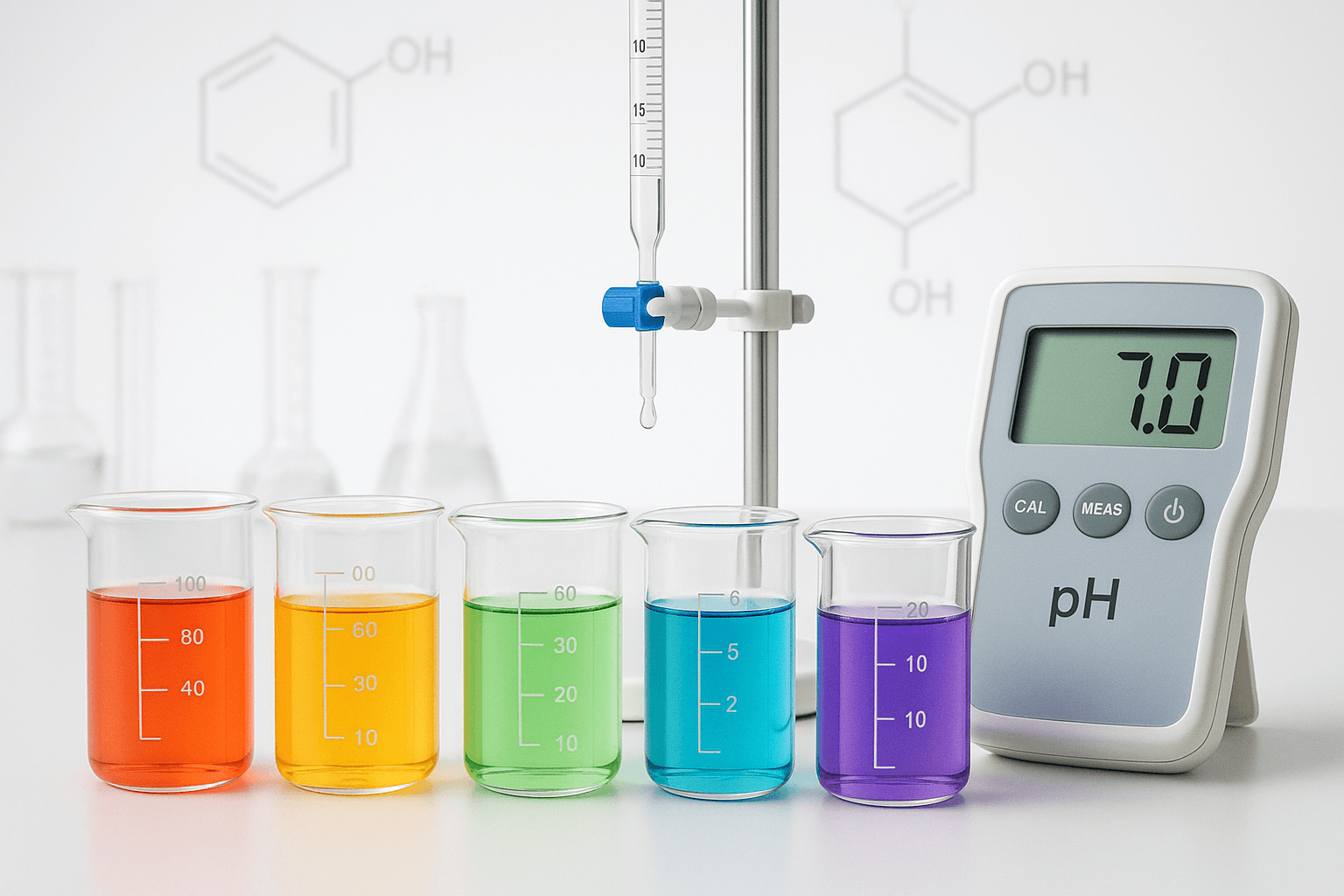
An acid-base indicator is a weak acid whose conjugate base has a different color. The indicator changes color when pH ≈ pKa of the indicator. Choose an indicator whose color change range includes the equivalence point pH of your titration:
- Strong acid/strong base → any indicator near pH 7 works
- Weak acid/strong base → choose an indicator that changes above pH 7 (phenolphthalein, pH 8-10)
- Weak base/strong acid → choose an indicator that changes below pH 7 (methyl orange, pH 3-4)
Common Exam Mistakes
Forgetting to convert between pH and pOH. If you calculate [OH⁻] from a weak base problem, remember to find pOH first, then convert: pH = 14 - pOH.
Using Henderson-Hasselbalch when there's no buffer. HH only works when both HA and A⁻ are present in significant amounts. If you have a strong acid or a weak acid with no added conjugate base, use Ka and an ICE table instead.
Ignoring the stoichiometry step in buffer + strong acid/base problems. You must do the neutralization reaction first (using moles), then apply equilibrium calculations to what remains.
Misidentifying the equivalence point pH. The equivalence point of a weak acid/strong base titration is NOT at pH 7. It's above 7 because the solution contains the conjugate base A⁻ at the equivalence point.
Exam Strategy for Unit 8
According to the College Board's course description, this unit appears in roughly 5-7 MCQ questions and almost always in at least one FRQ (often as part of a multi-concept question combining equilibrium, thermodynamics, and acid-base chemistry). The FRQ typically includes a multi-part calculation problem with an ICE table, Henderson-Hasselbalch application, and interpretation of a titration curve.
For the calculation-heavy FRQs, show all your work — even if your final answer is wrong, you can earn partial credit for correct setup, correct Ka expression, and correct use of equations. Don't skip steps.
For more on the 2026 AP Chemistry exam format and content changes, see our AP Chemistry overview. If acids, bases, and buffers is a unit where you're consistently losing points, our AP Chemistry tutors can work through practice problems with you and identify exactly where your approach is breaking down.
Find Your AP Chemistry Tutor →
Related: AP Chemistry in 2026: What Changed and How to Prepare | AP Chemistry Subject Page