Is It Too Late to Score a 5? Your 6-Week AP Rescue Plan
Is It Too Late to Score a 5? Your 6-Week AP Rescue Plan Six weeks before your AP exam, you might feel like the window for a strong score has closed. It hasn't....
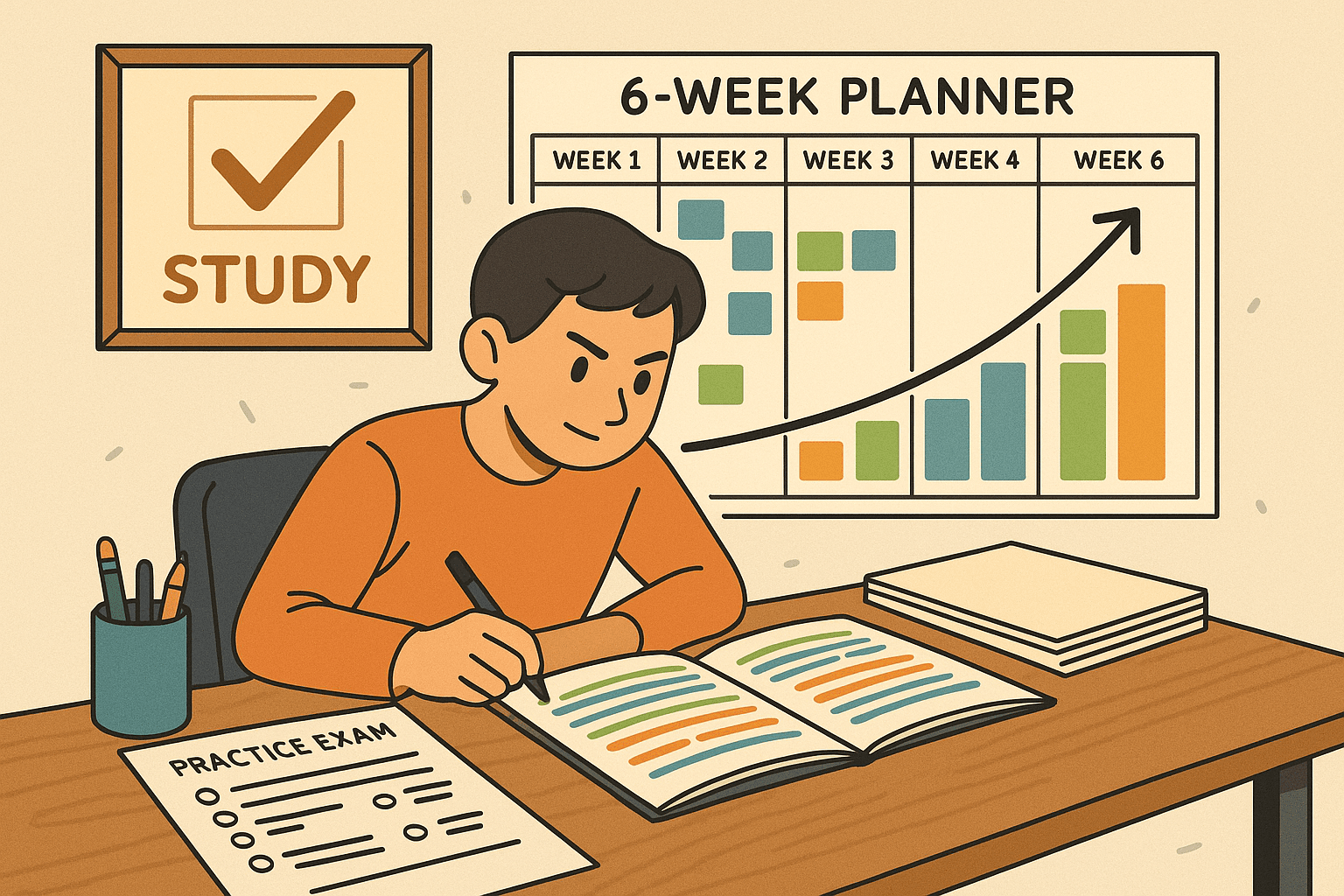
Six weeks before your AP exam, you might feel like the window for a strong score has closed. It hasn't. Six weeks is enough time to go from a 3 to a 5 — but only if you stop studying the way you've been studying. The problem isn't usually missing content knowledge. It's unfocused preparation: rereading notes for units you already understand while ignoring the ones that are actually costing you points.
This 6-week rescue plan works for any AP subject. It's built around the principle that targeted practice on weak areas produces more score improvement per hour than broad review of everything.
Week 1: The Diagnostic Reality Check
Before you study anything, you need data. Take one full-length practice exam under realistic conditions — timed, no notes, no phone. Use an official College Board practice exam or released FRQs from AP Central, not a third-party approximation.
When you finish, score it honestly against the rubric. Don't give yourself partial credit for "basically getting it." Then sort every question you got wrong into three categories:
Category A — Content gaps: You got it wrong because you don't know the material. Maybe you missed that unit in class, or the concept never clicked.
Category B — Application errors: You know the concept but applied it incorrectly. You set up the problem wrong, used the wrong equation, or missed a step in your reasoning.
Category C — Careless mistakes: You know how to do it and made a silly error — wrong sign, misread the question, arithmetic mistake, forgot units.
Count how many questions fall into each category. A typical student scoring a 3 might have 30% Category A, 45% Category B, and 25% Category C. A student scoring a 4 might have 10% Category A, 50% Category B, and 40% Category C. Knowing your distribution tells you exactly where your study time goes. Category A requires learning new content. Category B requires practice with feedback. Category C requires better test-taking habits. Most students who score a 3-4 have their points distributed across B and C — which means the fix is practice strategy, not more content review.
Week 2: Attack Your Weakest Units
Look at your diagnostic results and identify the 2-3 units where you lost the most points. These are your rescue targets. For the next week, focus exclusively on these units.
Here's the approach that works: don't just reread the textbook. Instead, work through problems. For each unit, do 15-20 practice MCQ questions and 2-3 FRQs. After each problem, check the answer immediately. If you got it wrong, don't just read the correct answer — figure out exactly where your reasoning broke down. Write a one-sentence explanation of what you did wrong. This active correction is what builds lasting understanding.
For STEM subjects like AP Physics, Chemistry, or Calculus, focus on mastering the problem types that appear most frequently. Check the College Board's course description for the unit weightings — a unit worth 20-28% of the exam deserves proportionally more of your study time than a unit worth 2-4%.
If you're spending more than 20 minutes stuck on a single concept and not making progress, that's a signal you need a different explanation — try a video, a different textbook, or ask a teacher or tutor to walk you through it. Struggling in silence for hours isn't productive; it's just frustrating.
Week 3: FRQ Boot Camp
The FRQ section is where most students leave the most points on the table. Whether your AP exam has 3 long FRQs or 7 short ones, the scoring rubrics follow predictable patterns. This week, you're going to learn those patterns.
Pull up 4-6 released FRQs from AP Central for your specific exam. Before you attempt each one, read the scoring rubric for a different FRQ from the same exam. Notice what earns points and what doesn't. Rubrics reveal that the College Board rewards specific things: using correct terminology, showing clear mathematical work, connecting claims to evidence, and answering all parts of the question.
Now attempt your FRQs under timed conditions. Score each one against the rubric immediately afterward. Track your points: how many did you earn, how many did you lose, and why? By the end of this week, you should see clear patterns in where your FRQ points disappear. Common patterns include not fully answering "explain" or "justify" prompts, skipping parts of multi-part questions, and using vague language instead of specific physics, chemistry, or history terms.
Week 4: Full Practice Exam #2
Take a second full-length practice exam. Compare your score to your Week 1 diagnostic. You should see improvement in the specific areas you targeted in Weeks 2 and 3. If you don't, that tells you something important: either your practice wasn't targeted enough, or you need a different approach to those concepts.
After scoring, repeat the Category A/B/C analysis. Your Category A errors should be significantly reduced. If you still have Category B errors (application mistakes), focus this week on doing more practice problems in those specific topic areas. If your remaining errors are mostly Category C (careless mistakes), you need to build better test-taking habits: read every question twice, underline key words, check units, and always re-read FRQ prompts before submitting.
This is also the week to refine your time management. Note how long you spent on each section and each FRQ. Are you spending too much time on questions you can't solve at the expense of questions you can? Adjust your pacing strategy accordingly.
Week 5: MCQ Strategy and Speed
MCQ sections reward a different skill set than FRQs. You need to be fast, accurate, and strategic about elimination. This week, focus on building MCQ speed and accuracy.
Work through 30-50 MCQ questions per day in timed sets. For every wrong answer, write down why you got it wrong and the correct reasoning. Review these notes before each new set. You'll start seeing the same types of errors shrink.
Remember that every AP exam now uses the Bluebook digital testing app for MCQ sections, so get comfortable with the interface before exam day if you haven't already.
Three MCQ strategies that consistently improve scores: First, eliminate obviously wrong answers before trying to solve the problem — on many questions, you can narrow it to two choices just by checking units or order of magnitude. Second, on questions that ask "which of the following is true," evaluate each option independently rather than comparing them to each other. Third, flag difficult questions and come back to them — spending 3 minutes on a hard question costs you time for two easier questions you haven't reached yet.
Week 6: The Final Push
This is not the week for new content. If you don't know it by now, it's not going in. Instead, this week is about sharpening what you already know and building confidence.
Days 1-3: Take your third and final full practice exam. Score it. Celebrate the improvement from your Week 1 diagnostic — this isn't optional, recognizing progress matters for exam-day confidence. Do a final Category A/B/C analysis and spend one focused session on any remaining Category B errors.
Days 4-5: Review your "error journal" from the past five weeks. Read through every mistake you documented. This refreshes the corrections in your memory right before the exam.
Day 6 (day before the exam): Light review only. Skim your formula sheet or key terms. Lay out everything you need for exam day: your approved calculator (fully charged or with fresh batteries), number 2 pencils, a pen with black or dark blue ink for FRQ booklets, your school ID, a water bottle, and a snack for the break. Go to bed at your normal time. Do not cram — research consistently shows that sleep consolidation is more effective than last-minute review for exam performance.
Exam day: Eat a real breakfast with protein and complex carbs. Arrive early so you're settled and calm when the exam starts. During the exam, remember your pacing plan and your error patterns — you've spent five weeks learning exactly where your points come from. Trust that preparation.
When 6 Weeks Isn't Enough on Your Own
This rescue plan works if your starting point is a 3 or a solid 4 and you're aiming higher. If your diagnostic score is a 1 or 2, six weeks of solo study may not be enough — not because you can't learn the material, but because you have more ground to cover and less margin for inefficient practice.
In that situation, working with a subject-specific AP tutor who can identify your exact gaps and provide real-time feedback on your FRQ responses accelerates the process significantly. A tutor doesn't replace your study time — they make every hour of it more productive.
For a detailed guide on how to use practice exams most effectively, see our AP practice exam strategy guide.
Related: AP Practice Exams: How to Actually Improve Your Score | AP Exam Subjects