AP Practice Exams: How to Actually Improve Your Score
AP Practice Exams: How to Actually Improve Your Score You've probably heard that taking practice exams is one of the most effective ways to prepare for AP tests...
Key Takeaways
- Studying your notes and rereading your textbook feels productive.
- Not all practice exams are created equal.
- Scoring your practice exam takes 5 minutes.
- Free-response questions are where most students leave the most points on the table.
- Create a simple spreadsheet or table to track your results across practice exams:.
Ready to Boost Your AP Grade?
Our AP AP tutors work with students at every level — whether you're aiming to move from a 4 to a 5 or pushing for that final jump to a 7. We'll match you with someone who understands the AP AP syllabus inside out. Find your tutor →
Frequently Asked Questions
How far in advance should I start exam revision?
Begin structured revision at least 6-8 weeks before your exams. Start with a review of all topics, then focus increasingly on weak areas and past paper practice as the exam approaches.
For more on this topic, explore our guide on How to Manage Time Effectively the Students Guide to Acing Mock Exams.
What is the best revision technique for IB exams?
Active recall (testing yourself) and spaced repetition are the most effective techniques. Combine these with past paper practice under timed conditions for the best results.
How do I manage exam anxiety?
Practice relaxation techniques like deep breathing, maintain a regular sleep schedule, and build confidence through thorough preparation. Remember that some anxiety is normal and can actually improve performance.
How many past papers should I complete before exams?
Aim to complete at least 3-5 full past papers per subject under timed conditions. Review your answers against mark schemes carefully — understanding where you lost marks is more valuable than doing more papers.
You've probably heard that taking practice exams is one of the most effective ways to prepare for AP tests. That's true — but only if you use them correctly. Most students don't. They take a practice exam, check their score, feel good or bad about it, and move on. That's like going to the gym, lifting weights once, and wondering why you're not stronger.
A practice exam is not a performance. It's a diagnostic tool. The score matters far less than what you do with the information it gives you. This guide covers the right way to use AP practice exams during the final 7-8 weeks before the May 2026 exams, including when to take them, how to analyze your results, and how to turn mistakes into actual score improvements.
If you're looking for a structured approach to AP AP, working with a tutor who's been through the AP system can make a real difference — especially when it comes to exam technique and time management. Tell us what you need help with →
Why Practice Exams Matter More Than Review
Studying your notes and rereading your textbook feels productive. But research on learning consistently shows that retrieval practice — actively trying to recall and apply information under realistic conditions — produces significantly better long-term retention and exam performance than passive review.
A full-length practice exam forces retrieval practice across every topic simultaneously, under time pressure, in the format you'll actually face. There is no substitute for this experience. Students who take at least two full-length practice exams before the real test consistently score higher than students who spend the same amount of time reviewing notes.
Where to Find Quality Practice Exams
Not all practice exams are created equal. Here's what to use and what to avoid.
For more on this topic, explore our guide on How to Support Your Child Through Final Exams a Parents Step by Step Guide.
Use these (College Board official materials): Released exams from the College Board are the gold standard. These are actual past exams with genuine questions written by the same people who write your real exam. Find them on the AP Central website under each course's "Exam" section, or through your teacher. The College Board's AP Classroom also contains practice questions organized by unit.
Use these with caution (prep company exams): Practice exams from companies like Princeton Review, Barron's, or Kaplan can be useful for additional practice, but the difficulty level and question style may not perfectly match the real exam. Use them for volume, but trust the College Board materials for calibrating your actual readiness.
Avoid these (random online quizzes): Free practice tests found through general web searches are often inaccurate, outdated, or based on old exam formats. The 2026 AP exams are digital or hybrid digital — practice materials should reflect the current format.
Use Bluebook: For the 2026 digital exams, download the College Board's Bluebook app and take practice exams within it. This familiarizes you with the actual testing interface, including the built-in calculator, highlighting tools, and question navigation. You don't want exam day to be the first time you've used the software.
When to Take Practice Exams
Timing matters. Here's a schedule that works for the 7-8 weeks remaining before May exams.
First practice exam: Now (7-8 weeks out). Take your first full-length practice exam as soon as possible if you haven't already. This establishes your baseline score and identifies which units need the most work. Don't wait until you feel "ready" — the whole point is to find out where you actually stand, not where you hope you stand.
Second practice exam: 4-5 weeks out (early April). After several weeks of targeted study based on your first practice exam results, take a second full-length exam to measure your progress. Compare your performance by unit — you should see improvement in the areas you've been focusing on.
Third practice exam: 2 weeks out (late April). This is your final calibration. By now, your score on the practice exam should be close to what you'll score on the real thing. Use the results to make last-minute adjustments to your study plan.
Don't take more than three full-length practice exams. Each one takes 3+ hours including review. That time is better spent on targeted practice if you've already identified your weak areas. Quality of review beats quantity of exams.
How to Take a Practice Exam Properly
The conditions under which you take the exam dramatically affect its value as a diagnostic tool.
Simulate real conditions. Take the exam in a quiet room, at a desk, with only the materials you'll have on exam day (calculator if allowed, pencils, your device with Bluebook). No phone, no notes, no music. Set a timer for each section and stop when time runs out — even if you're mid-problem.
Don't take it in pieces. Splitting a practice exam across multiple days destroys its value as a stamina test. Part of what the AP exam measures is your ability to maintain focus and accuracy over 3+ hours. If you can't block out a full session, take a half-exam (one section only) and save the other half for another day.
Record your process. As you work through the exam, mark any questions you're unsure about with a star or flag (Bluebook has a flagging feature). After the exam, you'll use these flags to distinguish between questions you got right because you knew the material and questions you got right by guessing.
The Review Process: Where the Real Learning Happens
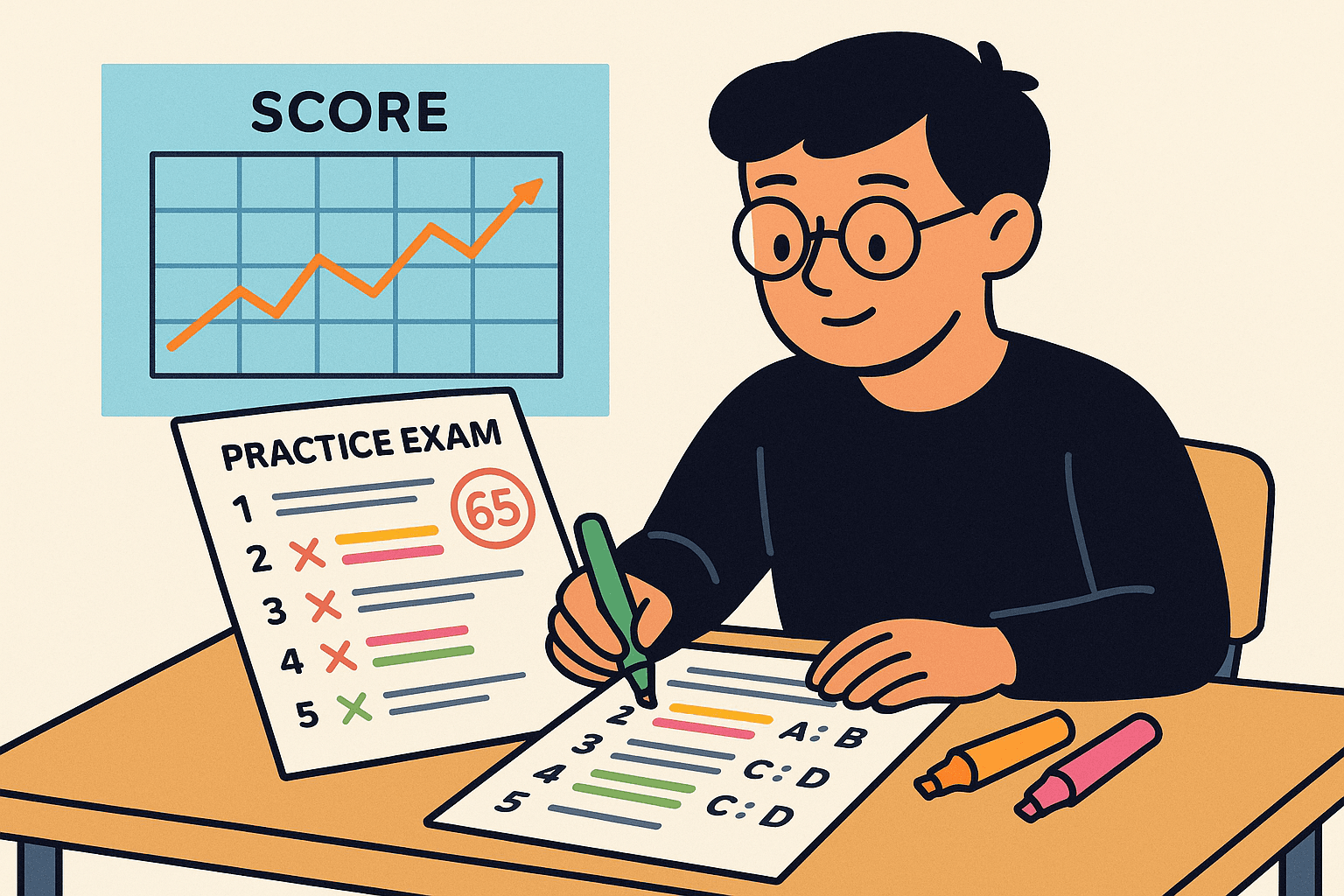
Scoring your practice exam takes 5 minutes. Reviewing it properly takes 2-3 hours. This is the step most students skip, and it's the reason their scores don't improve between practice exams.
Step 1: Score the Exam and Calculate Your AP Score
Use the scoring guidelines provided with the practice exam to calculate your raw score, then convert it to a 1-5 using the scoring table. Write down your overall score and your score by section (MCQ and FRQ separately).
Step 2: Categorize Every Wrong Answer
Go through every question you got wrong and categorize the mistake into one of four types:
Content gap: You didn't know the concept being tested. You couldn't have answered this question correctly no matter how much time you had. This means you need to go back and relearn this material.
Application error: You knew the concept but applied it incorrectly. Maybe you used the wrong formula, set up the problem wrong, or made a logical error in your reasoning. This means you need more practice with this type of problem.
Careless mistake: You knew how to solve it and your approach was correct, but you made an arithmetic error, misread the question, or bubbled the wrong answer. This means you need to work on accuracy and checking your work.
Time pressure: You ran out of time and either rushed through or left it blank. This means you need to improve your pacing — either by working faster on questions you know or by spending less time on questions you don't.
Step 3: Analyze Patterns
After categorizing every mistake, look for patterns. Are your content gaps concentrated in specific units? Are you making careless mistakes in the second half of the exam (fatigue)? Are your FRQ scores much lower than your MCQ scores (suggesting you understand concepts but can't communicate them clearly)?
These patterns determine your study priorities for the next several weeks.
Step 4: Create a Targeted Action Plan
Based on your analysis, create specific study tasks:
For content gaps: go back to the textbook or class notes for that topic, watch explanation videos, then do at least 15 practice problems before moving on.
For application errors: practice similar problems from your textbook or AP Classroom. Focus on setting up problems correctly — the setup matters more than the calculation.
For careless mistakes: practice under timed conditions with a specific focus on checking work. Develop a checking routine (re-read the question, verify your answer makes sense, check your arithmetic).
For time pressure: practice individual sections under time pressure. Identify which question types take you longest and develop strategies for working through them more efficiently.
FRQ Review: The Highest-Impact Activity
Free-response questions are where most students leave the most points on the table. Here's how to review FRQs effectively.
You might also find these guides helpful: 3 Top Chemistry Ia Topics That Score High Marks and How to Ace Your Final Exams a Stress Free Study Guide That Actually Works.
Read the scoring rubric before looking at your answer. The College Board publishes detailed scoring rubrics for released FRQs. Read the rubric first to understand exactly what earners of each point had to do. Then compare your answer to the rubric point by point.
Identify rubric points you missed. For each point you didn't earn, determine why: did you not know the content, did you know it but not express it correctly, or did you not understand what the question was asking?
Rewrite your answers. After reviewing the rubric, rewrite your answers to earn full marks. This forces you to practice the specific skill of writing exam-quality responses — which is different from understanding the material.
Study the sample responses. The College Board publishes student sample responses at different scoring levels. Read the high-scoring response and notice how it's structured, what language it uses, and how it addresses each part of the prompt. Then read the low-scoring response and identify what's missing.
Common Practice Exam Mistakes
Taking the exam but not reviewing it. An unreviewed practice exam is a waste of 3 hours. You learned nothing from the experience that you can apply to the real exam.
Reviewing answers without categorizing mistakes. If you just check whether you got each question right or wrong, you're missing the diagnostic value. The type of mistake matters more than the number of mistakes.
Only reviewing wrong answers. Also review questions you got right but flagged as uncertain. You may have guessed correctly — that's not the same as knowing the material. If you can't explain why the right answer is right, it's still a gap.
Changing study habits based on a single exam. One practice exam is a snapshot, not a complete picture. If you score poorly on one unit, confirm the weakness with additional practice problems before overhauling your study plan.
Taking practice exams too close together. If you take a practice exam on Monday and another on Wednesday, you haven't had time to actually address the weaknesses the first exam revealed. Space them at least 2-3 weeks apart.
Tracking Your Progress
Create a simple spreadsheet or table to track your results across practice exams:
| Exam | Date | MCQ Score | FRQ Score | Overall (1-5) | Weakest Units |
|---|---|---|---|---|---|
| Practice 1 | March | ||||
| Practice 2 | April | ||||
| Practice 3 | Late April |
This visual record of your improvement is motivating and helps you see whether your targeted study is working.
When Practice Exams Reveal You Need More Help
If your practice exam scores aren't improving after 2-3 weeks of targeted study, or if your content gaps span multiple units, it may be time to bring in outside support. A tutor can look at your practice exam results and identify root causes that you might not see yourself — often, what looks like five separate content gaps is actually one foundational misunderstanding that affects everything else.
Our AP tutors work with students' actual practice exam data to build a study plan targeting the specific skills and content areas where improvement will have the largest score impact. With 7-8 weeks left, there's still time to make significant progress — but only if the remaining study time is focused on the right things.
Related: AP Exams Go Digital in 2026 | Your Child's AP Exam Is in 8 Weeks: A Parent's Action Plan