Your Child's AP Exam Is in 8 Weeks: A Parent's Action Plan
Your Child's AP Exam Is in 8 Weeks: A Parent's Action Plan Your child has AP exams starting May 4, 2026. That's roughly 8 weeks away. You probably have question...
Key Takeaways
- AP exams are scored on a 1-5 scale.
- AP exams run over two weeks in May.
- Here's a week-by-week framework for how you can support your child without micromanaging their study sessions.
- The morning of: Wake them up with time to spare.
- AP scores are typically released in early to mid-July through the College Board website.
Ready to Boost Your AP Grade?
Our AP AP tutors work with students at every level — whether you're aiming to move from a 4 to a 5 or pushing for that final jump to a 7. We'll match you with someone who understands the AP AP syllabus inside out. Find your tutor →
Frequently Asked Questions
How far in advance should I start exam revision?
Begin structured revision at least 6-8 weeks before your exams. Start with a review of all topics, then focus increasingly on weak areas and past paper practice as the exam approaches.
For more on this topic, explore our guide on How to Help Your Child Beat Exam Anxiety a Parents Step by Step Guide.
What is the best revision technique for IB exams?
Active recall (testing yourself) and spaced repetition are the most effective techniques. Combine these with past paper practice under timed conditions for the best results.
How do I manage exam anxiety?
Practice relaxation techniques like deep breathing, maintain a regular sleep schedule, and build confidence through thorough preparation. Remember that some anxiety is normal and can actually improve performance.
How many past papers should I complete before exams?
Aim to complete at least 3-5 full past papers per subject under timed conditions. Review your answers against mark schemes carefully — understanding where you lost marks is more valuable than doing more papers.
Your child has AP exams starting May 4, 2026. That's roughly 8 weeks away. You probably have questions: Is my child on track? Should I be worried? What can I actually do to help without making things worse?
This guide is written specifically for parents — not students. It covers what you need to understand about the AP exam process, how to evaluate where your child stands, and the concrete steps you can take over the next 8 weeks that genuinely help (rather than adding to the pressure).
If you're looking for a structured approach to AP AP, working with a tutor who's been through the AP system can make a real difference — especially when it comes to exam technique and time management. Tell us what you need help with →
Understanding What's at Stake — and What Isn't
AP exams are scored on a 1-5 scale. Most colleges award credit or advanced placement for scores of 3 or higher, though selective universities often require a 4 or 5. Each exam costs $99 ($129 internationally), and your child may be taking anywhere from one to five exams over the two-week testing window.
Here's what AP scores can do: save your child a semester of college tuition by earning credit for introductory courses, demonstrate academic readiness for competitive university admissions, and provide placement into higher-level college courses. The College Board reports that students who score 3 or higher generally perform as well or better in subsequent college courses as students who took the introductory course on campus.
Here's what AP scores won't do: make or break a college application on their own. Admissions offices look at AP scores as one data point among many. A single 3 on an exam won't derail an otherwise strong application. This perspective matters because it helps you calibrate how much pressure is appropriate.
The 2026 AP Exam Schedule
AP exams run over two weeks in May. Morning sessions begin at 8:00 AM local time and afternoon sessions at 12:00 PM. Here are some of the most commonly taken exams and their dates:
For more on this topic, explore our guide on How to Help Your Child Master Picture Questions a Parents Guide to Exam Success.
| Date | Morning (8 AM) | Afternoon (12 PM) |
|---|---|---|
| Mon, May 4 | US Government, Chemistry | Psychology, Computer Science A |
| Tue, May 5 | Environmental Science, Physics 1 | Art History |
| Wed, May 6 | English Literature | Microeconomics, Music Theory |
| Thu, May 7 | US History, Comp Sci Principles | World History: Modern, Physics C: E&M |
| Fri, May 8 | European History, Physics C: Mechanics | Spanish Language |
| Mon, May 11 | Calculus AB, Calculus BC | Human Geography, Italian |
| Tue, May 12 | English Language | Physics 2, Japanese, Latin |
| Wed, May 13 | Comparative Government, Chinese | Statistics |
| Thu, May 14 | French Language, Spanish Literature | Biology, Macroeconomics |
| Fri, May 15 | German Language | AP Precalculus |
If your child is taking multiple exams, check for scheduling conflicts now. Some subjects are tested at the same time, which would require late testing (May 18-22). Your child's AP coordinator at school handles these arrangements.
How to Assess Where Your Child Stands
You don't need to understand AP Chemistry to know whether your child is prepared. Here are three practical indicators:
Ask about practice exam scores. If your child has taken a full-length practice exam (timed, under realistic conditions), their score is the single most reliable predictor of their actual exam performance. A student scoring a 4 on practice exams will almost certainly score a 3-5 on the real thing. A student who hasn't taken a practice exam yet has a significant blind spot.
Check whether they have a study plan. Students who say "I'll study more later" without a specific plan are the ones who run out of time. A reasonable plan for 8 weeks out includes which topics need the most work, how many hours per week they'll study, and when they'll take at least one more practice exam. If your child can't articulate their plan, that's a conversation worth having.
Look at recent grades and teacher feedback. Classroom performance isn't a perfect predictor of AP exam scores (the exam tests different skills than homework), but consistent struggles in class usually indicate gaps that will also appear on the exam. If a teacher has flagged concerns, take them seriously.
What Parents Can Actually Do: The 8-Week Checklist
Here's a week-by-week framework for how you can support your child without micromanaging their study sessions.
Weeks 1-2 (Early March): Set the Foundation
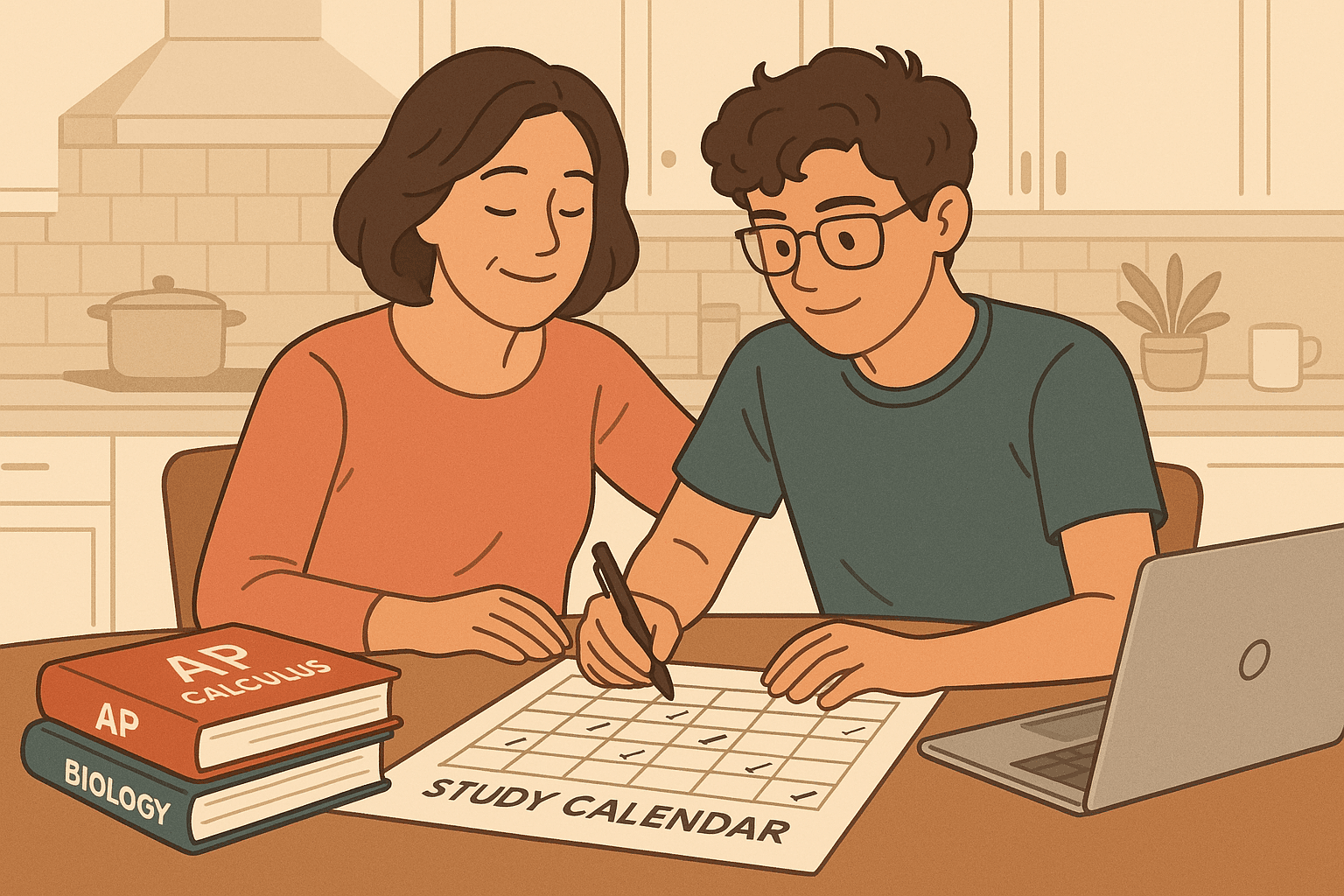
Have the planning conversation. Sit down together and map out exam dates on a family calendar. Identify any conflicts with other commitments (sports events, family trips, other exams). Ask your child which subjects they feel strongest and weakest in — their self-assessment is usually fairly accurate.
Gather resources. Make sure your child has access to the prep materials they need. At minimum, they should be working with released College Board practice exams (free on the AP Central website) and their course textbook. If they want a prep book, buy it now — not in April.
Address logistics. Confirm exam registration is complete through their school. Check that your child has a working laptop or tablet with the Bluebook testing app installed — the 2026 AP exams are digital or hybrid digital. They'll need a device that holds a charge for 4 hours and a power cord as backup.
Weeks 3-4 (Mid-March): Monitor Progress
Check in without hovering. Ask how studying is going once or twice a week, but don't demand hourly updates. Useful questions include: "Which topics are you working on this week?" and "When is your next practice test?" Avoid: "Have you studied today?" (this feels like policing, not supporting).
Watch for avoidance. If your child is spending all their study time on subjects they already know well while avoiding their weakest areas, that's a common pattern worth gently flagging. Most students gravitate toward comfort rather than challenge.
Weeks 5-6 (Early April): Practice Exams
Ensure they take at least one full-length practice exam. This is non-negotiable for serious AP preparation. A timed practice exam reveals time management problems, identifies weak content areas, and reduces anxiety about the real exam format. If they haven't done one by early April, it's time to make it happen.
Protect study time. This is the stretch where other obligations start competing for attention. Where possible, reduce extracurricular commitments during these weeks. Your child doesn't need to quit everything, but they do need predictable blocks of uninterrupted study time.
Weeks 7-8 (Late April): Final Preparation
Handle the practical details. Confirm your child knows where and when each exam takes place. Ensure their device is fully updated with the Bluebook app. For exams that allow calculators, make sure they have an approved calculator with fresh batteries.
Prioritize sleep and nutrition. This matters more than one more hour of cramming. Research consistently shows that sleep-deprived students perform significantly worse on tests requiring sustained focus and complex reasoning — which is exactly what AP exams demand. The week before exams, your job is to protect their sleep schedule.
Don't introduce new prep materials. If your child hasn't used a particular study resource by now, starting it during the final week will create more anxiety than knowledge. The last week should be about reviewing what they've already studied, not starting from scratch.
Exam Day: Your Role
The morning of: Wake them up with time to spare. Provide a solid breakfast with protein and complex carbohydrates. Keep the mood calm and positive — this is not the time for a pep talk about how important the exam is.
You might also find these guides helpful: Parent Tips What Top Students Eat on Exam Day Proven Recipes Inside and How to Help Kids Taking Tests a Parents Proven Guide to Calm Exam Nerves.
What they need to bring: A fully charged device with Bluebook installed, a power cord or portable charger, pencils and pens (dark blue or black ink), an approved calculator if applicable, and their school-issued ID or photo ID if testing at an unfamiliar location. Scratch paper is provided — they should not bring their own.
After the exam: Don't ask "How did it do?" as the first thing you say. Many students can't accurately assess their performance immediately after a test, and the question adds pressure. Instead, try: "How are you feeling?" and "What would you like for dinner?" The debrief can wait.
When to Consider Outside Help
Not every student needs a tutor. But certain situations warrant bringing in external support, particularly with 8 weeks remaining:
Your child is scoring more than 1 point below their target. A student aiming for a 4 who consistently scores 2 on practice exams has a gap that self-study may not close in time. The issue is usually conceptual — they're missing foundational understanding that affects everything else.
They're strong on content but struggle with exam technique. Some students know the material but lose significant points because they don't understand how AP exams are scored. This is especially common on free-response questions (FRQs), where students write correct information that doesn't align with the rubric.
Motivation has dropped. By March, some students feel overwhelmed and disengage. An outside perspective — someone who isn't a parent or teacher — can sometimes re-energize their effort.
They're taking 3+ AP exams. Managing preparation across multiple subjects requires prioritization and time management skills that many high schoolers are still developing. A tutor can help them allocate effort where it will have the most impact on their overall score profile.
Score Release and What Comes After
AP scores are typically released in early to mid-July through the College Board website. Your child will log in to their AP account to see their results. Scores are also sent to one college for free (designated during registration) and additional score reports cost $15 each.
If your child scores lower than expected on one exam, it's not catastrophic. Many colleges allow students to withhold individual AP scores from their applications using the AP Score Withholding service. And remember — AP scores are one factor among many in college admissions, not the defining one.
If they score well, help them research their intended college's AP credit policy. Policies vary significantly: some schools grant credit for a 3, others require a 4 or 5, and some offer placement without credit. The College Board's AP Credit Policy Search tool lets you look up specific institutions.
The Parent Mindset That Helps Most
The most effective AP exam parents share a common approach: they provide structure and support while letting their child own the process. Your teenager needs to feel that this is their exam and their preparation — with you as a resource, not a manager.
That means offering help without requiring it, celebrating effort and improvement rather than just scores, and keeping perspective about what these exams actually are: one set of tests during a very small window of a very long academic life.
If you're looking for expert support for your child's AP preparation, our AP tutors are experienced teachers and AP exam readers who work with students to close specific gaps in both content knowledge and exam technique. Every engagement starts with a free assessment to determine exactly where your child stands and what targeted work will have the greatest impact on their score.
Related: AP Exams Go Digital in 2026: What You Need to Know | AP Subject Pages