AP Calculus AB/BC Formula Sheet: The Complete Reference
Unlike AP Physics or AP Chemistry, the AP Calculus exam does not provide a formula sheet. Every derivative rule, integration formula, and theorem must come from...
Key Takeaways
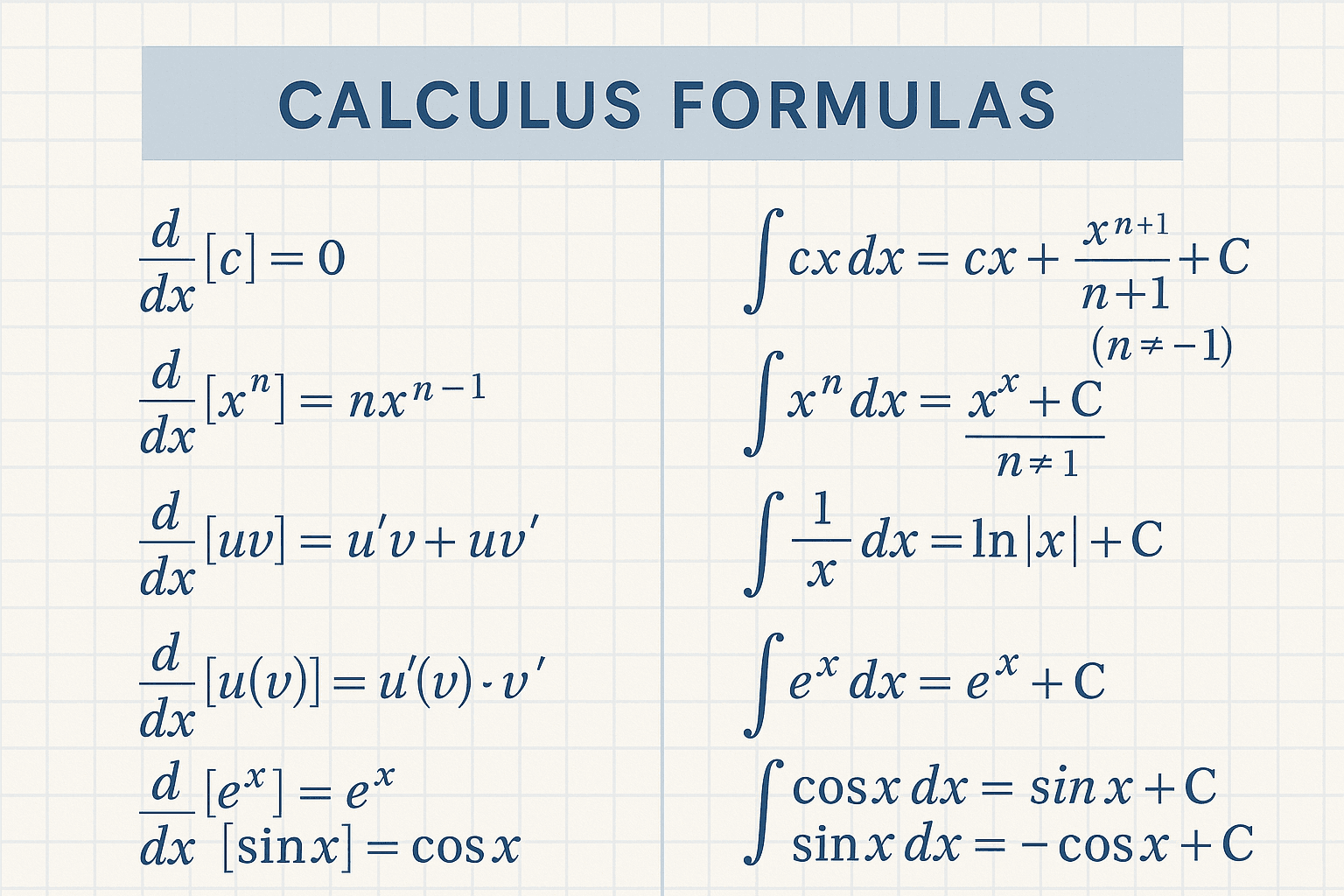
- These are the formulas you'll use most often.
- Mean Value Theorem (MVT): If f is continuous on [a, b] and differentiable on (a, b), then there exists c in (a, b) where f'(c) = [f(b) - f(a)] / (b - a).
- Area between curves: A = ∫[a to b] [f(x) - g(x)] dx, where f(x) ≥ g(x) on [a, b].
- Separation of variables: If dy/dx = f(x)g(y), separate to get dy/g(y) = f(x)dx, then integrate both sides.
- The following formulas appear only on the AP Calculus BC exam.
Ready to Boost Your Maths Grade?
Our AP Maths tutors work with students at every level — whether you're aiming to move from a 4 to a 5 or pushing for that final jump to a 7. We'll match you with someone who understands the AP Maths syllabus inside out. Find your tutor → (This guide has been updated for 2025.)
Frequently Asked Questions
What is the difference between Math AA and Math AI?
Math AA (Analysis and Approaches) focuses on algebraic methods and theoretical mathematics, while Math AI (Applications and Interpretation) emphasizes real-world applications and technology. Choose AA if you plan to study math-heavy subjects at university.
For more on this topic, explore our guide on Last Minute Physics Formula Sheet the Only Pdf Youll Need for Exam Day.
How do I improve my IB Math grade?
Focus on understanding concepts rather than memorizing procedures. Practice past papers under timed conditions, review your mistakes carefully, and ensure you can explain why each step works, not just how.
Is IB Math HL harder than A-Level Maths?
Both are challenging but different. IB Math AA HL covers a broader curriculum including the IA component, while A-Level Further Maths may go deeper into specific topics. Difficulty depends on individual strengths.
What calculator do I need for IB Math?
A graphing calculator is required for IB Math. The TI-84 Plus CE and TI-Nspire are popular choices. Make sure you know how to use all relevant functions, including statistical analysis and graphing.
Unlike AP Physics or AP Chemistry, the AP Calculus exam does not provide a formula sheet. Every derivative rule, integration formula, and theorem must come from memory. That's dozens of formulas you need to recall under pressure — and knowing them cold is the difference between finishing with time to spare and running out halfway through the FRQ section.
This guide covers every formula you need for AP Calculus AB, with additional BC-only formulas clearly marked. Use it as your study companion during the 10 weeks before the exam. The goal isn't just to read these formulas — it's to practice them until they're automatic.
If you're looking for a structured approach to AP Maths, working with an AP Calculus tutor who's been through the AP system can make a real difference — especially when it comes to exam technique and time management. Tell us what you need help with →
Limits and Continuity
These are the foundation. You'll use limit properties throughout the exam, and L'Hôpital's Rule appears on nearly every AP Calculus exam.
Core limit properties:
| Formula | When to use |
|---|---|
| lim[cf(x)] = c · lim[f(x)] | Constant multiple |
| lim[f(x) ± g(x)] = lim[f(x)] ± lim[g(x)] | Sum/difference |
| lim[f(x) · g(x)] = lim[f(x)] · lim[g(x)] | Product |
| lim[f(x)/g(x)] = lim[f(x)] / lim[g(x)], if denominator ≠ 0 | Quotient |
Special limits you must know:
| Limit | Value |
|---|---|
| lim(x→0) [sin(x)/x] | 1 |
| lim(x→0) [(1 - cos(x))/x] | 0 |
| lim(x→∞) [(1 + 1/n)^n] | e |
L'Hôpital's Rule: If lim[f(x)/g(x)] gives 0/0 or ∞/∞, then lim[f(x)/g(x)] = lim[f'(x)/g'(x)]. This is one of the most frequently tested formulas. Always check that the indeterminate form exists before applying it.
Key theorems:
The Intermediate Value Theorem (IVT) states that if f is continuous on [a, b] and k is between f(a) and f(b), then there exists some c in (a, b) where f(c) = k.
The Squeeze Theorem states that if g(x) ≤ f(x) ≤ h(x) near a point and lim g(x) = lim h(x) = L, then lim f(x) = L.
Derivative Rules
These are the formulas you'll use most often. Every MCQ section includes at least 8-10 questions that require derivative computation.
For more on this topic, explore our guide on 7 Critical Math Ia Topic Mistakes That Cost Students Points in 2024.
Basic rules:
| Rule | Formula |
|---|---|
| Power Rule | d/dx [x^n] = nx^(n-1) |
| Constant Multiple | d/dx [cf(x)] = c · f'(x) |
| Sum/Difference | d/dx [f(x) ± g(x)] = f'(x) ± g'(x) |
| Product Rule | d/dx [f(x)g(x)] = f'(x)g(x) + f(x)g'(x) |
| Quotient Rule | d/dx [f(x)/g(x)] = [f'(x)g(x) - f(x)g'(x)] / [g(x)]² |
| Chain Rule | d/dx [f(g(x))] = f'(g(x)) · g'(x) |
Derivatives of common functions:
| Function | Derivative |
|---|---|
| sin(x) | cos(x) |
| cos(x) | -sin(x) |
| tan(x) | sec²(x) |
| sec(x) | sec(x)tan(x) |
| csc(x) | -csc(x)cot(x) |
| cot(x) | -csc²(x) |
| e^x | e^x |
| a^x | a^x · ln(a) |
| ln(x) | 1/x |
| log_a(x) | 1/(x · ln(a)) |
| arcsin(x) | 1/√(1-x²) |
| arccos(x) | -1/√(1-x²) |
| arctan(x) | 1/(1+x²) |
Exam tip: The chain rule combined with these derivatives accounts for more than half of all derivative questions. Practice composites like d/dx[sin(3x²)] = cos(3x²) · 6x until the pattern is instant.
Applications of Derivatives
Mean Value Theorem (MVT): If f is continuous on [a, b] and differentiable on (a, b), then there exists c in (a, b) where f'(c) = [f(b) - f(a)] / (b - a). The MVT appears on nearly every AP exam, often in FRQ form asking you to justify its application.
Related rates: Use implicit differentiation with respect to time t. Identify what rates are given and what rate you need to find, then differentiate the relationship equation. Common setups include expanding circles, filling cones, and ladder-wall problems. Always draw a diagram and label variables before differentiating.
Optimization: Find critical points where f'(x) = 0 or f'(x) is undefined. Use the First or Second Derivative Test to classify them as maxima or minima. Check endpoints for closed intervals. The First Derivative Test examines the sign change of f'(x) around the critical point. The Second Derivative Test checks the sign of f''(c): if f''(c) > 0, it's a local minimum; if f''(c) < 0, it's a local maximum.
Linearization: L(x) = f(a) + f'(a)(x - a). This approximates f(x) near x = a using the tangent line. On the AP exam, you may also see this as the tangent line approximation — same formula, different name.
Integration Formulas
Basic antiderivatives:
| Function | Antiderivative |
|---|---|
| x^n (n ≠ -1) | x^(n+1)/(n+1) + C |
| 1/x | ln |
| e^x | e^x + C |
| a^x | a^x/ln(a) + C |
| sin(x) | -cos(x) + C |
| cos(x) | sin(x) + C |
| sec²(x) | tan(x) + C |
| csc²(x) | -cot(x) + C |
| sec(x)tan(x) | sec(x) + C |
| csc(x)cot(x) | -csc(x) + C |
| 1/√(1-x²) | arcsin(x) + C |
| 1/(1+x²) | arctan(x) + C |
Fundamental Theorem of Calculus:
Part 1: If F(x) = ∫[a to x] f(t) dt, then F'(x) = f(x).
Part 2: ∫[a to b] f(x) dx = F(b) - F(a), where F is any antiderivative of f.
U-substitution: The most common integration technique on the AB exam. Identify u, find du, substitute, integrate, and substitute back.
Applications of Integration
Area between curves: A = ∫[a to b] [f(x) - g(x)] dx, where f(x) ≥ g(x) on [a, b].
You might also find these guides helpful: How to Use Exam Mode Calculator Hacks for Ib Maths Past Papers and Math Ia Criteria Expert Guide to Calculus Modeling That Examiners Want.
Volume by disk method: V = π ∫[a to b] [f(x)]² dx (rotation around x-axis).
Volume by washer method: V = π ∫[a to b] {[R(x)]² - [r(x)]²} dx (rotation with a hole).
Average value: f_avg = (1/(b-a)) ∫[a to b] f(x) dx.
Accumulation and net change: ∫[a to b] f'(x) dx = f(b) - f(a). The integral of a rate gives the total change.
Differential Equations (AB and BC)
Separation of variables: If dy/dx = f(x)g(y), separate to get dy/g(y) = f(x)dx, then integrate both sides. Don't forget the +C and solve for y if possible.
Slope fields: Match the differential equation to the visual pattern. At each point (x, y), the slope equals dy/dx evaluated at that point. Look for horizontal segments where dy/dx = 0 and vertical patterns where the slope depends only on x or only on y.
Euler's method (BC only): y_(n+1) = y_n + f(x_n, y_n) · Δx. This numerical method approximates solutions to differential equations step by step. Smaller step sizes give more accurate approximations but require more calculations.
Exponential growth/decay: dy/dt = ky has the solution y = y₀e^(kt). If k > 0, growth. If k < 0, decay.
Logistic growth (BC only): dy/dt = ky(1 - y/L), where L is the carrying capacity. The solution is a sigmoid curve. Maximum growth rate occurs at y = L/2.
BC-Only Formulas
The following formulas appear only on the AP Calculus BC exam. If you're taking AB, you can skip this section.
Integration by parts: ∫u dv = uv - ∫v du. Use LIATE (Logarithmic, Inverse trig, Algebraic, Trig, Exponential) to choose u.
Partial fractions: Decompose rational functions into simpler fractions before integrating. Factor the denominator first.
Improper integrals: ∫[a to ∞] f(x) dx = lim(b→∞) ∫[a to b] f(x) dx. Converges if the limit exists; diverges if it doesn't.
Parametric derivatives: If x = f(t) and y = g(t), then dy/dx = (dy/dt)/(dx/dt).
Arc length (parametric): L = ∫[a to b] √[(dx/dt)² + (dy/dt)²] dt.
Polar area: A = (1/2) ∫[α to β] [r(θ)]² dθ.
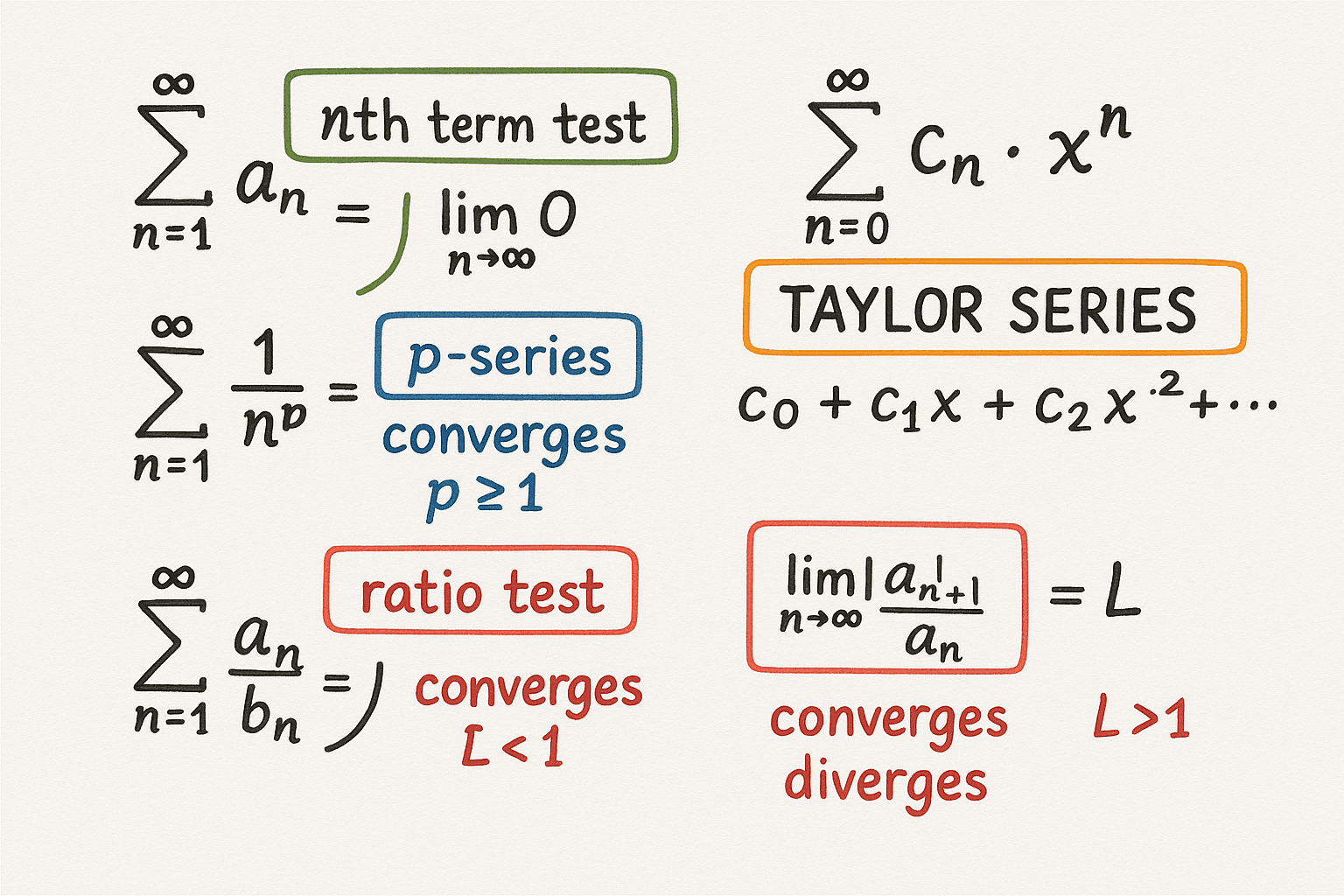
Taylor/Maclaurin series:
P(x) = Σ [f^(n)(a)/n!] · (x-a)^n
Key Maclaurin series to memorize: e^x = Σ x^n/n!, sin(x) = Σ (-1)^n · x^(2n+1)/(2n+1)!, cos(x) = Σ (-1)^n · x^(2n)/(2n)!, 1/(1-x) = Σ x^n for |x| < 1, ln(1+x) = Σ (-1)^(n+1) · x^n/n for |x| ≤ 1.
Convergence tests: Ratio Test, Root Test, Integral Test, Comparison Test, Limit Comparison Test, Alternating Series Test, p-series (converges if p > 1), geometric series (converges if |r| < 1).
Lagrange error bound: |Rn(x)| ≤ |f^(n+1)(c)| / (n+1)! · |x-a|^(n+1) for some c between a and x.
How to Study These Formulas
Since there's no formula sheet on exam day, you need a strategy for memorizing all of this. Here's what works:
Week 1-2: Flashcards for all derivative rules. Quiz yourself daily until you can state every derivative without hesitation. Focus on the trig derivatives and inverse trig derivatives — these are where most students hesitate.
Week 3-4: Flashcards for all integration formulas. Practice u-substitution problems alongside memorization so the formulas are connected to problem-solving, not just isolated recall.
Week 5-6: Drill the theorems (IVT, MVT, FTC Parts 1 and 2). These appear on FRQs and require both the statement and the conditions for application.
Week 7-8: Practice full FRQs that require multiple formulas. The exam doesn't test formulas in isolation — it tests whether you can select the right formula for the situation.
Week 9-10: Take full timed practice exams. Identify which formulas you still hesitate on and drill those specifically.
Want a tutor who can identify which formulas are costing you points? Our AP Calculus tutors work through practice exams with students, spotting the gaps in formula recall and building the speed you need for the timed exam.
Related: AP Calculus AB: 11-Week Study Plan to Score a 5 | AP Calculus Subject Page