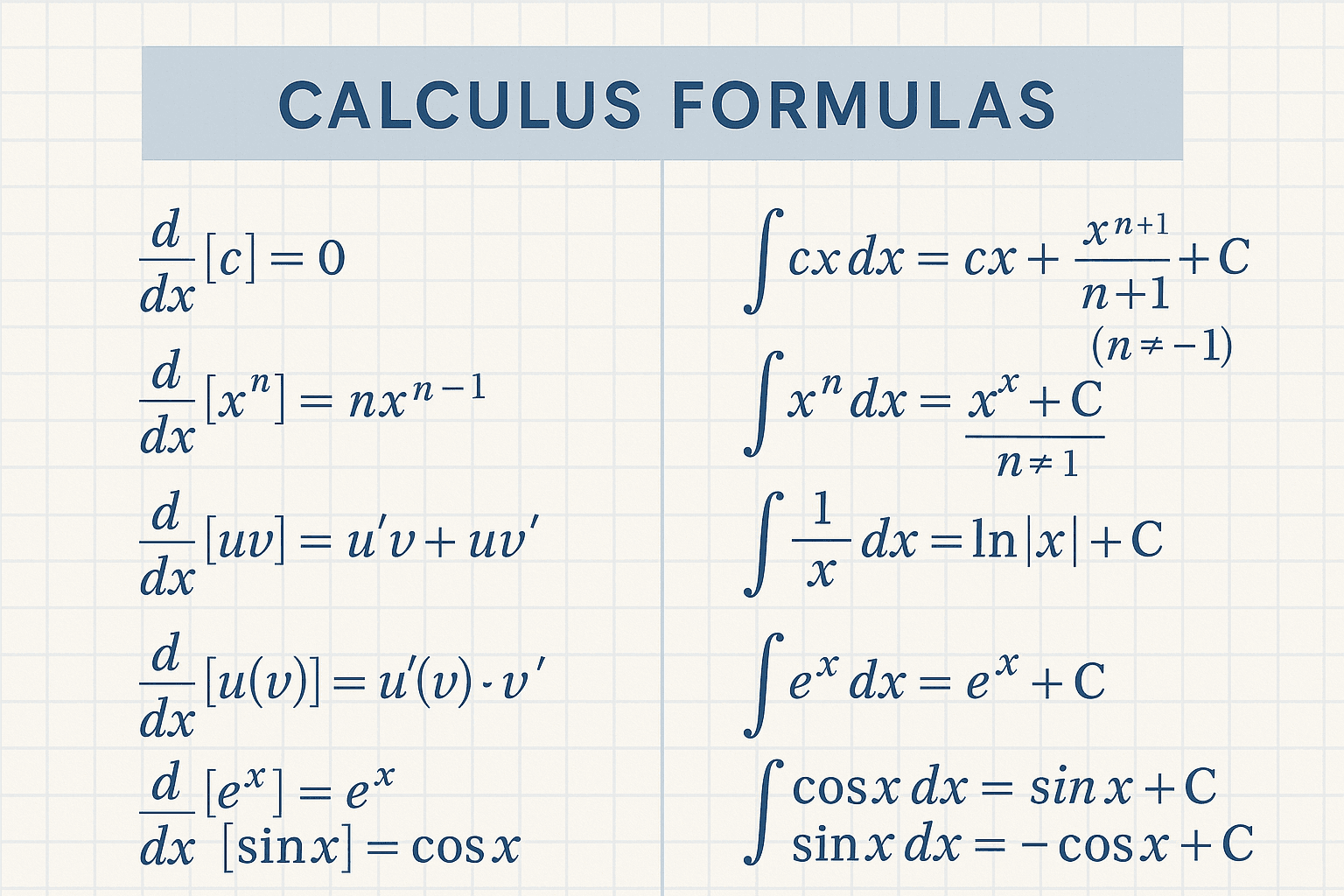
AP Calculus BC: Series and Sequences — The Complete Review
AP Calculus BC: Series and Sequences — The Complete Review Series and sequences are the defining content of AP Calculus BC. This material makes up roughly 17-18...
Key Takeaways
- A sequence is a function whose domain is the natural numbers.
- The AP exam expects you to choose the right convergence test for a given series.
- A power series centered at x = a has the form Σcₙ(x-a)ⁿ.
- The AP exam tests two types of error bounds:.
- Applying the nth-term test incorrectly.
Need Personalised Guidance?
A sequence is a function whose domain is the natural numbers, and understanding sequences is the foundation for mastering series — one of the highest-weighted topics on the AP Calculus BC exam. This guide covers convergence tests, Taylor and Maclaurin series, and the exact strategies you need to earn full marks on series free-response questions. This guide covers every key aspect you need to understand. (This guide has been updated for 2025.)
Frequently Asked Questions
What is the difference between Math AA and Math AI?
Math AA (Analysis and Approaches) focuses on algebraic methods and theoretical mathematics, while Math AI (Applications and Interpretation) emphasizes real-world applications and technology. Choose AA if you plan to study math-heavy subjects at university.
For more on this topic, explore our guide on Ap Calculus Bc Mastering Series and Sequences.
How do I improve my IB Math grade?
Focus on understanding concepts rather than memorizing procedures. Practice past papers under timed conditions, review your mistakes carefully, and ensure you can explain why each step works, not just how.
Is IB Math HL harder than A-Level Maths?
Both are challenging but different. IB Math AA HL covers a broader curriculum including the IA component, while A-Level Further Maths may go deeper into specific topics. Difficulty depends on individual strengths.
What calculator do I need for IB Math?
A graphing calculator is required for IB Math. The TI-84 Plus CE and TI-Nspire are popular choices. Make sure you know how to use all relevant functions, including statistical analysis and graphing.
Series and sequences are the defining content of AP Calculus BC. This material makes up roughly 17-18% of the exam (Unit 10: Infinite Sequences and Series), and it's the unit that separates BC from AB. If you're taking the BC exam, you need to be confident with convergence tests, power series, Taylor and Maclaurin series, and error bounds — because this content appears on both the MCQ and FRQ sections.
Most BC students encounter series late in the school year, which means you're learning the hardest material with the least time to practice it. This review covers everything you need to know, organized by how it appears on the exam.
Navigating AP Maths can feel overwhelming, especially if it's your first time. If you'd like personalised guidance from someone who's helped hundreds of AP students, our AP Calculus tutors are here to help. Tell us what you need →
Sequences: The Foundation
A sequence is a function whose domain is the natural numbers. For the AP exam, you need to understand convergence and divergence of sequences: a sequence converges if its terms approach a finite limit as n approaches infinity, and diverges otherwise.
Key concepts to know: if lim(n→∞) aₙ = L where L is a finite number, the sequence converges to L. If the limit doesn't exist or is infinite, the sequence diverges. A sequence can be bounded (all terms fall within some fixed interval), monotonic (always increasing or always decreasing), or both.
The Monotone Convergence Theorem states that every bounded, monotonic sequence converges. You probably won't be asked to prove this, but you may need to apply it to determine whether a sequence converges.
Series: Partial Sums and Convergence
A series is the sum of the terms of a sequence. The series Σaₙ converges if the sequence of its partial sums Sₙ = a₁ + a₂ + ... + aₙ converges to a finite limit. Otherwise, the series diverges.
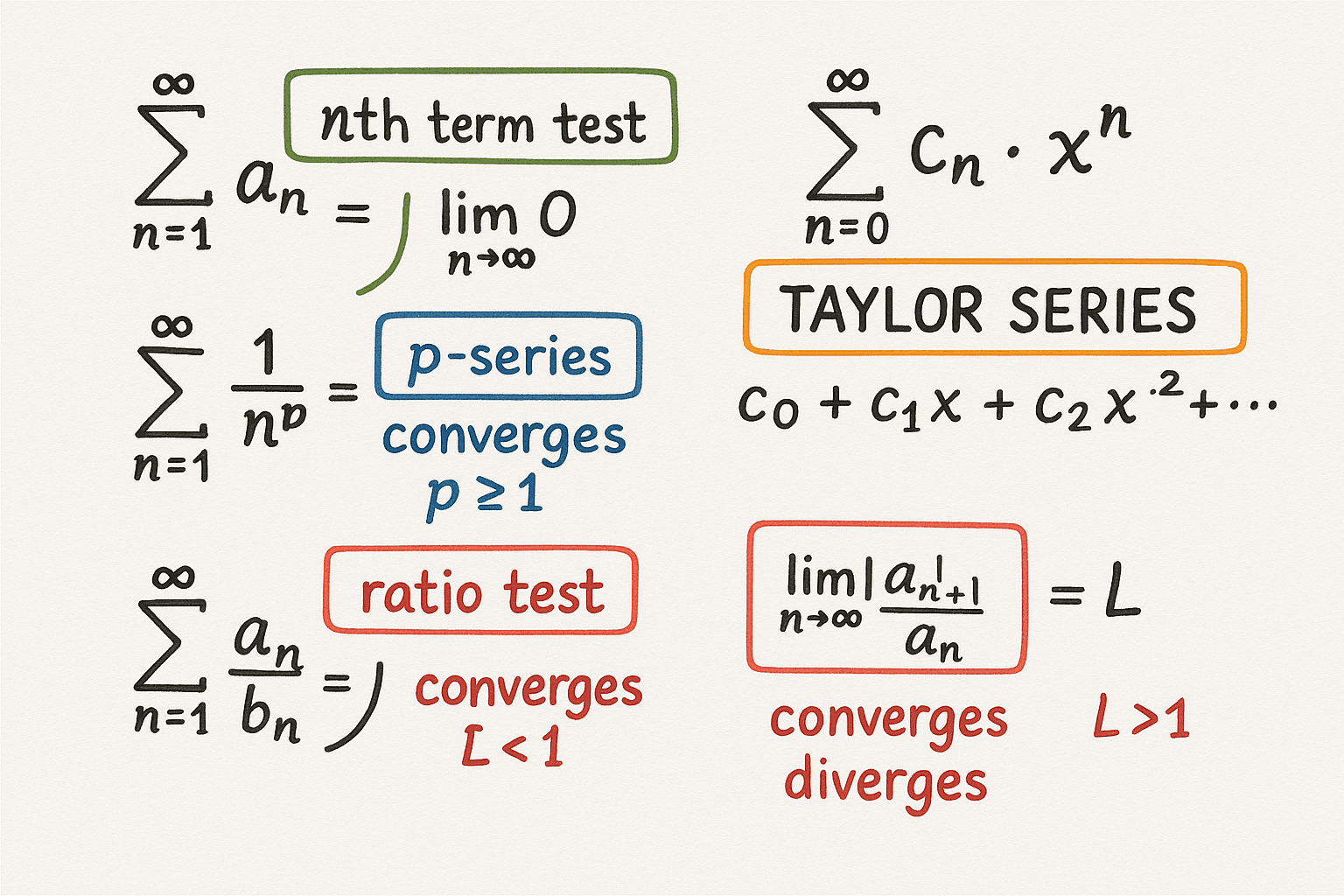
The nth-Term Test (Divergence Test): If lim(n→∞) aₙ ≠ 0, the series Σaₙ diverges. This test can only prove divergence, never convergence. If the limit equals zero, the test is inconclusive — you need another test. This is the first test you should apply when analyzing any series.
Geometric Series: A series of the form Σarⁿ converges if |r| < 1, and its sum equals a/(1-r). If |r| ≥ 1, it diverges. You must be able to identify geometric series quickly and find their sums. This is tested every year.
p-Series: A series of the form Σ1/nᵖ converges if p > 1 and diverges if p ≤ 1. The harmonic series (p = 1) diverges. Know this cold — it's a building block for comparison tests.
The Convergence Tests: Your Complete Toolkit
The AP exam expects you to choose the right convergence test for a given series. Here's each test with guidance on when to use it.
For more on this topic, explore our guide on Things No One Will Tell You About What to Expect at University Part Ii.
Integral Test
What it says: If f(x) is positive, continuous, and decreasing for x ≥ 1, and aₙ = f(n), then Σaₙ converges if and only if the integral ∫₁^∞ f(x)dx converges.
When to use it: When the series terms look like a function you can integrate (especially rational functions or expressions with ln).
Watch out for: The integral test tells you whether the series converges but does NOT give you the sum of the series.
Direct Comparison Test
What it says: If 0 ≤ aₙ ≤ bₙ for all n, then if Σbₙ converges, so does Σaₙ. If Σaₙ diverges, so does Σbₙ.
When to use it: When you can compare your series to a known p-series or geometric series that's clearly larger or smaller.
Common mistake: Comparing in the wrong direction. To prove convergence, you need a larger series that converges. To prove divergence, you need a smaller series that diverges.
Limit Comparison Test
What it says: If aₙ > 0 and bₙ > 0, and lim(n→∞) aₙ/bₙ = c where 0 < c < ∞, then Σaₙ and Σbₙ either both converge or both diverge.
When to use it: When direct comparison is awkward but the series behaves like a simpler series for large n. This is often easier to apply than direct comparison.
Exam tip: Compare rational expressions to their dominant terms. For example, compare (3n² + 1)/(n⁴ + 5n) to 3/n² (which is a convergent p-series with p = 2).
Alternating Series Test
What it says: An alternating series Σ(-1)ⁿbₙ converges if bₙ > 0, bₙ is decreasing, and lim(n→∞) bₙ = 0.
When to use it: Whenever you see alternating signs (terms switching between positive and negative).
Important: This test only works for alternating series. The series must alternate in sign, the absolute values of the terms must be decreasing, and the terms must approach zero.
Ratio Test
What it says: If lim(n→∞) |aₙ₊₁/aₙ| = L, then the series converges absolutely if L < 1, diverges if L > 1, and the test is inconclusive if L = 1.
When to use it: This is your go-to test for series involving factorials (n!), exponentials (rⁿ), or combinations of both. If you see a factorial, use the ratio test.
Exam frequency: The ratio test appears on the AP exam more than any other convergence test. Know it thoroughly.
Root Test
What it says: If lim(n→∞) |aₙ|^(1/n) = L, then the series converges absolutely if L < 1 and diverges if L > 1.
When to use it: When the general term has the form [f(n)]ⁿ — that is, when the variable n appears in the exponent.
Absolute and Conditional Convergence
A series Σaₙ converges absolutely if Σ|aₙ| converges. It converges conditionally if Σaₙ converges but Σ|aₙ| diverges. The classic example: the alternating harmonic series Σ(-1)ⁿ⁺¹/n converges conditionally (the alternating series converges, but the harmonic series diverges).
Absolute convergence implies convergence, but not the other way around. This distinction appears regularly on the MCQ section.
Power Series
A power series centered at x = a has the form Σcₙ(x-a)ⁿ. Every power series has a radius of convergence R such that the series converges absolutely for |x-a| < R and diverges for |x-a| > R. At the endpoints x = a ± R, you must test each endpoint individually.
Finding the radius of convergence: Apply the ratio test to the general term. The radius R equals the value where the limit equals 1. Set |L| < 1 and solve for x.
Finding the interval of convergence: Start with the open interval (a-R, a+R), then test each endpoint separately by substituting into the original series and applying an appropriate convergence test.
The interval of convergence is tested almost every year on the FRQ section. Practice this procedure until it's automatic.
Taylor and Maclaurin Series
A Taylor series for f(x) centered at x = a is: f(x) = Σ f⁽ⁿ⁾(a)/n! × (x-a)ⁿ. A Maclaurin series is simply a Taylor series centered at a = 0.
Essential Maclaurin Series to Memorize
These five series appear repeatedly on the exam. Memorize them:
eˣ = 1 + x + x²/2! + x³/3! + ... = Σ xⁿ/n! (converges for all x)
sin(x) = x - x³/3! + x⁵/5! - ... = Σ (-1)ⁿx²ⁿ⁺¹/(2n+1)! (converges for all x)
cos(x) = 1 - x²/2! + x⁴/4! - ... = Σ (-1)ⁿx²ⁿ/(2n)! (converges for all x)
1/(1-x) = 1 + x + x² + x³ + ... = Σ xⁿ (converges for |x| < 1)
ln(1+x) = x - x²/2 + x³/3 - ... = Σ (-1)ⁿ⁺¹xⁿ/n (converges for -1 < x ≤ 1)
Generating New Series from Known Ones
The AP exam frequently asks you to find a series for a new function by manipulating a known series. Key techniques include substitution (replace x with -x², 2x, etc.), differentiation (term-by-term differentiation within the interval of convergence), integration (term-by-term integration within the interval of convergence), and multiplication by x or a constant.
For example, to find the series for e^(-x²), substitute -x² for x in the eˣ series: e^(-x²) = 1 + (-x²) + (-x²)²/2! + ... = 1 - x² + x⁴/2! - x⁶/3! + ...
Error Bounds
The AP exam tests two types of error bounds:
You might also find these guides helpful: How to Use Exam Mode Calculator Hacks for Ib Maths Past Papers and Math Ia Criteria Expert Guide to Calculus Modeling That Examiners Want.
Alternating Series Error Bound: For a convergent alternating series, the error from using the first n terms is less than or equal to the absolute value of the (n+1)th term. That is, |error| ≤ |aₙ₊₁|.
Lagrange Error Bound: For a Taylor polynomial of degree n approximating f(x) centered at a, the error satisfies |Rₙ(x)| ≤ M|x-a|ⁿ⁺¹/(n+1)!, where M is the maximum value of |f⁽ⁿ⁺¹⁾(t)| for t between a and x.
Error bounds appear on the FRQ almost every year. Practice setting them up — the most common mistake is choosing the wrong value for M in the Lagrange bound.
How Series Appears on the AP Exam
MCQ (roughly 5-7 questions): Convergence/divergence determination, finding radius and interval of convergence, identifying the correct series representation of a function, evaluating series sums.
FRQ (1 question, sometimes 2 parts): Typically asks you to write the first several terms of a Taylor or Maclaurin series, find the interval of convergence, use the series to approximate a value, and bound the error of the approximation.
The FRQ on series tends to follow a predictable structure: part (a) asks you to write the series, part (b) asks about convergence, part (c) asks you to use the series for an approximation, and part (d) asks for an error bound. Practicing released FRQs on the College Board website is the most efficient way to prepare.
Common Mistakes to Avoid
Applying the nth-term test incorrectly. If lim(n→∞) aₙ = 0, you cannot conclude that the series converges. You can only conclude divergence if the limit is not zero.
Forgetting to check endpoints. When finding the interval of convergence, students frequently find the radius of convergence and stop. You must test each endpoint individually.
Confusing Taylor polynomial with Taylor series. A Taylor polynomial has a finite number of terms. A Taylor series is infinite. When the exam asks for a "Taylor polynomial of degree 4," it wants exactly the terms up to the x⁴ term.
Using the wrong error bound. The alternating series error bound only applies to alternating series. For general Taylor series approximations, use the Lagrange error bound.
Targeted Review Strategy
If you're working through this unit with limited time, prioritize in this order: memorize the five Maclaurin series (they appear on almost every exam), practice finding radius and interval of convergence (tested every year on the FRQ), learn the ratio test thoroughly (the most commonly tested convergence test), and practice error bounds (the most commonly missed FRQ points).
For additional review, our AP Calculus BC page covers the full exam, and our AP Calculus formula sheet provides a quick reference for all equations.
If series and sequences is the unit that's holding your BC score back, working with one of our AP Calculus tutors can help you build fluency with convergence tests and Taylor series faster than working through problems alone. Many students find that a few focused sessions on series transforms this from their weakest unit to one of their strongest.
Related: AP Calculus AB/BC Formula Sheet | AP Calculus AB: 11-Week Study Plan