AP Physics 1 FRQ Practice: 8 Questions With Worked Solutions
AP Physics 1 FRQ Practice: 8 Questions With Worked Solutions The FRQ section of the AP Physics 1 exam is worth 50% of your total score. The 2026 exam includes f...
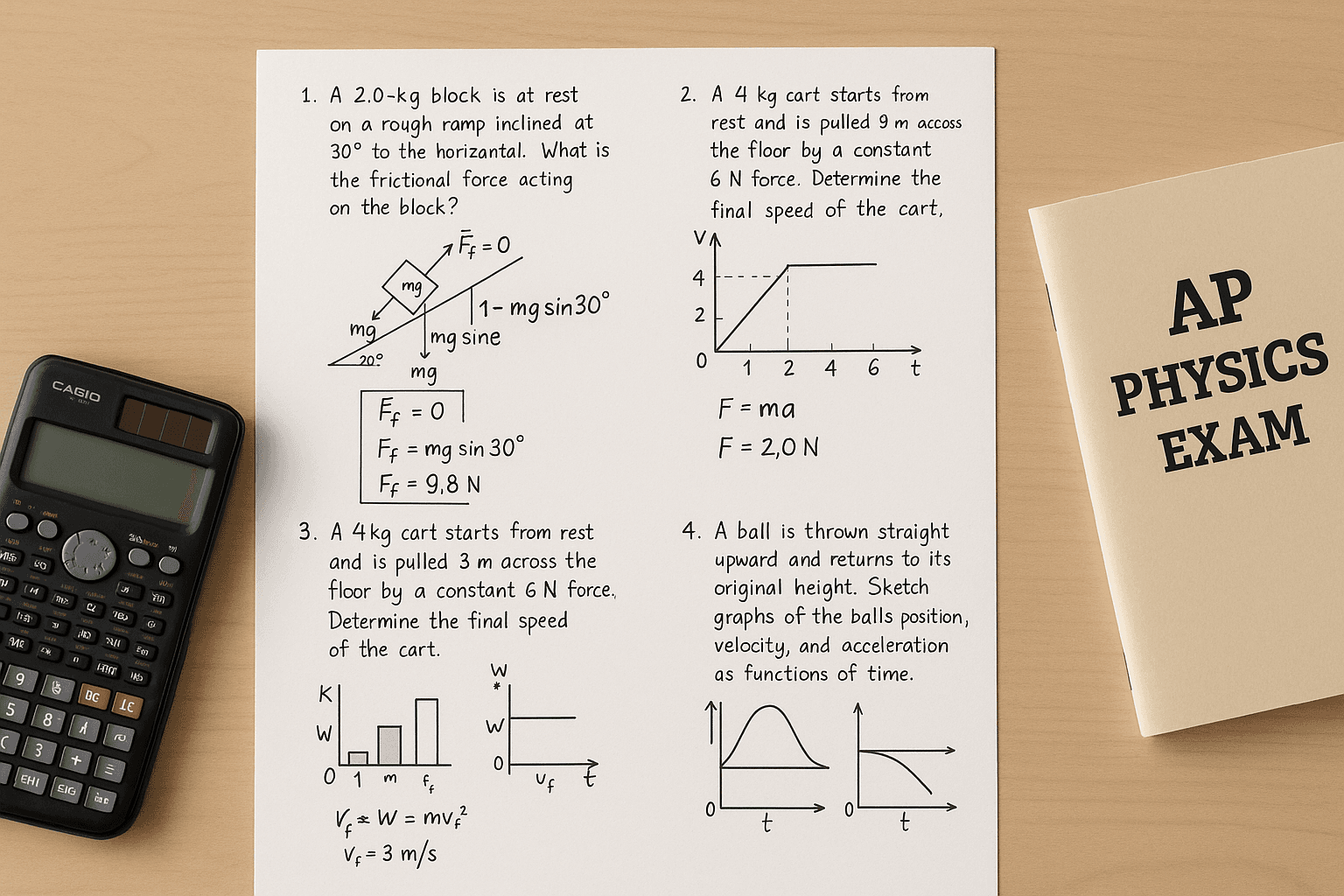
The FRQ section of the AP Physics 1 exam is worth 50% of your total score. The 2026 exam includes four FRQ types: Mathematical Routines, Translation Between Representations, Experimental Design and Analysis, and Qualitative/Quantitative Translation. Each question tests different skills, and practicing all four types is essential for a strong score.
This practice set includes two questions per FRQ type with worked solutions. Use these alongside official College Board released FRQs from AP Central.
How to Use This Practice Set
Attempt each question under timed conditions (25 minutes) before reading the solution. Write on paper — FRQ responses are handwritten in paper booklets. Check whether your reasoning is clear enough for full credit, not just whether you got the right answer.
Type 1: Mathematical Routines
Question 1: Projectile Motion
A ball is launched horizontally from the edge of a table that is 1.25 m above the floor. The ball lands 3.0 m from the base of the table.
(a) Calculate the time it takes for the ball to hit the ground. Show all work.
(b) Calculate the initial horizontal velocity of the ball.
(c) Calculate the speed of the ball just before it hits the ground.
(d) The experiment is repeated on the Moon, where gravitational acceleration is 1.6 m/s². Describe how the landing distance would change if the ball is launched with the same horizontal velocity. Justify your answer quantitatively.
Worked Solution:
(a) Using vertical motion: y = ½gt²
1.25 = ½(9.8)t²
t² = 1.25/4.9 = 0.255
t = 0.505 s ≈ 0.50 s
(b) Horizontal motion: x = v₀t
3.0 = v₀(0.505)
v₀ = 5.94 m/s ≈ 5.9 m/s
(c) Find vertical velocity at impact: vy = gt = (9.8)(0.505) = 4.95 m/s
Speed = √(vx² + vy²) = √(5.94² + 4.95²) = √(35.3 + 24.5) = √59.8 = 7.7 m/s
(d) On the Moon: t = √(2y/g) = √(2(1.25)/1.6) = 1.25 s. Landing distance: x = (5.94)(1.25) = 7.4 m. The distance increases because weaker gravity gives the ball more time in the air.
Question 2: Circular Motion and Gravitation
A satellite orbits Earth at an altitude of 400 km above Earth's surface. Earth's radius is 6.37 × 10⁶ m and Earth's mass is 5.97 × 10²⁴ kg.
(a) Derive an expression for the orbital speed of the satellite in terms of G, M (Earth's mass), and r (orbital radius).
(b) Calculate the orbital speed of the satellite.
(c) Calculate the orbital period of the satellite.
Worked Solution:
(a) The gravitational force provides the centripetal force:
GMm/r² = mv²/r
Cancelling m and one r: GM/r = v²
Therefore v = √(GM/r)
(b) Orbital radius r = 6.37 × 10⁶ + 4.00 × 10⁵ = 6.77 × 10⁶ m
v = √(GM/r) = √((6.67 × 10⁻¹¹)(5.97 × 10²⁴)/(6.77 × 10⁶))
v = √(5.88 × 10⁷) = 7,670 m/s ≈ 7.7 km/s
(c) Period T = 2πr/v = 2π(6.77 × 10⁶)/(7670) = 5,540 s ≈ 92 minutes
Type 2: Translation Between Representations
Question 3: Force and Motion Graphs
A 2.0 kg block starts from rest on a frictionless surface. A net horizontal force is applied to the block. The force-time graph below shows the net force on the block during a 6-second interval:
- From t = 0 to t = 2 s: F = 6 N (constant)
- From t = 2 to t = 4 s: F = 0 N
- From t = 4 to t = 6 s: F = -3 N (constant)
(a) Sketch the acceleration-time graph for the block from t = 0 to t = 6 s. Label the axes with values and units.
(b) Sketch the velocity-time graph for the block from t = 0 to t = 6 s. Label all key values.
(c) Determine the total displacement of the block during the 6-second interval.
(d) Determine the velocity of the block at t = 6 s.
Worked Solution:
(a) Using a = F/m:
t = 0 to 2 s: a = 6/2 = 3 m/s²
t = 2 to 4 s: a = 0/2 = 0 m/s²
t = 4 to 6 s: a = -3/2 = -1.5 m/s²
The acceleration graph is a step function with three horizontal segments at 3, 0, and -1.5 m/s².
(b) Starting from rest (v₀ = 0):
At t = 2 s: v = 0 + 3(2) = 6 m/s
At t = 4 s: v = 6 + 0(2) = 6 m/s (constant velocity)
At t = 6 s: v = 6 + (-1.5)(2) = 3 m/s
The velocity graph rises linearly from 0 to 6 m/s, stays constant at 6 m/s, then decreases linearly to 3 m/s.
(c) Displacement = area under velocity-time graph:
t = 0 to 2 s: ½(2)(6) = 6 m (triangle)
t = 2 to 4 s: (2)(6) = 12 m (rectangle)
t = 4 to 6 s: ½(6 + 3)(2) = 9 m (trapezoid)
Total displacement = 6 + 12 + 9 = 27 m
(d) As calculated in (b), the velocity at t = 6 s is 3 m/s in the positive direction.
Question 4: Energy Bar Charts
A 0.50 kg ball is dropped from a height of 2.0 m onto a spring with spring constant k = 500 N/m. The spring is initially at its natural length.
(a) Draw a qualitative energy bar chart showing the kinetic energy, gravitational potential energy, and elastic potential energy at the following positions: (i) at the moment of release, (ii) the instant the ball first touches the spring, and (iii) at maximum compression of the spring.
(b) Calculate the speed of the ball just before it contacts the spring.
(c) Calculate the maximum compression of the spring.
(d) Explain why the ball does not return to its original height in a real-world scenario, using energy concepts.
Worked Solution:
(a) Energy bar charts:
(i) Release: KE = 0, GPE = high, EPE = 0
(ii) Touches spring: KE = high, GPE = lower (but not zero — the ball continues to fall as the spring compresses), EPE = 0
(iii) Maximum compression: KE = 0, GPE = lowest (below the spring contact point), EPE = highest
(b) Using conservation of energy from release to spring contact:
mgh = ½mv²
v = √(2gh) = √(2 × 9.8 × 2.0) = √39.2 = 6.3 m/s
(c) From release to maximum compression, let x = compression distance. The ball falls a total distance of (2.0 + x):
mg(2.0 + x) = ½kx²
(0.50)(9.8)(2.0 + x) = ½(500)x²
9.8 + 4.9x = 250x²
250x² - 4.9x - 9.8 = 0
Using the quadratic formula: x = (4.9 + √(24.01 + 9800))/500 = (4.9 + 99.1)/500 = 0.208 m ≈ 0.21 m
(d) In a real-world scenario, energy is transferred to thermal energy through air resistance and internal friction within the spring. Since total mechanical energy decreases, the ball cannot return to its original height — the remaining mechanical energy at maximum rebound is less than the initial gravitational potential energy.
Type 3: Experimental Design and Analysis
Question 5: Investigating Newton's Second Law
A student wants to determine the relationship between the net force applied to a cart and the cart's acceleration. The student has a low-friction track, a cart with known mass, a set of hanging masses, a string and pulley, and a motion sensor connected to a computer.
(a) Describe an experimental procedure the student could use to collect data to determine the relationship between net force and acceleration. Include enough detail that another student could replicate the experiment.
(b) Describe how the student should analyze the data to determine the relationship between net force and acceleration. State what should be graphed and what the slope represents.
(c) The student collects the following data:
| Hanging mass (kg) | Acceleration (m/s²) |
|---|---|
| 0.050 | 0.48 |
| 0.100 | 0.93 |
| 0.150 | 1.35 |
| 0.200 | 1.79 |
| 0.250 | 2.18 |
The total system mass (cart + hanging mass) is 1.05 kg for all trials. Using this data, determine the experimental value of the total system mass.
(d) The accepted value of the total system mass is 1.05 kg. Calculate the percent error and identify one source of systematic error that could account for the discrepancy.
Worked Solution:
(a) Attach the string to the cart, run it over the pulley, and hang a mass from the other end. The hanging mass provides the net force on the system. Position the motion sensor at the opposite end. Release the cart from rest and use the motion sensor to record position vs. time data, from which acceleration is calculated. Repeat for 5 different hanging masses, performing 3 trials each. Keep the total system mass constant by transferring mass from the cart to the hanging mass.
(b) Plot net force (F = m_hanging × g) on the y-axis versus acceleration on the x-axis. By Newton's second law (F = ma), the slope of the linear fit equals the total system mass. A linear graph through the origin confirms direct proportionality.
(c) Calculate net force for each trial: F = m_hanging × g (using g = 9.8 m/s²):
0.49 N, 0.98 N, 1.47 N, 1.96 N, 2.45 N
Slope = ΔF/Δa. Using the first and last data points:
Slope = (2.45 - 0.49)/(2.18 - 0.48) = 1.96/1.70 = 1.15 kg
The experimental value of the total system mass is approximately 1.15 kg.
(d) Percent error = |1.15 - 1.05|/1.05 × 100% = 9.5%
Systematic error source: friction on the track opposes motion, reducing measured acceleration for each force. Since accelerations are systematically low, the slope (F/a) is systematically high.
Question 6: Momentum Conservation
Cart A (0.50 kg) moves at 2.0 m/s toward stationary Cart B (0.75 kg) on a low-friction track. After the collision, Cart A moves at 0.20 m/s and Cart B moves at 1.20 m/s, both in the original direction.
(a) Calculate the total momentum before and after the collision.
(b) Calculate the kinetic energy before and after the collision. Classify the collision type.
(c) Explain why kinetic energy is not conserved even though momentum is conserved.
Worked Solution:
(a) Before: p = (0.50)(2.0) + (0.75)(0) = 1.00 kg·m/s
After: p = (0.50)(0.20) + (0.75)(1.20) = 0.10 + 0.90 = 1.00 kg·m/s
Momentum is conserved.
(b) KE before = ½(0.50)(2.0²) = 1.00 J
KE after = ½(0.50)(0.20²) + ½(0.75)(1.20²) = 0.01 + 0.54 = 0.55 J
KE decreased from 1.00 J to 0.55 J. This is an inelastic collision.
(c) The 0.45 J of "missing" kinetic energy was converted to thermal energy through deformation of the carts during contact and to sound energy. Momentum is always conserved when no external net force acts on the system, but kinetic energy is only conserved in perfectly elastic collisions.
Type 4: Qualitative/Quantitative Translation
Question 7: Rotational Motion
A solid disk and a hollow ring, both with the same mass M and same radius R, are released from rest at the highest point of an inclined plane of height h.
(a) Without performing calculations, predict which object reaches the bottom first. Justify your prediction using the concept of rotational inertia.
(b) Derive expressions for the speed of each object at the bottom of the incline in terms of g and h.
(c) Explain why both objects would reach the bottom at the same time if the incline were frictionless, and why friction is necessary for the outcome you predicted in (a).
Worked Solution:
(a) The solid disk reaches the bottom first. The ring has greater rotational inertia (I = MR² vs. I = ½MR² for the disk). The ring converts a larger fraction of GPE into rotational KE, leaving less for translational KE. Since translational speed determines which arrives first, the disk wins.
(b) Using energy conservation for rolling without slipping: mgh = ½mv² + ½Iω², and ω = v/R:
For the disk (I = ½MR²): Mgh = ½Mv² + ½(½MR²)(v/R)² = ½Mv² + ¼Mv² = ¾Mv²
v_disk = √(4gh/3)
For the ring (I = MR²): Mgh = ½Mv² + ½(MR²)(v/R)² = ½Mv² + ½Mv² = Mv²
v_ring = √(gh)
Since √(4gh/3) > √(gh), the disk has a greater speed at the bottom and arrives first.
(c) On a frictionless incline, neither object would roll — both would slide without rotating. Without rolling, rotational inertia is irrelevant and both have the same translational acceleration (g sin θ), reaching the bottom simultaneously. Friction provides the torque that causes rotation, enabling the difference in rotational inertia to affect the motion.
Question 8: Energy and Simple Harmonic Motion
A 0.30 kg block is attached to a horizontal spring (k = 120 N/m) on a frictionless surface. The block is pulled 0.10 m from equilibrium and released.
(a) Without calculations, describe how the speed of the block changes as it moves from maximum displacement to the equilibrium position. Use energy arguments to justify your answer.
(b) Calculate the maximum speed of the block and state where it occurs.
(c) Calculate the speed of the block when it is 0.05 m from equilibrium.
(d) The experiment is modified by adding a rough patch on the surface between 0.05 m and 0 m from equilibrium. Describe qualitatively how this changes the motion of the block over many oscillation cycles.
Worked Solution:
(a) Speed increases continuously from maximum displacement to equilibrium. At maximum displacement, all energy is elastic PE (½kx²) and KE is zero. As the spring returns toward equilibrium, elastic PE converts to KE. At equilibrium (x = 0), all elastic PE has converted to KE, so speed is maximum. Total mechanical energy remains constant on the frictionless surface.
(b) Using conservation of energy: ½kA² = ½mv²_max
v_max = A√(k/m) = 0.10√(120/0.30) = 0.10√400 = 0.10 × 20 = 2.0 m/s
Maximum speed occurs at the equilibrium position (x = 0).
(c) ½kA² = ½kx² + ½mv²
½(120)(0.10²) = ½(120)(0.05²) + ½(0.30)v²
0.60 = 0.15 + 0.15v²
0.45 = 0.15v²
v² = 3.0
v = 1.7 m/s
(d) The rough patch removes mechanical energy as thermal energy each cycle, so amplitude decreases progressively. Eventually, the block may lack enough energy to reach the rough patch, at which point it oscillates with constant small amplitude in the frictionless region only.
Next Steps
Review your performance across all four FRQ types. If you consistently lose points on one type, focus your remaining practice there. See also our AP Physics 1 formula sheet and common exam mistakes to avoid.
If you want expert feedback on your FRQ solutions, our AP Physics tutors can score your work against the rubric and show you where to pick up more points.
Find Your AP Physics 1 Tutor →
Related: 7 Mistakes That Cost Students a 5 on AP Physics 1 | AP Physics 1 Formula Sheet | AP Physics 1 Subject Page