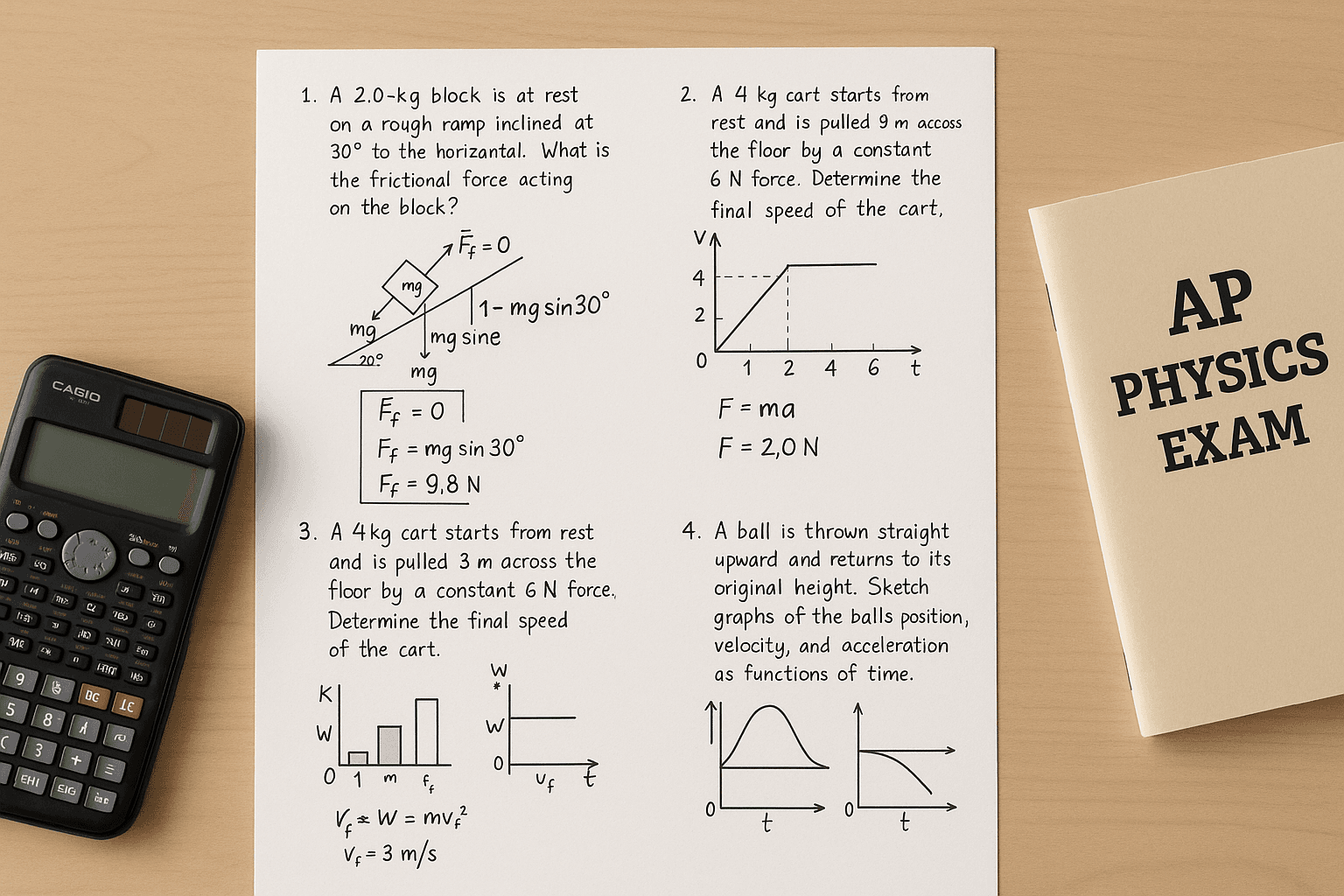
7 Mistakes That Cost Students a 5 on AP Physics 1
7 Mistakes That Cost Students a 5 on AP Physics 1 AP Physics 1 has one of the lowest 5-rates of any AP exam — typically around 8-10% of test-takers score a 5. B...
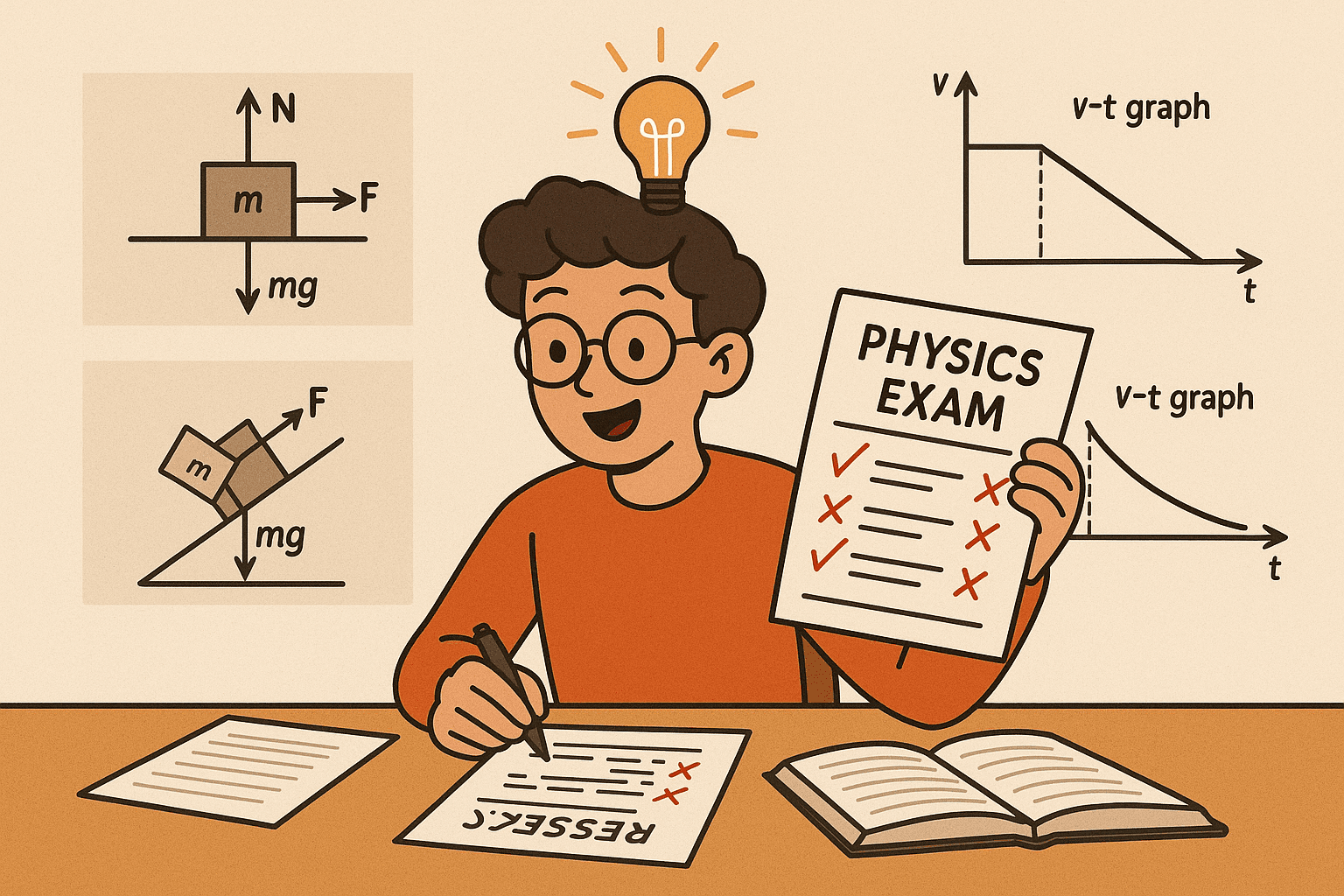
AP Physics 1 has one of the lowest 5-rates of any AP exam — typically around 8-10% of test-takers score a 5. But many students who understand the physics still lose points to avoidable errors. After working with hundreds of AP Physics students, our tutors see the same patterns over and over. Here are the seven mistakes that most commonly separate a 4 from a 5, and exactly how to fix each one.
Mistake #1: Treating Physics Like a Formula-Plugging Class
The single biggest reason students underperform on AP Physics 1 is approaching it like a math class. They memorize equations, identify variables, plug in numbers, and get an answer. This works for about 30% of the exam. The other 70% requires conceptual reasoning, explanation, and justification.
The College Board designs AP Physics 1 to test whether you actually understand why things happen, not just whether you can calculate what happens. When an FRQ asks you to "justify your answer," writing F = ma and solving for a is not enough. You need to explain the physical reasoning: what forces act on the object, why the net force points in a specific direction, and how that connects to the acceleration.
The fix: Practice explaining physics concepts in words before you ever touch an equation. For every problem you solve, ask yourself: "Could I explain this answer to someone who hasn't taken physics?" If not, you don't understand it deeply enough for a 5.
Mistake #2: Sloppy or Incomplete Free-Body Diagrams
Free-body diagrams appear on nearly every AP Physics 1 exam, and the scoring rubrics are brutally specific. Students lose points for drawing force arrows from the wrong point (they must originate from the center of the object), including forces that don't exist (like a "force of motion"), mislabeling forces, or leaving out force components.
The most common free-body diagram error: including a "net force" arrow alongside the individual forces. A free-body diagram shows all individual forces acting on the object — the net force is the result, not a separate force on the diagram.
The fix: Follow this checklist every time you draw a free-body diagram. Start with the object as a dot. Draw gravitational force (Fg) pointing down. Identify every surface contact and draw the normal force perpendicular to each surface. Add friction forces parallel to surfaces if the object is moving or has a tendency to move. Add any applied forces, tension, or spring forces. Label every arrow with the correct symbol. That's it — if a force doesn't come from a physical interaction, it doesn't belong on your diagram.
Mistake #3: Ignoring Units and Significant Figures
This seems minor, but it adds up fast. On MCQ questions, wrong units can lead you to select the wrong answer choice. On FRQs, the rubric typically awards a point for correct units even when the numerical answer is wrong — and takes a point away for missing or incorrect units.
Students also lose points by carrying too many or too few significant figures through calculations, or by mixing up metric prefixes (confusing centimeters with meters is especially common in kinematics problems).
The fix: Write units at every step of your calculation, not just at the end. Treat units like variables that must cancel correctly. If you end up with kg·m/s when the answer should be in Newtons, you know something went wrong. And always convert to SI base units (meters, kilograms, seconds) before plugging into any equation.
Mistake #4: Misreading Graphs
AP Physics 1 is a graph-heavy exam. You'll encounter position-time, velocity-time, acceleration-time, force-time, and energy-position graphs on both MCQ and FRQ sections. The most common mistake is confusing what the slope and area represent for each graph type.
Here's what students mix up most often: the slope of a position-time graph gives velocity, but students read the y-value as velocity instead. The area under a velocity-time graph gives displacement, but students mistake it for distance. The slope of a velocity-time graph gives acceleration, not the y-value of the graph.
The fix: Before answering any graph question, stop and identify three things: what's on the x-axis, what's on the y-axis, and whether the question asks about the slope, the area, or a specific value. Write these down in the margin. This 10-second habit eliminates most graph-reading errors.
Mistake #5: Using Vague Language in Justification Questions
The redesigned AP Physics 1 exam places heavy emphasis on reasoning and argumentation. FRQs don't just ask for calculations — they ask you to "explain," "justify," or "argue" using physics principles. Students who write vague answers like "energy is conserved" or "the force makes it speed up" lose points even when they understand the concept.
The rubric rewards specificity. Saying "the net force is zero, so by Newton's second law the acceleration is zero, meaning the velocity remains constant" earns full marks. Saying "nothing is pushing it so it stays the same" does not.
The fix: Use the Claim-Evidence-Reasoning (CER) framework for every explanation question. State your claim (what happens). Provide evidence (reference specific physics quantities, equations, or data from the problem). Explain your reasoning (connect the evidence to the claim using a named physics principle). For example: "The block accelerates to the right [claim] because the applied force (20 N) exceeds the friction force (12 N), producing a net force of 8 N to the right [evidence]. By Newton's second law, F_net = ma, so the block must accelerate in the direction of the net force [reasoning]."
Mistake #6: Forgetting That Physics 1 Is Algebra-Based
Students who've taken or are concurrently taking calculus sometimes try to use derivatives and integrals on the AP Physics 1 exam. This doesn't earn extra credit — and it can actually hurt you. AP Physics 1 is explicitly algebra-based, and the scoring rubrics expect algebraic solutions. If you set up a calculus-based solution correctly but make an error, you may not earn partial credit because the grader is looking for the algebraic approach.
More importantly, many problems that seem to require calculus have elegant algebraic solutions using conservation laws. Energy conservation, momentum conservation, and the work-energy theorem can solve most AP Physics 1 problems without any calculus at all.
The fix: Practice solving problems using conservation principles first. If a problem involves motion with variable forces, use the work-energy theorem (W_net = ΔKE) rather than trying to integrate. If a collision is involved, use momentum conservation. These approaches are faster, less error-prone, and exactly what the rubric expects.
Mistake #7: Poor Time Management on FRQs
The AP Physics 1 exam gives you 90 minutes for 5 FRQs, which works out to 18 minutes per question. But not all FRQs are equally time-consuming. The Experimental Design question (Question 5) typically requires the most writing, while some shorter questions can be completed in 12-15 minutes. Students who spend 25 minutes perfecting one question run out of time on others.
Here's the math that makes this critical: the FRQ section is worth 50% of your total exam score. A partially completed FRQ might earn 3 out of 12 points, but a rushed attempt at every question can still earn 7-8 out of 12 on each — and that difference adds up to an entire score level.
The fix: On your first pass through the FRQ section, read all five questions and rank them by difficulty. Start with the question you're most confident about. Budget 15 minutes for shorter questions and 20 minutes for the Experimental Design question. If you're stuck on a part, write what you know (the relevant equation, the correct diagram, the physics principle) and move on. Partial credit is real, and earning 2 points on four questions beats earning 8 points on two. Remember that the experimental design FRQ is worth 12 points while other FRQs may be worth 7-12 points each — knowing the point values helps you allocate time wisely.
How to Use These Fixes in the Next 6 Weeks
If the AP exam is 6 weeks away, you still have time to address every one of these mistakes. Here's the priority order:
Start with your FRQ practice. Take a timed FRQ from a past AP Physics 1 exam and score it honestly against the rubric. Identify which of the seven mistakes appear most in your work, then focus your practice on those specific areas.
For a deeper review of the 2026 exam format, units, and content changes, check our complete AP Physics 1 guide. And if you want the equation reference, see our AP Physics 1 formula sheet.
If you're making these mistakes consistently and can't seem to break the pattern on your own, an AP Physics tutor can watch you work through problems in real time and catch the habits you don't notice.
Find Your AP Physics 1 Tutor →
Related: AP Physics 1 in 2026: What Changed and How to Score a 5 | AP Physics 1 Formula Sheet | AP Physics 1 Subject Page