AP Physics 1 Formula Sheet: Every Equation for 2026
Get the complete AP Physics 1 formula sheet for 2026 Every official equation, constant, and SI prefix organized by unit, plus quick guidance on when to use each formula for MCQ and FRQs. Includes the new Unit 8 Fluids equations (buoyancy, continuity, Bernoulli) and the key relationships you should memorize to score a 5.
Key Takeaways
- The AP Physics 1 reference sheet includes equations, constants, and SI prefixes covering all eight units of the course.
- Forces cause changes in motion.
- Momentum connects force and time to changes in motion.
- Simple harmonic motion (SHM) occurs whenever a restoring force is proportional to displacement.
- The reference sheet covers most of what you need, but a few relationships are important to have internalized:.
Ready to Boost Your Physics Grade?
Our AP Physics tutors work with students at every level — whether you're aiming to move from a 4 to a 5 or pushing for that final jump to a 7. We'll match you with someone who understands the AP Physics syllabus inside out. Find your tutor →
Frequently Asked Questions
What are the hardest topics in IB Physics?
Electromagnetic induction, quantum physics, and wave-particle duality are commonly cited as the most challenging topics. Thermodynamics and relativity also require careful study for HL students.
For more on this topic, explore our guide on Last Minute Physics Formula Sheet the Only Pdf You'll Need for Exam Day.
How should I study for IB Physics exams?
Practice solving problems from past papers, create formula reference sheets, and work through challenging questions step by step. Understanding the derivation of key equations helps with Paper 2 and 3 questions.
Is IB Physics HL very difficult?
IB Physics HL is demanding but manageable with consistent study. The key is staying on top of the material throughout the course rather than trying to catch up before exams. Regular problem practice is essential.
What is the best Physics revision strategy?
Combine concept review with timed practice problems. Focus on understanding the physics behind each formula rather than just memorizing equations. Past papers are your most valuable resource for exam preparation.
The AP Physics 1 equation sheet is one of the most useful tools you'll have on exam day — but only if you know how to use it. College Board provides a multi-page reference document during both the multiple-choice and free-response sections, listing every formula, constant, and conversion factor you're expected to work with. The problem? Most students see these equations for the first time under exam pressure and have no idea which one to reach for.
This guide breaks down every equation on the official 2026 AP Physics 1 reference sheet, organized by unit, with plain-language explanations of when and how to use each one. If you're preparing for the May 5, 2026 exam, bookmark this page and use it as your study companion alongside the official sheet.
If you're looking for a structured approach to AP Physics, working with an AP Physics tutor who's been through the AP system can make a real difference — especially when it comes to exam technique and time management. Tell us what you need help with →
What's on the Official Reference Sheet
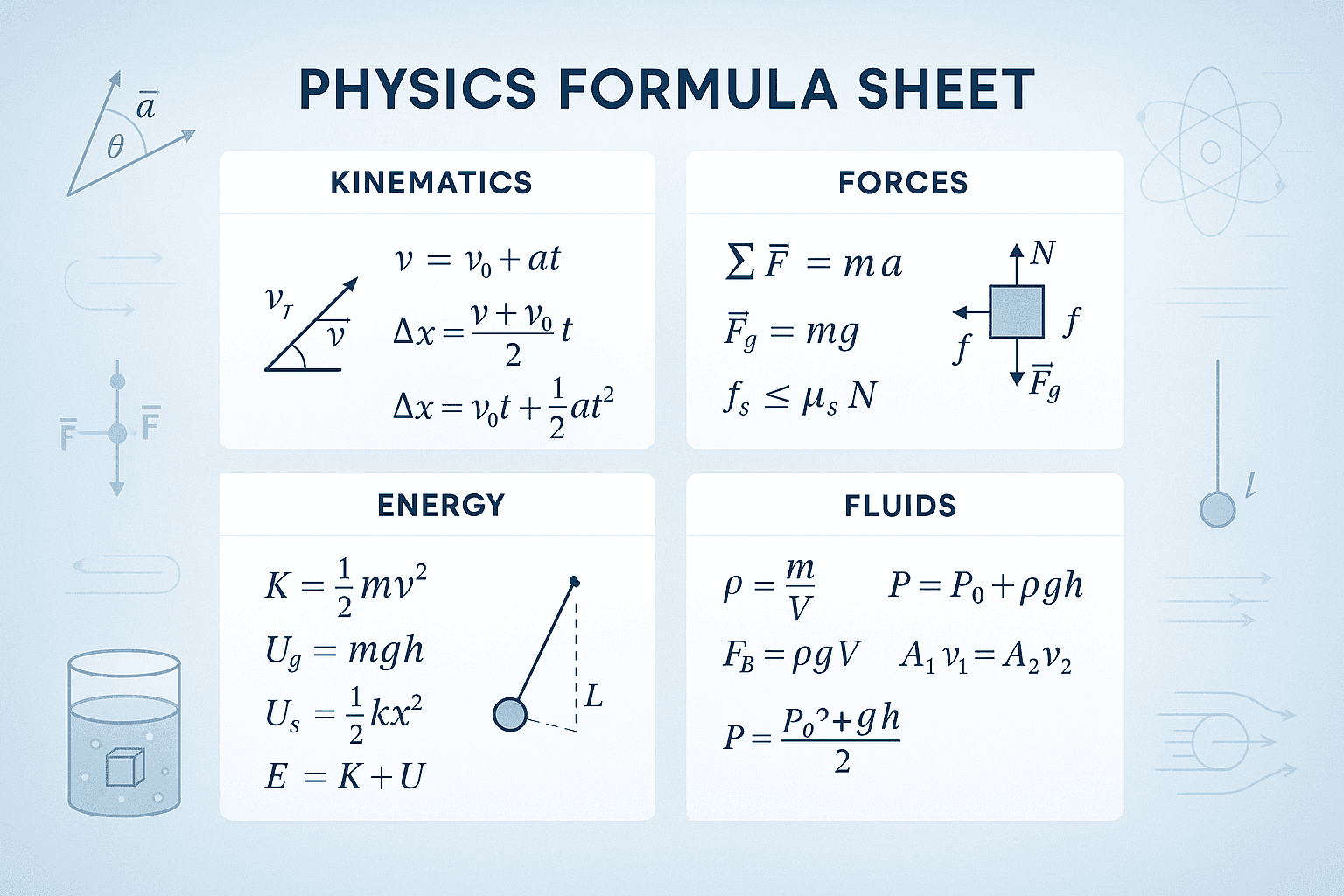
The AP Physics 1 reference sheet includes equations, constants, and SI prefixes covering all eight units of the course. For 2026, the sheet includes fluids equations for the first time — reflecting the addition of Unit 8 (Fluids) to the AP Physics 1 curriculum.
Constants you'll have access to:
| Constant | Symbol | Value |
|---|---|---|
| Acceleration due to gravity | g | 9.8 m/s² |
| Universal gravitational constant | G | 6.67 × 10⁻¹¹ N·m²/kg² |
| Atmospheric pressure | P₀ | 1.01 × 10⁵ Pa |
What's NOT on the sheet: Moments of inertia for specific shapes (disk, sphere, rod, hoop). When a problem requires one, it will be given in the question. You don't need to memorize them, but you do need to know what rotational inertia means and how it functions in equations.
Format note: During the MCQ section, the reference sheet is accessible in the Bluebook testing app on your screen. During the FRQ section, you'll receive a physical paper copy. Practice reading equations from both formats before exam day.
Unit 1: Kinematics
Kinematics describes motion without worrying about what causes it. These are the equations you'll use whenever a problem involves an object moving with constant acceleration.
The three kinematic equations:
| Equation | Use when you don't know... |
|---|---|
| v = v₀ + at | displacement (x) |
| x = x₀ + v₀t + ½at² | final velocity (v) |
| v² = v₀² + 2a(x − x₀) | time (t) |
Variables: v = final velocity, v₀ = initial velocity, a = acceleration, t = time, x = position, x₀ = initial position.
How to choose the right equation: Look at what you know and what you're solving for. Each equation is missing one variable. Find the equation that's missing the variable you don't have and don't need.
Exam tip: These equations only work for constant acceleration. If acceleration changes, you'll need to use energy methods or calculus-based reasoning (which is beyond Physics 1's scope, but the exam may test whether you recognize when kinematics doesn't apply).
Unit 2: Forces and Newton's Laws
Forces cause changes in motion. This unit connects what's pushing or pulling an object to how it accelerates.
For more on this topic, explore our guide on Ap Physics 1 in 2026 What Changed and How to Score a 5.
Key equations:
| Equation | What it describes |
|---|---|
| ΣF = ma (Newton's Second Law) | Net force equals mass times acceleration |
| F_g = mg | Weight (gravitational force near Earth's surface) |
| F_f ≤ μF_N | Friction force (static: ≤ μ_s·F_N; kinetic: = μ_k·F_N) |
| F_s = kx | Hooke's Law (spring force) |
| F_g = Gm₁m₂/r² | Universal gravitation |
| a_c = v²/r | Centripetal acceleration |
Variables: F = force, m = mass, a = acceleration, g = gravitational field strength, μ = coefficient of friction, F_N = normal force, k = spring constant, x = displacement from equilibrium, r = radius, G = gravitational constant.
Exam tip: Every force problem starts with a free body diagram. Draw one before writing any equations. Label every force with its type (gravity, normal, friction, tension, applied, spring). The most common error on FRQs is forgetting a force or getting the direction wrong.
Unit 3: Work, Energy, and Power
Energy methods let you solve problems that would be difficult or impossible with forces alone, especially problems involving curved paths or variable forces.
Key equations:
| Equation | What it describes |
|---|---|
| K = ½mv² | Kinetic energy |
| U_g = mgy | Gravitational potential energy (near Earth's surface) |
| U_s = ½kx² | Elastic (spring) potential energy |
| W = Fd cos θ | Work done by a force |
| W_net = ΔK | Work-energy theorem |
| P = W/t = Fv | Power (rate of doing work) |
| ΔE_system = W_external | Conservation of energy with external work |
Variables: K = kinetic energy, U = potential energy, W = work, F = force, d = displacement, θ = angle between force and displacement, P = power, t = time.
When to use energy vs. forces: If a problem asks about speed at a certain position (not time), energy methods are usually faster. If a problem asks about acceleration or force at a specific instant, Newton's second law is the way to go.
Exam tip: Conservation of energy problems are among the most common on the exam. The key is identifying your system, listing all forms of energy at the start and end, and accounting for any work done by external forces. Practice writing: "E_initial + W_external = E_final" and substituting the specific energy terms.
Unit 4: Linear Momentum and Impulse
Momentum connects force and time to changes in motion. It's especially powerful for collision and explosion problems where forces are complex but total momentum is conserved.
Key equations:
| Equation | What it describes |
|---|---|
| p = mv | Momentum |
| J = FΔt = Δp | Impulse-momentum theorem |
| Σp_initial = Σp_final | Conservation of momentum (closed system) |
Variables: p = momentum, m = mass, v = velocity, J = impulse, F = average force, Δt = time interval.
Types of collisions:
In elastic collisions, both momentum and kinetic energy are conserved. In perfectly inelastic collisions (objects stick together), only momentum is conserved — kinetic energy decreases. The exam will test whether you can identify which type of collision is described and apply the correct conservation law.
Exam tip: Momentum is a vector. In 2D collision problems, you need to conserve momentum separately in the x and y directions. Always define a positive direction before setting up your equations.
Unit 5: Torque and Rotational Dynamics
Rotational motion mirrors linear motion. Therefore, every linear equation has a rotational counterpart. If you understand Newton's second law, you already understand the structure of rotational dynamics.
Key equations:
| Equation | Linear equivalent |
|---|---|
| τ = rF sin θ | Torque (rotational equivalent of force) |
| Στ = Iα | Newton's second law for rotation |
| ω = ω₀ + αt | v = v₀ + at |
| θ = θ₀ + ω₀t + ½αt² | x = x₀ + v₀t + ½at² |
| ω² = ω₀² + 2α(θ − θ₀) | v² = v₀² + 2a(x − x₀) |
Variables: τ = torque, r = distance from axis, F = force, θ = angle, I = rotational inertia (moment of inertia), α = angular acceleration, ω = angular velocity, θ = angular position.
The connection between linear and rotational: v = rω and a = rα relate the linear motion of a point on a rotating object to the rotational quantities. These are essential for problems involving rolling without slipping.
Exam tip: When a problem involves both translation and rotation (like a ball rolling down a ramp), you need both energy approaches: K_total = ½mv² + ½Iω². Many students forget the rotational kinetic energy term and get the wrong speed.
Unit 6: Energy and Momentum of Rotating Systems
This unit extends energy and momentum concepts to rotating objects.
Key equations:
| Equation | What it describes |
|---|---|
| K_rot = ½Iω² | Rotational kinetic energy |
| L = Iω | Angular momentum |
| ΔL = τΔt | Angular impulse = change in angular momentum |
| L_initial = L_final | Conservation of angular momentum (no net external torque) |
Variables: K_rot = rotational kinetic energy, I = rotational inertia, ω = angular velocity, L = angular momentum, τ = torque, Δt = time interval.
Exam tip: Conservation of angular momentum explains why a spinning figure skater speeds up when they pull their arms in — I decreases, so ω must increase to keep L constant. The exam loves this concept. Be ready to explain it both qualitatively (why it happens) and quantitatively (using L = Iω).
Unit 7: Oscillations
Simple harmonic motion (SHM) occurs whenever a restoring force is proportional to displacement. Springs and pendulums are the two primary examples on the AP Physics 1 exam.
You might also find these guides helpful: A Level Physics Circular Motion Centripetal Force and Analyzing the Hardest Physics Questions in Ib Exams Key Insights.
Key equations:
| Equation | What it describes |
|---|---|
| T_spring = 2π√(m/k) | Period of a mass on a spring |
| T_pendulum = 2π√(L/g) | Period of a simple pendulum |
| f = 1/T | Frequency and period relationship |
| x(t) = A cos(2πft) | Position as a function of time |
Variables: T = period, m = mass, k = spring constant, L = pendulum length, g = gravitational acceleration, f = frequency, A = amplitude, x = position, t = time.
What affects the period and what doesn't:
For a spring: period depends on mass and spring constant. Amplitude does NOT affect the period. For a pendulum: period depends on length and gravitational acceleration. Mass and amplitude (for small angles) do NOT affect the period. The exam tests this distinction regularly.
Exam tip: A common FRQ setup gives you a position-time or velocity-time graph and asks you to determine amplitude, period, or frequency. Practice reading these graphs — the period is the time for one complete cycle, and the amplitude is the maximum displacement from equilibrium.
Unit 8: Fluids (New for 2026)
Fluids were added to AP Physics 1 starting with the 2024-25 school year. This unit accounts for 10-15% of your exam score, so don't skip it.
Key equations:
| Equation | What it describes |
|---|---|
| ρ = m/V | Density |
| P = F/A | Pressure definition |
| P = P₀ + ρgh | Pressure at depth (gauge pressure) |
| F_b = ρ_fluid · V_displaced · g | Buoyant force (Archimedes' principle) |
| A₁v₁ = A₂v₂ | Continuity equation (conservation of mass for fluids) |
| P₁ + ½ρv₁² + ρgy₁ = P₂ + ½ρv₂² + ρgy₂ | Bernoulli's equation |
Variables: ρ = density, m = mass, V = volume, P = pressure, F = force, A = area, h = depth, g = gravitational acceleration, F_b = buoyant force, v = fluid velocity, y = height.
Connecting fluids to energy: Bernoulli's equation is essentially conservation of energy per unit volume applied to a flowing fluid. The three terms represent pressure energy, kinetic energy per volume, and gravitational potential energy per volume. If you understand energy conservation from Unit 3, Bernoulli's equation follows the same logic.
Exam tip: Since fluids are new to Physics 1, College Board will almost certainly test them on at least one FRQ. Make sure you can apply both the continuity equation and Bernoulli's equation to a pipe system where the cross-sectional area or height changes. Also practice buoyancy problems — determining whether an object floats, sinks, or is neutrally buoyant based on density comparison.
Equations That Aren't on the Sheet (But You Should Know)
The reference sheet covers most of what you need, but a few relationships are important to have internalized:
Relationships between linear and rotational motion:
v = rω (tangential velocity equals radius times angular velocity) and a_t = rα (tangential acceleration equals radius times angular acceleration). These are on the sheet, but students often forget to use them when connecting translational and rotational quantities.
The condition for rolling without slipping:
v_cm = rω. If an object rolls without slipping, the velocity of the center of mass equals the radius times the angular velocity. This appears frequently on the exam and is essential for solving rolling-on-a-ramp problems.
Gravitational field strength vs. gravitational force:
g = F_g/m = GM/r². Near Earth's surface, g ≈ 9.8 N/kg. At other distances from a planet, use the full equation. The distinction matters for orbit and satellite problems.
Static vs. kinetic friction:
Static friction can take any value up to μ_s·F_N (it adjusts to prevent sliding). Kinetic friction is always exactly μ_k·F_N. The exam tests whether you understand that static friction is an inequality, not an equation.
How to Actually Study With This Sheet
Having a formula sheet doesn't mean you don't need to study the formulas. Here's how to use this guide effectively:
Step 1: Categorize by unit. When you encounter a problem, identify which unit it belongs to first. This narrows your equation choices immediately.
Step 2: Identify knowns and unknowns. Write down every given value and what you're solving for, then find the equation that connects them.
Step 3: Practice without the sheet first. Solve problems from memory during study sessions, then check the reference sheet afterward. This builds the recognition speed you'll need during the timed exam.
Step 4: Drill the new fluids equations. Since fluids are new to Physics 1, many students haven't practiced these equations as thoroughly. Spend extra time on buoyancy, continuity, and Bernoulli's equation.
What Separates a 3 From a 5
The formula sheet gives every student the same equations. What separates scores is knowing which equation to use, setting it up correctly, and explaining your reasoning. On the 2025 exam, nearly 20% of students scored a 5 — up from about 10% the year before. The redesigned format rewards students who can connect concepts to math and explain why an equation applies to a specific situation.
When you study, don't just solve for the number. Practice stating which principle you're applying and why. "I'm using conservation of energy because the system is closed and no external work is done" earns you the justification point that separates a 4 from a 5.
Want a tutor who teaches the physics behind the formulas? Our AP Physics tutors help students understand when and why to use each equation, not just how to plug in numbers. They know exactly what College Board tests and how FRQs are scored.
Related: AP Physics 1 Subject Page | AP Physics 1 in 2026: What Changed and How to Score a 5