How to Master the IB Grading System for Chemistry Success
How to Master the IB Grading System for Chemistry Success Did you know that less than 10% of IB Chemistry students worldwide achieve a grade 7? That's right – scoring top marks in IB Chemistry isn't just about understanding molecular structures and balancing equations. The secret weapon? Mastering the IB grading system itself. Think about […]

Key Takeaways
- Let's dive into the exciting world of IB Chemistry assessment structure – your roadmap to success! The 2025 assessment format brings some significant changes you'll want to know about.
- Ready to tackle Paper 1 like a pro? Let's explore the strategies that will help you excel in this crucial component of the IB Chemistry grading system!.
- Get ready for the most challenging part of your IB Chemistry journey – Paper 2! This component makes up 40% (SL) or 36% (HL) of your overall chemistry grade [14], and with the right approach, you can .
- Time to unlock the secrets of the Internal Assessment – the component that can truly showcase your chemistry genius!.
- Welcome to the hands-on world of IB Chemistry, where theory transforms into exciting practical discoveries!.
How to Master the IB Grading System for Chemistry Success
Let's dive into the exciting world of IB Chemistry assessment structure – your roadmap to success! The 2025 assessment format brings some significant changes you'll want to know about. This step-by-step guide walks you through the full process, with practical examples and expert tips at every stage.
That's right – scoring top marks in IB Chemistry isn't just about understanding molecular structures and balancing equations. The secret weapon? Mastering the IB grading system itself. For more on this, see our guide on balancing redox reactions.
Think about it: you wouldn't play a game without knowing the rules, so why tackle IB Chemistry without understanding exactly how you'll be assessed? The IB grading system might seem complex at first, but once you crack its code, you'll know exactly what examiners are looking for. Learn more in our guide on use chemistry AI solver for effective IB.
From multiple-choice questions to internal assessments, each component of IB Chemistry has its own scoring criteria and weight. Understanding these elements isn't just helpful – it's essential for maximizing your score.
Ready to transform your approach to IB Chemistry and boost your chances of scoring that coveted 7? Let's break down everything you need to know about the IB grading system and how to make it work in your favor.
Navigating IB Chemistry can feel overwhelming, especially if it's your first time. If you'd like personalised guidance from someone who's helped hundreds of IB students, our IB Chemistry tutors are here to help. Tell us what you need →
Understanding the IB Chemistry Assessment Structure
Let's dive into the exciting world of IB Chemistry assessment structure – your roadmap to success! The 2025 assessment format brings some significant changes you'll want to know about. Explore our detailed guide on mastering organic chemistry for more tips.
Breakdown of External Assessment Components
The external assessment makes up a whopping 80% of your total grade. Here's the breakdown of what you'll face:
| Component | Standard Level | Higher Level |
|---|---|---|
| Paper 1 (Total Marks) | 55 marks – 90 mins | 75 marks – 120 mins |
| Paper 2 (Total Marks) | 50 marks – 90 mins | 90 marks – 150 mins |
Paper 1 is split into two exciting sections: Paper 1A with multiple-choice questions and Paper 1B featuring data-based questions [2]. Paper 2 challenges you with short-answer and extended-response questions, testing your depth of understanding.
Internal Assessment Requirements
The Internal Assessment (IA) contributes 20% to your final grade [4]. Your scientific investigation should be:
- 3000 words in length [5]
- Worth 24 marks total
- Based on your own research question
- Assessed on four key criteria including research design, data analysis, evaluation, and conclusion.
Grade Boundaries and Mark Allocation
The IB uses a dynamic grade boundary system that converts your total marks into a 1-7 grade scale. These boundaries are set through careful review of:
- Quality of candidate work against grade descriptors
- Expected standards for each grade level
- Overall performance patterns
Get Expert Help Mastering Chemistry Grading System
Understanding the grading system is one thing; applying it strategically in your preparation is another. To align your study plan with exactly what examiners reward, master the chemistry IA through expert or develop a perfect study plan or work with an experienced IB Chemistry tutor who can help you translate grade criteria into specific exam preparation strategies and point you toward the study materials and practice methods that yield the best results.
Your final grade combines both external and internal assessment components, with each part weighted appropriately. The grade boundaries are reviewed and adjusted each examination session to maintain consistent standards.
Remember, understanding these assessment components isn't just about knowing the structure – it's about strategically preparing for each element to maximize your success!
Mastering Chemistry Paper 1 Strategies
Ready to tackle Paper 1 like a pro? Let's explore the strategies that will help you excel in this crucial component of the IB Chemistry grading system!
Multiple Choice Question Techniques
Paper 1 consists of two sections: 1A and 1B, with approximately 30 questions for Standard Level and 40 questions for Higher Level. The key to success lies in smart elimination techniques. When approaching each question:
- Read the question twice, focusing on key terms
- Eliminate obviously incorrect options first
- Use periodic table references wisely
- If stuck, mark the question and return later – there's no penalty for guessing
Time Management Tips
For Higher Level students, you'll have 120 minutes to tackle 40 questions, while Standard Level students get 90 minutes for 30 questions. Here's your winning time strategy:
- Allocate 1.5 minutes per question initially
- Save 15 minutes for review at the end
- Mark challenging questions for later review
- Use the remaining time to tackle marked questions
Common Question Types and Approaches
Paper 1 typically includes a mix of question styles, with most being straightforward if you're well-prepared [10]. You'll encounter:
Calculation Questions:
Master your mental math skills – you'll need quick addition, subtraction, multiplication, and division abilities [11]. While recent changes allow calculator use, developing mental math prowess remains valuable.
Content-Based Questions:
Most questions are generally manageable, with only 2-3 potentially tricky ones per paper [10]. Aim for a score of 34 or above to position yourself well for a grade 6 or 7 [10].
Periodic Table Questions:
With the new format allowing full data booklet access, expect questions focusing on understanding trends rather than memorizing values. Pay special attention to:
- Second ionization energy concepts
- Ionic radius patterns
- Periodic trends not listed in the data booklet
Remember, while the format might seem challenging, Paper 1 is often considered the most straightforward component by many students. With proper preparation and these strategies in your arsenal, you're well-equipped to excel! To deepen your understanding, study chemistry a.
Excelling in Chemistry Paper 2
Get ready for the most challenging part of your IB Chemistry journey – Paper 2! This component makes up 40% (SL) or 36% (HL) of your overall chemistry grade, and with the right approach, you can turn it into your strongest performance!
Long Answer Question Strategies
Paper 2 gives you approximately 1.5 minutes per mark, so organization is key! Here's your winning strategy:
- Start with a clear structure
- Show all working steps – partial marks count!
- Use chemistry-specific terminology
- Include relevant equations and balanced reactions
- Link your answer to theoretical concepts
Pro Tip: When nothing is specified in the question, round your answers to 3 significant figures. However, match the significant figures of the numerical values given in the question when provided.
Data Analysis Techniques
Data analysis questions appear consistently as the first question of Paper 2. Master these essential skills:
- Identify variables (independent and dependent)
- Look for trends and patterns
- Use statistical tools effectively
- Connect data to relevant theories
- Draw clear, logical conclusions [16]
A structured approach to data interpretation will help you score maximum points. Remember to label axes correctly and include units in your calculations! For deeper insight into analytical approaches, learn how to analyze data for.
Calculation Question Methods
The secret to acing calculation questions lies in your systematic approach. Here's your time-tested formula for success:
| Step | Action |
|---|---|
| 1 | Write the balanced equation |
| 2 | Determine known quantities |
| 3 | Use mole ratios from a balanced equation |
| 4 | Calculate unknown quantities [17] |
Important: The data booklet contains around 40 pages of crucial information. Know exactly where to find:
- Ionization energies
- Bond enthalpies
- Standard electrode potentials
- Strengths of organic acids and bases
When tackling calculations, always show your working – you can earn partial marks even if your final answer isn't perfect! Use your calculator wisely, but don't forget to sanity-check your answers against reasonable expectations.
Remember, Paper 2 combines multiple topics throughout the exam, so stay flexible and ready to connect concepts across different areas of chemistry. Keep your data booklet close – it's your best friend during this exam!
Optimizing Your Internal Assessment
Time to unlock the secrets of the Internal Assessment – the component that can truly showcase your chemistry genius!
Choosing the Right Research Question
Your research question is the foundation of your IA success! The key is selecting a topic that genuinely excites you while meeting these essential criteria:
- Must include specific independent and dependent variables [4]
- Should be related to the IB Chemistry syllabus content [4]
- Needs to be practical and feasible within available resources [4]
Pro Tip: Start with a broad topic you love, then narrow it down to a specific, measurable question. Remember, you'll need to include at least 5 manipulations of your independent variable with 3 trials each! For comprehensive guidance, check how to choose the best Chemistry.
Meeting Assessment Criteria
Your IA is worth a substantial 20% of your final grade [19], so let's break down the marking criteria:
| Criterion | Marks | Key Focus |
|---|---|---|
| Research Design | 6 | Methodology and variables |
| Data Analysis | 6 | Recording and processing data |
| Conclusion | 6 | Answering research question |
| Evaluation | 6 | Investigation methodology |
Keep your report between 6-12 pages – anything longer will cost you marks in communication!
Common IA Pitfalls to Avoid
Let me share some game-changing tips to dodge common mistakes:
- Don't Overcomplicate: A simple, well-executed experiment often scores better than a complex one with poor execution [5]
- Document Everything: Take detailed notes during lab work and plenty of pictures – you'll thank yourself later [5]
- Data Management: Ensure you have:
- Clear tables with proper units
- Error bars in graphs
- Proper citations for any secondary data
Important: Never fake your data, even if results aren't perfect! The IB values honest evaluation of limitations more than perfect results. Remember, a complete failure can still earn top marks if you analyse it properly!
The secret to IA success isn't just about the experiment – it's about showing your thinking process. Make your personal engagement shine through by explaining why you chose your topic and how it connects to your interests [4].
Practical Skills Development
Welcome to the hands-on world of IB Chemistry, where theory transforms into exciting practical discoveries!
Laboratory Work Best Practices
Practical work stands as a cornerstone of the IB Chemistry program, requiring 40 hours for Standard Level and 60 hours for Higher Level students. This hands-on experience isn't just about following procedures – it's about developing your scientific intuition! You may also find our resource on Le Chatelier's principle helpful.
Your practical journey includes:
- Hands-on experiments and investigations
- Collaborative science projects
- Data logging and sensor work
- Simulation and modeling activities
The IB program emphasizes developing a range of practical and investigative skills through these experiences. You'll collaborate with peers while exploring everything from closed experiments to open inquiry investigations.
Data Collection and Analysis
Master these essential data handling techniques to excel in your practical work:
| Skill Area | Key Focus |
|---|---|
| Error Analysis | Understanding uncertainty and limitations |
| Graphing | Technical presentation of results |
| Variable Management | Controlling and measuring factors |
| Data Logging | Using sensors and digital tools |
Remember to collect data for a minimum of 5 levels over your independent variable range, with at least 5 repeats for standard deviation calculations. This thorough approach ensures your results are reliable and scientifically sound.
Safety and Documentation Requirements
Safety isn't just a requirement – it's your ticket to confident experimentation! Here are your essential safety protocols:
- Personal Protection:
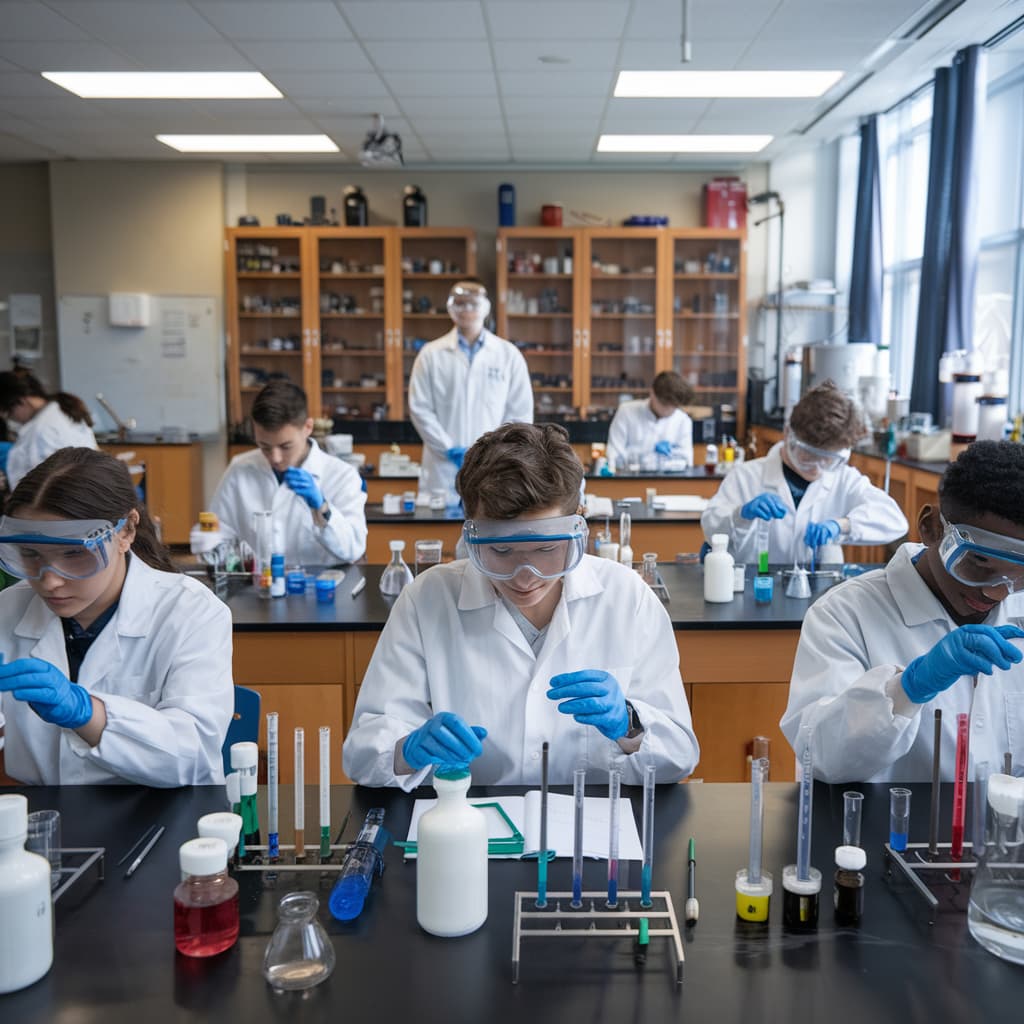
- Wear appropriate lab coats and safety goggles
- Use proper protective equipment for specific experiments
- Chemical Handling:
- Understand properties before use
- Follow proper storage procedures
- Know disposal protocols
- Emergency Preparedness:
- Learn emergency response procedures
- Know locations of safety equipment
- Understand first aid protocols
Your practical work documentation should include detailed records of all experiments, including qualitative observations and quantitative data. Keep your lab notebook organized with:
- Clear experimental procedures
- Raw data tables
- Processed results
- Safety considerations
Pro Tip: Pre-lab planning is crucial! Before each experiment, assess potential risks and prepare all necessary materials. This preparation not only ensures safety but also helps you maximize your learning from each practical session.
Remember, practical work in IB Chemistry isn't just about following procedures – it's about developing your scientific thinking and experimental design skills. Through these hands-on experiences, you'll build the confidence and competence needed for success in your IB assessments and beyond!
Your Path to Chemistry Excellence
Mastering the IB Chemistry grading system requires understanding each assessment component's weight, knowing exactly what examiners reward, and strategically preparing across all areas. Work with a Chemistry specialist tutor to develop a personalised study plan aligned with the grading criteria—one that targets your specific weaknesses while maximising your performance on Papers 1 and 2 and optimizing your Internal Assessment score.
Frequently Asked Questions
How are IB Chemistry grade boundaries determined, and what do they mean for my predicted grade?
IB grade boundaries are set annually based on the statistical distribution of global examination results and are adjusted to maintain consistent standards across different examination sessions. These boundaries determine the raw mark required for each grade from 1 (lowest) to 7 (highest), typically ranging from approximately 80–100% for a grade 7 and 70–79% for a grade 6, though exact boundaries vary by year. Your predicted grade is your teacher's assessment of the grade you are likely to achieve based on your current performance, internal assessment results, and practice examination outcomes. Understanding the boundary between grade 6 and 7 is particularly important if you are targeting competitive university programmes, as these grades carry different implications for your university applications.
What is the weighting of internal assessment versus examination in IB Chemistry?
Internal assessment accounts for 20% of your final IB Chemistry grade, whilst the three written examination papers comprise 80% of your total mark. This weighting means that whilst excelling in your IA is important, your examination performance ultimately carries greater influence on your final grade. However, the IA represents a significant opportunity to secure guaranteed marks through careful planning and execution—a perfect internal assessment (20 marks) contributes substantially towards achieving grade 7, whereas a weak IA forces you to score higher on exams to compensate. The 80:20 split emphasises the importance of developing strong examination technique and deep conceptual understanding, not merely procedural skills.
How does IB moderation work, and could my IA mark be adjusted?
The IB implements standardised moderation procedures where a sample of internal assessments from each school is independently marked by IB examiners to ensure consistency and fairness across schools globally. If the IB moderator identifies significant discrepancies between your school's marking and international standards, marks may be adjusted upwards or downwards for all students in your school. This moderation process is invisible to individual students unless adjustments are substantial, and it protects against over-marking or under-marking by individual teachers. Your IA mark is secure once submitted, though modest adjustments are possible; consequently, it is essential that your teacher marks fairly and according to precise IB criteria rather than inflating marks.
What is the most effective strategy for improving my Chemistry grade if I am currently underperforming?
If your current grade is below your target, conduct an honest diagnostic analysis of your performance: are you struggling with conceptual understanding of core chemistry topics, or are your difficulties primarily with examination technique and time management? Targeted intervention depends on this diagnosis—students with conceptual gaps benefit from systematic review of core topics such as bonding, equilibrium, and oxidation-reduction, often with the support of a tutor, whilst those with solid understanding but weak examination performance should focus on timed practice, memorising key equations and definitions, and developing systematic approaches to structured and extended response questions. Additionally, ensure your internal assessment reflects genuine effort and careful execution; a 2–3 mark improvement in your IA can meaningfully contribute to raising your overall grade.
How can I maximise my performance in the final examination to achieve grade 7?
Achieving grade 7 typically requires mastering approximately 85–90% of the course content and demonstrating strong command under examination pressure. Prioritise understanding core concepts deeply rather than superficially memorising facts, as the IB rewards conceptual reasoning in higher-mark questions. During the final revision period, focus on practising past examination papers under timed conditions, analysing the mark schemes carefully to understand what examiners expect, and identifying your weakest topics for intensive revision. On examination day, allocate your time carefully—attempt all questions even if your initial response is uncertain, tackle familiar content first to build confidence, and always show your working clearly so partial credit is awarded for methodology even if your final answer is incorrect.
Where can I find resources to understand grade boundaries better and access tutoring support?
The official IB website publishes detailed grade boundary statistics and statistical reports after each examination session, though understanding these requires careful interpretation of statistical data. Your school's IB coordinator can discuss predicted grades and realistic targets based on your current performance relative to historical cohort data. To develop a comprehensive strategy for achieving your target grade, combining examination technique, deep conceptual mastery, and strong internal assessment performance, explore our guide to HL versus SL differences to ensure, and visit our tutoring packages for personalised support tailored to your specific strengths and development areas.
References
[1] – https://www.ibo.org/globalassets/new-structure/recognition/pdfs/dp_sciences_chemistry_subject-brief_jan_2022_e.pdf
[2] – https://www.savemyexams.com/learning-hub/exam-guides/ib-chemistry-syllabus-update/
[3] – https://tibertutor.com/ib/chemistry-2025/useful-resources/exam-breakdown
[4] – https://www.tutorchase.com/blog/ib-chemistry-ia-guidance-and-example-titles
[5] – https://lanterna.com/blog/chemistry-ia-tips-and-15-ideas/
[6] – https://www.ibo.org/contentassets/5895a05412144fe890312bad52b17044/covid-19-amendments-to-dp-subject-briefs-may-21-and-november-21_en.pdf
[7] – https://www.ibsolved.com/post/ib-chemistry-internal-assessment-solved-a-guide-to-acing-your-chemistry-ia
[8] – https://educationlearningweb.com/laboratory-safety-and-best-practices-in-ib-chemistry-classes/
[9] – https://knowt.com/blog/everything-you-need-to-get-a-7-on-ib-chemistry
[10] – https://iblieve.org/acing-the-hl-chemistry-paper-1-and-paper-2/
[11] – https://www.easysevens.com/ib-chemistry-tips/
[12] – https://sherpa-online.com/blog/read/how-to-prepare-for-the-new-ib-chemistry-exams
[13] – https://blog.collegevine.com/ultimate-guide-to-ib-chemistry-sl-exam
[14] – https://www.make-sensei.com/tips-and-tricks-for-chemistry-paper-2/
[15] – https://www.reddit.com/r/IBO/comments/3kiots/as_requested_some_tips_for_maximising_your_hl/
[16] – https://www.revisiondojo.com/blog/paper-2-data-analysis-tips
[17] – https://www.savemyexams.com/dp/chemistry_sl/ib/16/revision-notes/1-stoichiometric-relationships/1-2-reacting-masses--volumes/1-2-8-concentration-calculations/
[18] – https://www.ahschools.us/cms/lib/MN01909485/Centricity/Domain/4810/Chem 2andIB Chem/IA Student Guide.pdf
[19] – https://nailib.com/blog/ib-chemistry-ia
[20] – https://tibertutor.com/ib/chemistry-2025/useful-resources/internal-assessment/ia-criteria
[21] – https://mrwengibchemistry.com/2020/03/19/fix-my-ib-chemistry-ia/
[22] – http://henniscience.weebly.com/practical-work.html
[23] – https://www.ibo.org/programmes/diploma-programme/curriculum/sciences/chemistry/
[24] – https://thinkib.net/chemistry/page/41553/practical-work-including-ia-group-4-project-
[25] – https://sites.google.com/view/crushchemistry/chemistry-ib-ia/analysis
[26] – https://www.ucps.k12.nc.us/cms/lib/NC01910453/Centricity/Domain/1981/IB_Chemistry_Lab_Report_Guide.pdf
[27] – https://www.crimsoneducation.org/us/blog/ib-chemistry/