IB Maths AA HL: Paper 3 Strategies That Actually Work
IB Maths AA HL: Paper 3 Strategies That Actually Work Paper 3 is where IB Mathematics Analysis and Approaches HL separates strong students from exceptional ones...
Key Takeaways
- Paper 3 contains two extended-response questions.
- This sounds obvious but most students don't do it.
- Paper 3 rewards mathematical communication more than any other component of the exam.
- You have 60 minutes for two questions.
- Ignoring "hence" instructions.
Ready to Boost Your Maths Grade?
Our IB Maths tutors work with students at every level — whether you're aiming to move from a 4 to a 5 or pushing for that final jump to a 7. We'll match you with someone who understands the IB Maths syllabus inside out. Find your tutor → (This guide has been with the latest 2025 insights.)
Frequently Asked Questions
What is the difference between Math AA and Math AI?
Math AA (Analysis and Approaches) focuses on algebraic methods and theoretical mathematics, while Math AI (Applications and Interpretation) emphasizes real-world applications and technology. Choose AA if you plan to study math-heavy subjects at university.
For more on this topic, explore our guide on A Level Maths Paper 1 What to Expect and How to Prepare.
How do I improve my IB Math grade?
Focus on understanding concepts rather than memorizing procedures. Practice past papers under timed conditions, review your mistakes carefully, and ensure you can explain why each step works, not just how.
Is IB Math HL harder than A-Level Maths?
Both are challenging but different. IB Math AA HL covers a broader curriculum including the IA component, while A-Level Further Maths may go deeper into specific topics. Difficulty depends on individual strengths.
What calculator do I need for IB Math?
A graphing calculator is required for IB Math. The TI-84 Plus CE and TI-Nspire are popular choices. Make sure you know how to use all relevant functions, including statistical analysis and graphing.
Paper 3 is where IB Mathematics Analysis and Approaches HL separates strong students from exceptional ones. It's only one hour, only two questions, and worth 20% of your final grade — but those two questions are unlike anything else in the exam. They're extended investigations that test your ability to explore unfamiliar mathematical territory, build on your own results, and communicate your reasoning clearly.
Most students walk into Paper 3 unsure of what to expect. The questions don't look like Paper 1 or Paper 2 problems. There's no fixed list of topics to memorise. Instead, the paper tests whether you can think mathematically when you're given something new. That's precisely why it rewards a specific set of strategies — and why students who prepare with those strategies consistently outperform those who don't.
If you're looking for a structured approach to IB Maths, working with an IB Maths AI tutor who's been through the IB system can make a real difference — especially when it comes to exam technique and time management. Tell us what you need help with →
What Paper 3 Actually Tests
Paper 3 contains two extended-response questions. Each question has multiple parts — often six to ten — that build on each other. The early parts tend to be more accessible: direct calculations, specific cases, or guided exploration. The later parts ask you to generalise, prove, or conjecture based on patterns you've found earlier.
The key difference from Papers 1 and 2 is that Paper 3 questions are investigative. You're not solving a known problem type — you're exploring a mathematical situation. The IBO is testing whether you can follow a logical progression from specific cases to general conclusions, use your GDC (graphing display calculator) effectively, communicate your mathematical reasoning in writing, and connect results from earlier parts to solve later parts.
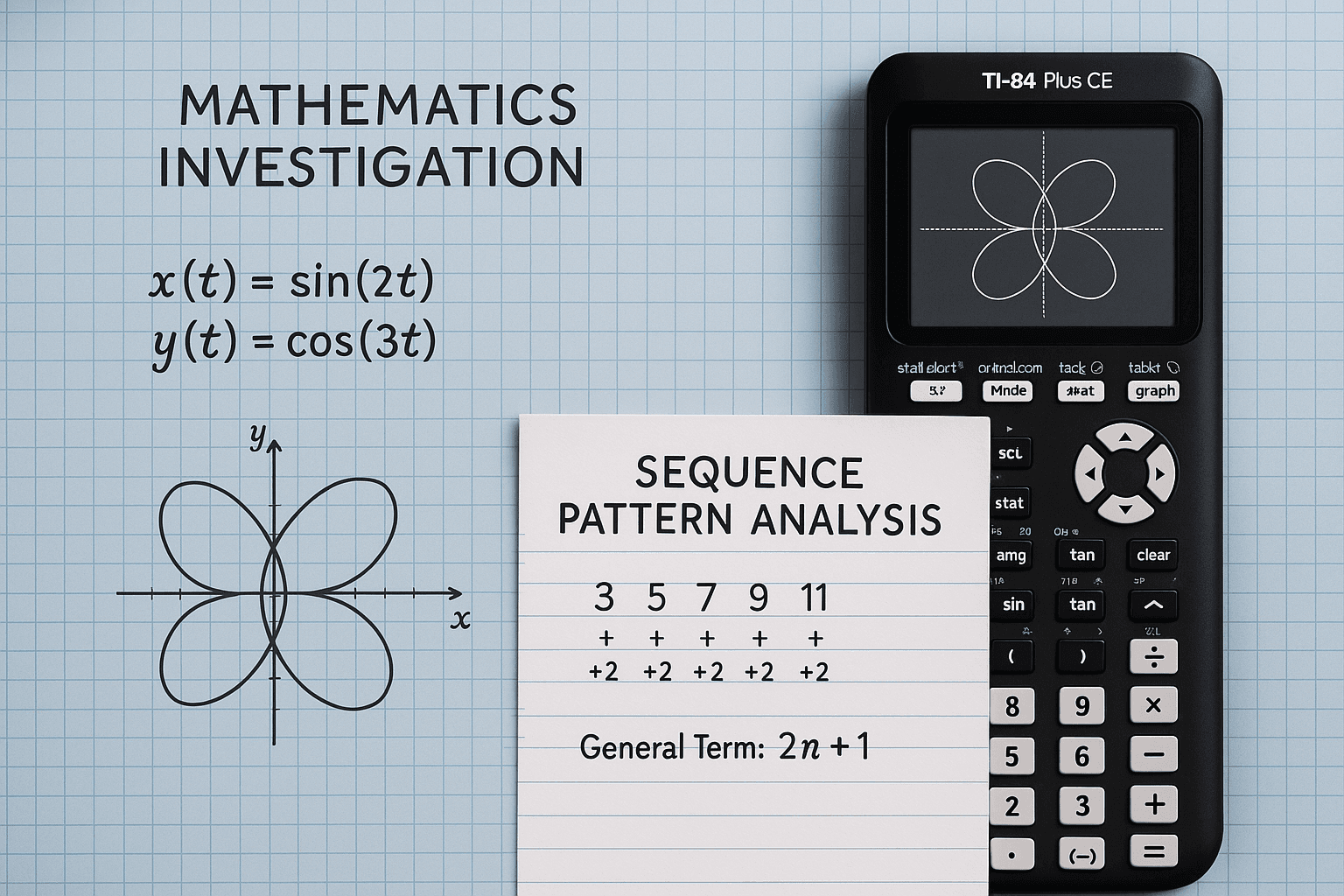
Common topics include sequences and recursive relationships, matrix modelling and transformations, parametric equations and optimisation, probability distributions and expected value, integration techniques applied to unfamiliar contexts, and proof by induction or contradiction. But the topic itself matters less than the investigative structure. Even if you recognise the underlying mathematics, the way the question asks you to engage with it will be different from anything in Paper 1 or Paper 2.
Strategy 1: Read the Entire Question Before You Start
This sounds obvious but most students don't do it. Paper 3 questions are designed as a narrative — each part sets up the next. If you read only part (a) and start working, you might choose an approach that makes parts (d) through (f) much harder.
Spend 2-3 minutes reading the entire question from start to finish before writing anything. Look for what the question is building towards. Is it heading towards a proof? A generalisation? An optimisation? Understanding the destination helps you choose better methods at the start.
Strategy 2: Use Earlier Parts as Stepping Stones
Paper 3 questions are scaffolded deliberately. The result you find in part (b) is almost certainly needed in part (d). The pattern you spot in part (c) is the basis for the generalisation in part (e).
For more on this topic, explore our guide on How to Use Exam Mode Calculator Hacks for Ib Maths Past Papers.
If you're stuck on a later part, look back at your earlier answers. Ask yourself: "How does what I found in part (b) connect to what's being asked here?" In many cases, the link is direct — substituting your earlier result into a new expression, or applying the pattern you identified to a broader case.
If you couldn't complete an earlier part, use the result stated in the question (if one is given) and carry on. The IBO frequently provides a "show that" result precisely so students who got stuck can still access later marks.
Strategy 3: Show Everything — Process Over Answers
Paper 3 rewards mathematical communication more than any other component of the exam. The markscheme awards points for method, reasoning, and clear presentation — not just the final answer.
This means you should write down every step, even if it feels obvious. If you're using a substitution, state it. If you're applying a theorem, name it. If you're using your GDC to find a value, write "Using GDC:" and state what you entered and what it returned.
For investigation-style parts where you're asked to "explore" or "conjecture," write your observations as full sentences. "For n = 1, 2, 3, the sequence gives values 1, 4, 9. This suggests the general term may be n²" is exactly the kind of reasoning that earns marks.
Strategy 4: Master Your GDC
Paper 3 is a calculator paper, and the GDC is one of your most powerful tools. Students who know their calculator well can verify algebraic work quickly, generate numerical evidence for conjectures, use regression to identify patterns, graph functions to check behaviour, and solve equations that would be impractical by hand.
Before the exam, make sure you can do all of the following without hesitation: store and recall functions, run regression analysis (linear, quadratic, exponential, power), find numerical solutions to equations, plot parametric and polar curves, work with matrices (multiplication, powers, inverses), and calculate definite integrals numerically.
Practice using your GDC under timed conditions. The students who lose time on Paper 3 aren't the ones who lack mathematical knowledge — they're the ones who fumble with calculator menus.
Strategy 5: Manage Your Time Ruthlessly
You have 60 minutes for two questions. That's 30 minutes per question — but the questions aren't equally difficult throughout. The early parts are typically worth fewer marks but take less time. The later parts are worth more marks but require deeper thinking.
A smart time split: spend about 20 minutes on the first six or seven parts of each question (the guided, scaffolded sections), then spend 10 minutes on the final investigative parts (generalisations, proofs, conjectures). If a part is taking more than 5 minutes and you're not making progress, move on. You can come back to it — but only after you've collected all the accessible marks on both questions.
Never spend 40 minutes on Question 1 and leave yourself only 20 for Question 2. The first few marks of Question 2 are much easier to earn than the last few marks of Question 1.
Strategy 6: Know How "Show That" Questions Work
Paper 3 frequently includes "show that" parts where the answer is given and you need to demonstrate why it's true. These exist for two reasons: they confirm you're on the right track, and they provide results you'll need later.
You might also find these guides helpful: 17 Time Management Strategies Ib Students Wish They Knew Earlier and How Real Companies Solved Big Problems Business Case Studies That Actually Work.
For "show that" questions, work forwards from the given information to the stated result. Show every algebraic step. Do not work backwards from the answer — examiners can spot this and may not award full marks. If the question says "show that the sum is (n² + n)/2," start from the sum and simplify until you reach that expression.
If you can't prove it, state the result and use it in subsequent parts anyway. You'll lose the marks for the proof but can still earn marks for everything that follows.
Strategy 7: Write Clear Conclusions
The final parts of Paper 3 questions often ask you to "conjecture," "generalise," or "comment on." These require you to write a mathematical statement, not just calculate a number.
A good conjecture is specific and testable: "Based on the pattern observed for n = 1 to 5, I conjecture that the general term is Tₙ = 2n² − n + 1 for all positive integers n."
A poor conjecture is vague: "The numbers keep getting bigger." The first earns marks; the second doesn't.
If you're asked to prove your conjecture (often by induction), structure your proof clearly: base case, inductive hypothesis, inductive step, conclusion. Label each step. Examiners look for these structural elements explicitly.
Common Mistakes on Paper 3
Ignoring "hence" instructions. If a question says "hence find..." it means use the result you just proved. Don't start from scratch with a different method — you'll waste time and may lose marks for not following the specified approach.
Not verifying with the GDC. If you derive a formula algebraically, check it against your GDC for a specific value. This takes 30 seconds and can catch errors before they propagate through the rest of the question.
Abandoning a question too early. Paper 3 questions get harder as they progress, but they also have accessible marks scattered throughout. Even if you can't do part (d), try parts (e) and (f) — they might depend on the result from (d) which is often stated in the question.
Poor mathematical notation. Using "=" when you mean "≈," omitting integral limits, or writing variables inconsistently (switching between x and X) costs marks. Be precise.
A 10-Week Preparation Plan
Weeks 1-3: Work through two full Paper 3 past papers per week. Focus on reading entire questions first and identifying the investigative arc. Time yourself to 30 minutes per question.
Weeks 4-6: Focus on the common topic clusters: sequences/recursion, matrix modelling, parametric equations, and probability. For each, solve the Paper 3 questions from past exams that feature these topics, then check against the markscheme.
Weeks 7-9: Practice the final parts of questions — the generalisations, conjectures, and proofs. These are where the top marks live. Write out full solutions with clear mathematical communication.
Week 10: Do two full timed Paper 3 mock exams. Mark them against the markscheme. Focus on whether your mathematical communication is clear enough to earn full method marks.
Need an examiner's perspective on your Paper 3 technique? Our IB Maths AA HL tutors include examiners who know exactly how the markscheme is applied. They can review your practice papers, identify where you're losing method marks, and sharpen your investigative approach before May.
Related: IB Mathematics Subject Page | IB Exam Preparation Resources