IB Psychology Paper 3: Strategies for the Final May 2026 Exam
Get ready for IB Psychology HL Paper 3 (May 2026) with a clear, mark-focused game plan for research methods, ethics, and critical evaluation — the three questions that make up 30% of your grade. This guide explains the Paper 3 structure, the essential methodology vocabulary (credibility, bias, transferability), and a 10-week revision strategy to help you hit the top markband.
Key Takeaways
- Paper 3 is worth 30% of your HL grade.
- Every Paper 3 follows the same structure.
- You don't need to memorise studies for Paper 3, but you do need fluency in research methodology terminology.
- The current IB Psychology syllabus (first taught in 2017) is being retired.
- With roughly 10 weeks until the May 2026 exams, here's how to structure your Paper 3 preparation:.
Ready to Boost Your Psychology Grade?
Our IB Psychology tutors work with students at every level. Whether you're aiming to move from a 4 to a 5 or pushing for that final jump to a 7, we'll match you with someone who understands the IB Psychology syllabus inside out. Find your tutor →
Frequently Asked Questions
How is IB Psychology structured?
IB Psychology covers biological, cognitive, and sociocultural approaches at SL and HL. HL students also study abnormal psychology and research methods in greater depth, plus complete a qualitative research project.
For more on this topic, explore our guide on Last Minute Physics Formula Sheet the Only Pdf You'll Need for Exam Day.
What is the best way to study IB Psychology?
Create study flashcards with key studies (researcher, method, findings, evaluation). Practice writing essay plans under timed conditions and learn to evaluate studies using GRAVE (Generalizability, Reliability, Application, Validity, Ethics).
How many studies should I know for IB Psychology?
Aim to know 2-3 studies thoroughly for each topic area. Quality of understanding matters more than quantity — being able to evaluate and compare studies is more important than memorizing many.
What are the command terms in IB Psychology exams?
Key command terms include Describe (give a detailed account), Evaluate (assess strengths and limitations), Discuss (present multiple perspectives), and Contrast (highlight differences). Understanding these determines how you structure your answers.
May 2026 is the last time the current IB Psychology syllabus will be examined. Starting in May 2027, a completely redesigned course takes over. New framework, new assessment structure, new Paper 3 format. That means the strategies in this guide apply specifically to the exam you are sitting this May, and they won't be relevant again.
If you're an HL Psychology student preparing for the May 2026 session, this is what you need to know about Paper 3: how it's structured, where the marks actually come from, and how to approach each question so you leave marks on the table as rarely as possible.
If you're looking for a structured approach to IB Psychology, working with an IB Physics tutor who's been through the IB system can make a real difference; especially when it comes to exam technique and time management. Tell us what you need help with →
What Paper 3 Tests (and What It Doesn't)
Paper 3 is worth 30% of your HL grade. You have one hour to answer three questions based on a single research scenario — a stimulus passage describing a study you've never seen before. The paper is worth 24 marks total.
Here's what makes Paper 3 different from Papers 1 and 2: you do not need to reference any studies you've learned in class. In fact, you'll get no credit for doing so. Every answer must be based on the stimulus material provided. The paper tests your understanding of research methodology, ethical considerations, and your ability to critically evaluate a study you're reading for the first time.
This is good news if your study recall is shaky heading into exams. Paper 3 rewards analytical skills and methodological knowledge, not memorisation.
The Three Questions: What You'll See
Every Paper 3 follows the same structure. The questions never change in format, only in specific focus.
For more on this topic, explore our guide on Guide for Acing Ib Psychology Paper 2.
Question 1: Research Methods (9 marks)
This question is always split into three parts, each worth 3 marks:
Q1(a): Identify the research method used in the study and outline two characteristics of that method.
Q1(b): Describe the sampling method used in the study.
Q1(c): Suggest an alternative or additional research method and give one reason for your choice.
This is the most predictable question on the paper. The method identification and sampling method are straightforward if you know your terminology. For Q1(c), always connect your suggested method back to the specific study — explain why your alternative would improve or complement the research described in the stimulus.
Time allocation: 10 minutes maximum. This question is your quickest win. Don't over-write it.
Question 2: Ethical Considerations (6 marks)
This question asks about ethics in one of two ways:
Version A: Describe the ethical considerations that were applied in the study and explain if further ethical considerations could be applied.
Version B: Describe the ethical considerations in reporting the results of the study.
Regardless of the version, you need six distinct points to access all 6 marks. A strong approach: identify three ethical considerations already present in the study (informed consent, confidentiality, right to withdraw, debriefing, protection from harm, deception avoidance), then suggest three additional considerations the researchers could have applied.
Treat "if further ethical considerations could be applied" as "how further ethical considerations could be applied." The IBO expects you to identify gaps, not just say "yes, they could do more."
Time allocation: 15 minutes. Write in paragraphs, not bullet points.
Question 3: Critical Evaluation (9 marks)
This is the highest-value question and the one that separates 6s from 7s. It will focus on one of three themes:
Theme A: How could the researchers ensure the credibility of the results?
Theme B: How could the researchers avoid bias in the study?
Theme C: How could the researchers ensure the findings can be generalised?
You won't know which theme until you open the paper. Prepare all three.
The top markband (7-9 marks) requires a focused, well-structured argument that references specific methodological concepts and applies them directly to the stimulus. Generic answers about "doing more research" or "using a bigger sample" without connecting to the specific study will land in the 4-6 range.
Time allocation: 25 minutes. This is where your marks are won or lost.
The Key Concepts You Must Know
You don't need to memorise studies for Paper 3, but you do need fluency in research methodology terminology. Here are the concepts that appear most frequently:
For Credibility Questions
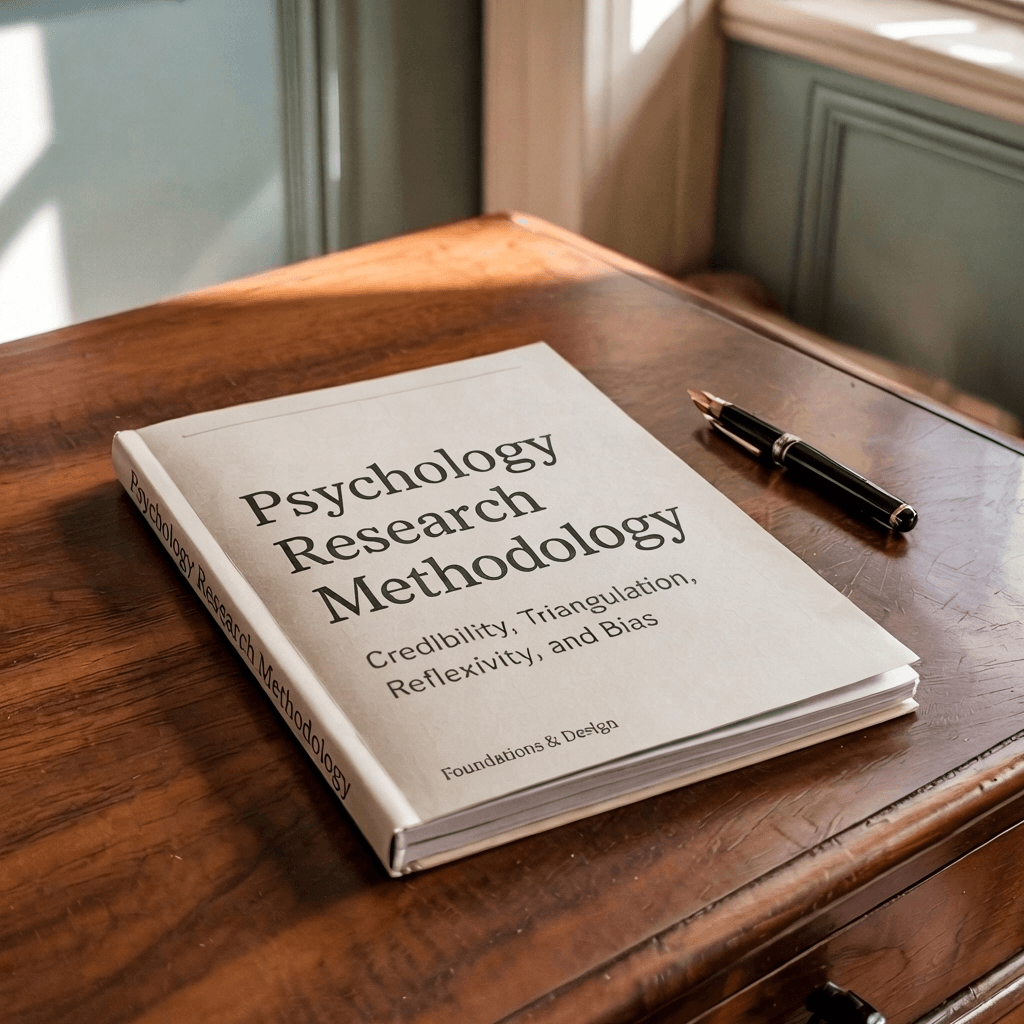
Credibility is about whether the findings are trustworthy and believable. Key concepts include triangulation (using multiple methods, sources, or researchers to cross-verify findings), reflexivity (the researcher acknowledging their own biases and how these might influence data collection or interpretation), member checking (sharing findings with participants to verify accuracy), and thick description (providing detailed context so readers can assess the findings' trustworthiness).
For Bias Questions
Bias is anything that systematically distorts the results. Key types include researcher bias (the researcher's expectations influencing data collection or interpretation), participant bias (social desirability, demand characteristics, or the Hawthorne effect), sampling bias (a non-representative sample that limits the validity of findings), and confirmation bias (selectively attending to data that supports existing hypotheses).
Counter-strategies include single-blind or double-blind procedures, reflexivity, standardised protocols, and using multiple researchers for data coding.
For Generalisation Questions
Generalisation asks whether findings can be applied beyond the specific study. Key concepts include transferability (whether findings from one context can be applied to another — the qualitative equivalent of generalisability), sample size and diversity (larger, more diverse samples support broader generalisation), ecological validity (whether the study setting reflects real-world conditions), and replication (whether the study could be repeated with similar results).
Five Mistakes That Cost HL Students Marks
1. Referencing studies from class. This is the most common error. Paper 3 is entirely about the stimulus. If you write "According to Milgram's study..." you're wasting time and showing the examiner you've misunderstood the task.
2. Writing bullet points instead of paragraphs. The IBO mark schemes reward coherent, structured prose. Bullet points signal a list, not an argument. Write in full paragraphs with clear topic sentences.
3. Spending too long on Question 1. Question 1 is worth 9 marks but should take 10 minutes. Question 3 is also worth 9 marks but requires significantly more depth. Students who spend 20 minutes on Q1 run out of time for Q3, which is where the higher-order marks live.
4. Giving generic answers to Question 3. "The researchers could use a bigger sample" is not enough. Specify what kind of sample, why the current sample is limiting, and how a different sample would address the specific weakness in the stimulus study. Connect every point to the scenario.
5. Forgetting to address both parts of Question 2. If the question asks about ethical considerations applied AND further considerations, you need both. Students who only describe what was done (but not what could be done) cap themselves at 3 out of 6.
A Suggested Answer Framework for Question 3
Since Question 3 carries the most analytical weight, here's a framework that consistently hits the top markband:
You might also find these guides helpful: Strategies to Handle Your Ibdp Biology Exam and The Ultimate Guide to Acing Ib Psychology Paper 3 Hl Tips and Tricks.
Opening (2-3 sentences): Identify the theme of the question and state how it applies to the study described. For example: "Credibility is a central concern in qualitative research, as it determines whether the findings can be trusted. In this study, several aspects of the methodology support credibility, while others introduce potential limitations."
Body (3-4 paragraphs): Each paragraph addresses one specific methodological concept. State the concept, define it briefly, then apply it to the stimulus material. Discuss both strengths and limitations. For a credibility question, you might address triangulation, reflexivity, and member checking, each with a direct reference to the study's design.
Closing (2-3 sentences): Summarise the overall credibility, bias risk, or generalisability of the study. Avoid introducing new points here, this is a synthesis.
This structure ensures you hit the mark scheme criteria: focused answer, accurate research terminology, direct application to the stimulus, and a balanced argument.
Why May 2026 Is Different
The current IB Psychology syllabus (first taught in 2017) is being retired. From May 2027, the new course shifts from memorisation-heavy assessment to concept-based, applied learning. Paper 3 will change significantly: it becomes a 1 hour 45 minute exam with source-based questions on HL extensions (culture, motivation, technology), including a 15-mark extended response.
For you, sitting the May 2026 exam, this means two things. First, there are nine years of past papers in the current format: more practice material than most IB subjects offer. Use it. Second, examiners marking the final session of a syllabus tend to follow established patterns closely. The question formats, mark scheme criteria, and top-markband descriptors you've practised with are exactly what you'll see.
The 10-Week Paper 3 Preparation Plan
With roughly 10 weeks until the May 2026 exams, here's how to structure your Paper 3 preparation:
Weeks 1-3: Build your methodology vocabulary. Create flashcards for every key term: credibility, triangulation, reflexivity, transferability, bias types, sampling methods, ethical considerations. You need these terms at instant recall.
Weeks 4-6: Practice two full Paper 3 responses per week under timed conditions (one hour). Use past papers from 2018-2025. After each attempt, compare your answers against the mark scheme and note which concepts you missed.
Weeks 7-9: Focus on Question 3 specifically. Write one Question 3 response per day on different themes (credibility, bias, generalisation). Time yourself to 25 minutes. Check that every paragraph connects a methodological concept to the stimulus.
Week 10: Do two full mock exams under exam conditions. Review your answers, then create a one-page summary sheet of your most-used concepts and frameworks for each question type.
How to Use This Alongside Your Other Papers
Paper 3 preparation doesn't have to be separate from Papers 1 and 2. Every study you review for Paper 1 or Paper 2 is an opportunity to practice identifying research methods, ethical considerations, and potential biases. When you read about Loftus and Palmer's eyewitness testimony research for Paper 1, ask yourself: what's the sampling method? What ethical considerations apply? Could the findings be generalised? This dual-purpose revision strengthens all three papers simultaneously.
Need targeted help with Paper 3? Our IB Psychology tutors include examiners who have marked Paper 3 responses and know exactly what the top markband requires. They can review your practice answers, identify where you're losing marks, and sharpen your analytical writing in the weeks before May.
Find Your IB Psychology Tutor →
Related: IB Psychology Subject Page | IB Exam Preparation Resources