Master Organic Chemistry: Student-Tested Concept Map for IB HL Success
Master Organic Chemistry: Student-Tested Concept Map for IB HL Success Students preparing for IB HL exams often feel overwhelmed by organic chemistry concept maps. The connections between alkenes, alcohols, benzene, and carbonyl compounds can seem like a puzzle without the full picture. Our student-tested approach turns this challenge into a manageable study system. Our resources […]
Key Takeaways
- Understanding functional groups are the foundations of any working organic chemistry concept map.
- Understanding reaction mechanisms at the molecular level helps you map organic reactions effectively.
- Your exam performance improves dramatically when you turn organic chemistry concept maps into active study tools.
Master Organic Chemistry: Student-Tested Concept Map for IB HL Success
Students preparing for IB HL exams often feel overwhelmed by organic chemistry concept maps. The connections between alkenes, alcohols, benzene, and carbonyl compounds can seem like a puzzle without the full picture. Our student-tested approach turns this challenge into a manageable study system. For more on this, see our guide on writing chemistry lab reports. (This guide has been for the 2025-26 academic year.)
Our resources feature detailed organic chemistry cheat sheets that cover topics like SN1 vs. SN2 reactions, nomenclature, and stereochemistry. On top of that, our organic chemistry notes break complex concepts into digestible sections and pair them with a study guide tailored to IB HL requirements. The organic chemistry reaction maps show how alcohols, alkenes, and alkynes transform, while the reactions chart serves as a quick reference during review sessions. This piece explains how these tools work together to build your understanding of measurement, data processing, and analysis skills—especially when you have IB HL success in mind. You may also find our resource on balancing redox reactions helpful.
Navigating AP Chemistry can feel overwhelming, especially if it's your first time. If you'd like personalised guidance from someone who's helped hundreds of AP students, our IB Chemistry tutors are here to help. Tell us what you need →
Core Functional Groups in the IB HL Concept Map
Understanding functional groups are the foundations of any working organic chemistry concept map. These unique arrangements of atoms give organic compounds their characteristic chemical and physical properties that serve as reaction centers in transformation pathways.
The alkane family, with general formula CnH2n+2, includes saturated hydrocarbons that show low reactivity. These stable compounds undergo free radical substitution that happens when they meet halogens with UV light through initiation, propagation, and termination steps.
Alkenes (CnH2n) contain carbon-carbon double bonds that easily participate in electrophilic addition reactions. The π bond breaks as electrophiles attack and forms carbocations that react with nucleophiles later. This process explains how hydrogen halides, water, and halogens add up to create complex functional groups.
The carbonyl group (C=O) shows up in many functional groups, especially in aldehydes and ketones. These compounds react through nucleophilic addition as electron-rich species attack the electrophilic carbon. Aldehydes react more than ketones because of steric and electronic factors. They have one substituent that blocks nucleophilic approach and greater polarization of the carbonyl bond.
Carboxylic acids and their derivatives (acid chlorides, anhydrides, esters, and amides) take part in nucleophilic acyl substitution reactions. The reactivity order follows: acid chlorides > anhydrides > esters > amides. This pattern relates to leaving group ability and creates a key branch in your organic chemistry study guide. Learn more in our guide on study chemistry a.
Aromatic compounds go through electrophilic aromatic substitution instead of addition to keep the stable aromatic ring. Common reactions include nitration, halogenation, sulfonation, and Friedel-Crafts alkylation or acylation.
Alcohols work as versatile intermediates that go through oxidation, dehydration, and esterification. Primary alcohols oxidize to aldehydes then carboxylic acids, while secondary alcohols create ketones.
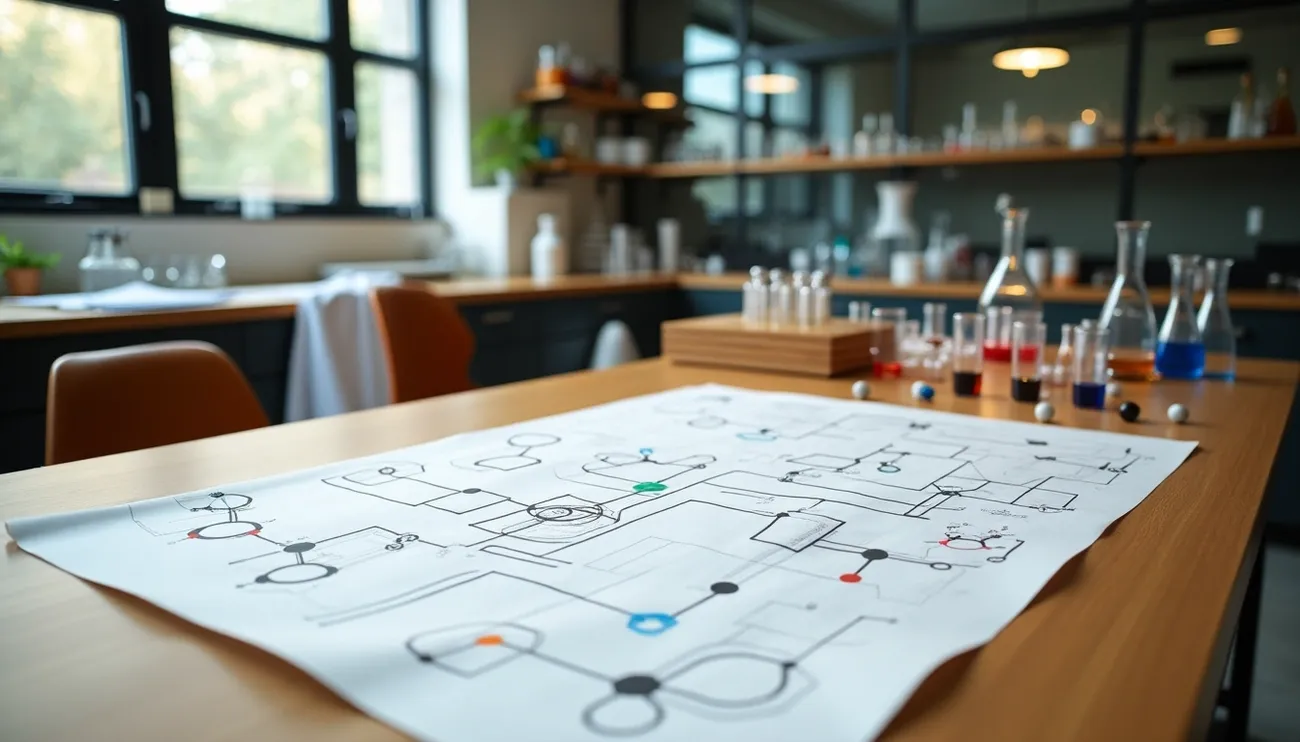
Creating an organic chemistry reactions chart that shows these transformation pathways helps visualize synthetic routes between functional groups. This visualization forms the core of a detailed IB HL concept map.
Reaction Pathways and Mechanism Mapping
Understanding reaction mechanisms at the molecular level helps you map organic reactions effectively. A powerful study tool emerges when you connect functional groups through their transformation pathways on your organic chemistry concept map. This approach reveals the underlying logic of organic synthesis. Explore our detailed guide on Le Chatelier's principle for more tips.
Nucleophilic substitution reactions have two distinct mechanisms. SN2 reactions show the nucleophile attacking from the backside of the leaving group in a single concerted step, which inverts the configuration. Both reactant concentrations determine the rate (rate = k[R-X][Nu]). SN1 reactions work differently and move through a two-step process. The carbocation formation becomes the rate-determining step (rate = k[R-X]). Your concept map should highlight how substrate structure influences mechanism choice – primary halides prefer SN2, tertiary halides favor SN1, and secondary halides can do either.
E1 and E2 pathways guide elimination reactions. E2 elimination happens in one concerted step and needs an anti-coplanar arrangement. E1 takes a different route through a carbocation intermediate. Strong bases paired with primary substrates favor E2, and tertiary substrates with weak bases promote E1.
Alcohol oxidation creates a crucial branch on your reaction map. The oxidation sequence moves from primary alcohols to aldehydes to carboxylic acids, or from secondary alcohols to ketones. Tertiary alcohols resist oxidation completely.
The Diels-Alder reaction adds cyclic connections to your map. This [4+2] cycloaddition combines a diene (4π electrons) and dienophile (2π electrons) to form a six-membered ring. The reaction works best when electron-rich dienes meet electron-poor dienophiles.
Electrophilic aromatic substitution rounds out the map based on directing effects. Electron-donating groups like -OH and -NH2 activate the ring and direct ortho/para. Electron-withdrawing groups such as -NO2 deactivate and direct meta. Halogens show unique behavior – they deactivate yet direct ortho/para due to competing electronic effects.
A unified organic chemistry concept map that connects these reaction pathways helps you visualize the transformation network. This approach makes complex IB HL organic chemistry more manageable and interconnected.
Using the Concept Map as a Study Tool
Your exam performance improves dramatically when you turn organic chemistry concept maps into active study tools. Students who used concept maps scored 5% higher on multiple choice and 10% higher on written portions of chemistry exams compared to those using standard review methods. The map’s power lies in helping students see connections between functional groups and reaction pathways.
The best way to use your concept map involves vertical and horizontal movement strategies. Vertical movements show transformations where carbon oxidation numbers shift from -4 to +4, suggesting oxidation processes that need specific reagents. You’ll find horizontal movements trace transformations where oxidation numbers stay the same but functional groups change, like turning an alkyl halide into an alcohol.
The sort of thing I love about synthesis practice is treating functional groups like cities on a map with reactions as roads between them. You can spot “busy” functional groups (like ketones) that link to multiple pathways and “one-horse towns” with limited connections. This approach helps reshape abstract reaction sequences into visual trips.
Our reaction maps PDF has 27 detailed maps that cover essential reaction webs and active links to mechanisms for each transformation. Students with eye strain from compressed versions will appreciate the four-quadrant format that allows 200% expansion without losing important information.
Students get better results from making their own concept maps than using pre-made versions. One instructor puts it well: “your personal concept map beats any fancy concept map that you can find in textbooks”. Making your own map pushes you to involve yourself with the material more deeply.
Concept maps do more than help memorization – they promote meaningful learning by requiring students to:
- Identify important concepts
- Show interconnections between reactions
- Think multidirectionally about synthetic pathways
- Visualize transformation networks
These tools work best with your organic chemistry study guide and reaction charts to prepare thoroughly for IB HL exams.
If this is feeling like a lot to take in, that's completely normal. Many students find it helpful to work with an experienced AP tutor who can provide clarity tailored to their situation. Get in touch →
Conclusion
This piece explores how concept mapping reshapes complex organic chemistry into a manageable system that leads to IB HL success. Visual tools connect functional groups through reaction pathways. These tools create a complete framework that mirrors organic chemistry’s natural logic.
Functional groups are without doubt the foundations of your concept map. They act as anchors where reaction mechanisms attach themselves. Primary, secondary, and tertiary substrates follow predictable patterns when they meet nucleophiles or bases. You can predict products once you know these patterns instead of memorizing countless individual reactions.
Students who use concept maps score by a lot higher on both multiple-choice and written exam portions – research makes this clear. Concept maps help turn isolated facts into connected knowledge networks, which explains this advantage.
The four-quadrant format works perfectly with IB HL requirements. It offers both complete coverage and practical use. Notwithstanding that, the most powerful concept map will be the one you create yourself. Building connections between functional groups makes you think deeper about the material. This beats passive review every time.
Concept mapping builds critical thinking skills you need to succeed in IB. These maps teach you to think like an organic chemist. You learn to see multiple pathways between starting materials and products while grasping why these transformations happen.
Your concept map should be more than just a study tool as you get ready for IB HL exams. It’s a powerful thinking tool that clarifies how beautifully organic chemistry connects. Of course, this approach helps turn what many students find overwhelming into a logical, manageable system that leads to exam success.
References
[1] – https://chem.libretexts.org/Bookshelves/Organic_Chemistry/Map%3A_Organic_Chemistry_(Wade)_Complete_and_Semesters_I_and_II/Map%3A_Organic_Chemistry_(Wade)/07%3A_Alkyl_Halides-_Nucleophilic_Substitution_and_Elimination/7.12%3A_Comparison_of_SN1_and_SN2_Reactions
[2] – https://ecampusontario.pressbooks.pub/mcmasterchem1aa3/chapter/3-1-4-sn1-vs-sn2/
[3] – https://chem.libretexts.org/Bookshelves/Organic_Chemistry/Map%3A_Organic_Chemistry_(Wade)_Complete_and_Semesters_I_and_II/Map%3A_Organic_Chemistry_(Wade)/07%3A_Alkyl_Halides-_Nucleophilic_Substitution_and_Elimination/7.18%3A_Comparison_of_E1_and_E2_Reactions
[4] – https://chemistrytalk.org/e1-vs-e2/
[5] – https://chem.libretexts.org/Bookshelves/Organic_Chemistry/Organic_Chemistry_(Morsch_et_al.)/17%3A_Alcohols_and_Phenols/17.07%3A_Oxidation_of_Alcohols
[6] – https://pmc.ncbi.nlm.nih.gov/articles/PMC9298865/
[7] – https://www.masterorganicchemistry.com/2017/08/30/the-diels-alder-reaction/
[8] – https://chem.libretexts.org/Bookshelves/General_Chemistry/Book%3A_Structure_and_Reactivity_in_Organic_Biological_and_Inorganic_Chemistry_(Schaller)/IV%3A__Reactivity_in_Organic_Biological_and_Inorganic_Chemistry_2/07%3A_Electrophilic_Aromatic_Substitution/7.04%3A_Activation_and_Deactivation
[9] – https://en.wikipedia.org/wiki/Electrophilic_aromatic_directing_groups
[10] – https://www.chemedx.org/blog/concept-mapping-chemistry
[11] – https://www.researchgate.net/publication/228634487_Using_concept_maps_in_teaching_organic_chemical_reactions
[12] – https://acta-arhiv.chem-soc.si/52/52-4-471.pdf
[13] – https://www.masterorganicchemistry.com/2012/05/07/organic-chemistry-study-tips-reaction-maps/
[14] – https://www.masterorganicchemistry.com/2021/11/09/reaction-maps-now-available/
[15] – https://chemistryguru.com.sg/organic-chemistry-concept-map
Need Personalised Guidance?
Every student's situation is different. Our tutors can help you understand your options, plan your next steps, and make informed decisions about your AP journey. Find your tutor →
Frequently Asked Questions
What are the best resources for IB Chemistry revision?
Top resources include the Oxford/Pearson textbook, past paper question banks, the IB Chemistry data booklet, and online platforms. Combine textbook reading with active practice for the best results.
How is the IB Chemistry exam structured?
IB Chemistry has three papers: Paper 1 (multiple choice), Paper 2 (structured/extended response), and Paper 3 (data-based and option questions for HL). Each paper tests different skills and knowledge areas.
What grade do I need in IB Chemistry for university?
Requirements vary by university and program. Most competitive science programs expect a 6 or 7 at HL, while SL scores of 5-6 are typically sufficient for non-science programs.
How do I balance IB Chemistry with other subjects?
Create a weekly study schedule that allocates specific time blocks for each subject. Use active recall and spaced repetition for Chemistry to maximize retention without spending excessive time on any single topic.