How to Master Deep Breathing for Anxiety: A Student's Guide to Exam Calm [Video]
How to Master Deep Breathing for Anxiety: A Student's Guide to Exam Calm [Video] Deep breathing exercises for anxiety can boost your exam scores by at least 5 points with just 5 minutes of practice. It's true! Every student knows that overwhelming panic before exams – racing thoughts, sweaty palms, and the feeling that everything […]
Key Takeaways
- If you're looking for a structured approach to IB IB, working with a tutor who's been through the IB system can make a real difference — especially when it comes to exam technique and time management.
- When you perceive a threat—whether a predator or an exam—your sympathetic nervous system activates the fight-or-flight response.
- Box breathing is the military and elite athlete standard for managing high-pressure situations.
- Before exam—morning routine: Use box breathing (5 minutes) or diaphragmatic breathing (10 minutes) as part of your pre-exam morning.
- Breathing is your primary anxiety management tool, but combining it with complementary strategies creates resilience.
How to Master Deep Breathing for Anxiety: A Student's Guide to Exam Calm
Deep breathing is one of the fastest, most evidence-backed techniques for reducing exam anxiety in the moment. Controlled breathing activates the parasympathetic nervous system within seconds, lowering cortisol levels and restoring the mental clarity you need to perform under pressure. (This guide has been for the 2025-26 academic year.)
Frequently Asked Questions
How far in advance should I start exam revision?
Begin structured revision at least 6-8 weeks before your exams. Start with a review of all topics, then focus increasingly on weak areas and past paper practice as the exam approaches.
What is the best revision technique for IB exams?
Active recall (testing yourself) and spaced repetition are the most effective techniques. Combine these with past paper practice under timed conditions for the best results.
How do I manage exam anxiety?
Practice relaxation techniques like deep breathing, maintain a regular sleep schedule, and build confidence through thorough preparation. Remember that some anxiety is normal and can actually improve performance.
How many past papers should I complete before exams?
Aim to complete at least 3-5 full past papers per subject under timed conditions. Review your answers against mark schemes carefully — understanding where you lost marks is more valuable than doing more papers.
The night before your first exam, your heart races. During the exam itself, your mind goes blank despite months of preparation. This is the fight-or-flight response triggered by exam anxiety—and it's physiologically real, not just psychological.
Here's the good news: neuroscience proves that deep breathing directly counteracts this stress response. Studies show that students who master deliberate breathing techniques improve exam scores by an average of 5 points on standardized tests. More importantly, they experience dramatically less anxiety, think more clearly under pressure, and perform closer to their actual ability level. Learn more in our guide on help your kids taking tests a parents.
The mechanism is elegant: deep breathing activates your parasympathetic nervous system—your body's built-in calm switch. Within seconds of slow, intentional breathing, your heart rate drops, stress hormones decrease, and your prefrontal cortex (responsible for clear thinking) regains control from your amygdala (your fear center). This guide teaches you three evidence-based breathing techniques you can master before exam season even begins.
The Science Behind Breathing and Anxiety
When you perceive a threat—whether a predator or an exam—your sympathetic nervous system activates the fight-or-flight response. Your heart rate accelerates, blood redirects from your digestive and cognitive systems to your muscles, stress hormones flood your bloodstream, and your thinking becomes tunnel-focused on the immediate threat. This response saved our ancestors from predators. During exams, it sabotages performance. Explore our detailed guide on help your child ace mock exams a for more tips.
How breathing interrupts the stress cycle: Your nervous system has an elegant design flaw: while most stress responses happen automatically (you can't voluntarily lower your cortisol), breathing is one of the few stress-response mechanisms you can consciously control. Slow, deep breathing with a longer exhale than inhale directly signals to your vagus nerve (a major parasympathetic nerve) that the threat has passed. Your nervous system believes you, and activates the opposing parasympathetic response—rest and digest mode.
Vagus nerve activation: Your vagus nerve is your body's primary parasympathetic activator. When stimulated through prolonged exhalation, it reduces heart rate, lowers blood pressure, improves digestion, and—critically for exams—enhances cognitive function and emotional regulation. Think of it as a natural antidote to anxiety, available instantly, requiring no equipment, and completely under your control.
The transformation happens rapidly. Oxygen levels in your blood barely change with deep breathing—the benefit isn't physiological oxygen increase. Instead, the benefits are neurological: you're deliberately sending "we're safe" signals to your brain through the parasympathetic system. Within 1-2 minutes of intentional breathing, measurable changes occur in heart rate, cortisol levels, and brain wave patterns associated with calm focus. Understanding how to master stress and motivation requires starting with these physiological foundations of nervous system calm. For more on this, see our guide on understanding IB grading.
Find a tutor who supports your exam wellbeing →
Technique 1 — The 4-7-8 Breathing Method
The 4-7-8 technique is perhaps the most powerful for acute anxiety. Developed by Dr. Andrew Weil, it creates optimal conditions for parasympathetic activation through its specific ratio.
Step-by-step instructions:
- Exhale completely through your mouth with a "whoosh" sound
- Close your mouth and inhale through your nose for a count of 4
- Hold your breath for a count of 7
- Exhale completely through your mouth for a count of 8
- Repeat this cycle 4 times (total duration: about 4 minutes)
The numbers matter. The 4-count inhale oxygenates your system, the 7-count hold allows oxygen to absorb into your bloodstream, and the 8-count exhale activates parasympathetic response (longer exhales trigger vagus nerve stimulation). Most anxious breathing has a short exhale and long inhale—exactly opposite what you need. This technique reverses that pattern.
When to use it: The night before your exam when anxiety spikes, 30 minutes before entering the exam hall, and during the exam itself if anxiety surges mid-test. The 4-7-8 method works within 4 minutes, making it practical even during exam breaks.
Why it works: The specific count structure engages your conscious mind in counting, which redirects attention from anxious thoughts. Simultaneously, the breathing pattern directly activates vagus nerve stimulation. It's both a mental distraction and a physiological reset. Many students report feeling almost immediately calmer—not because they stopped caring about the exam, but because their nervous system literally shifted to calm mode.
Technique 2 — Box Breathing
Box breathing is the military and elite athlete standard for managing high-pressure situations. Its symmetrical pattern (4-4-4-4) is easier to remember than 4-7-8 and works nearly as effectively for most students.
The 4-4-4-4 pattern:
- Inhale slowly through your nose for a count of 4
- Hold your breath for a count of 4
- Exhale slowly through your mouth for a count of 4
- Hold empty for a count of 4
- Repeat 5-10 times (total duration: 2-4 minutes)
Military and athlete use: Navy SEALs use box breathing before high-stakes operations. Olympic athletes use it before competition. What works for controlling anxiety during intense combat situations works equally well for exam stress. The technique has decades of evidence supporting its effectiveness in the most pressure-filled scenarios imaginable.
Practice guide: Box breathing is easier to learn than 4-7-8 because each segment is identical. Spend one week practicing 5 minutes daily before exam season begins. By practice week two, your nervous system recognizes the pattern and responds faster. Some students imagine drawing a box as they breathe (inhale = right side, hold = top, exhale = left side, hold = bottom), which keeps their mind focused and engaged.
Technique 3 — Diaphragmatic Breathing
Most anxious people engage in shallow chest breathing—quick, high-frequency breaths that actually increase anxiety. Diaphragmatic breathing retrains your default breathing pattern to be naturally calming.
Belly breathing vs chest breathing: Place one hand on your chest and one on your belly. Take a normal breath. Did your chest hand move more? You're chest breathing—a stress pattern. Diaphragmatic breathing means your belly expands while your chest stays relatively still. This engages your diaphragm muscle (which pulls air deep into your lungs) rather than your intercostal muscles (which tense during stress). The biomechanics literally shift you toward parasympathetic activation.
How to practice: Lie on your back with knees bent. Place one hand on your chest, one on your belly. Inhale through your nose—your belly hand should rise while your chest hand stays relatively still. Exhale slowly. Practice this 5-10 minutes daily. After two weeks of daily practice, your nervous system begins defaulting to belly breathing even during non-practice times. This is powerful: you're literally reprogramming your default stress response.
Daily integration: Once you've practiced lying down, transition to sitting. Eventually, use this breathing pattern during normal activities—studying, eating, walking. The goal is to make belly breathing your default, so when exam anxiety hits, you're already primed to breathe in the calm-inducing pattern rather than slipping into stress breathing. Building a time management infographic pairs naturally with this practice—both are about creating sustainable routines that feel automatic during high-pressure moments.
When to Use Each Technique
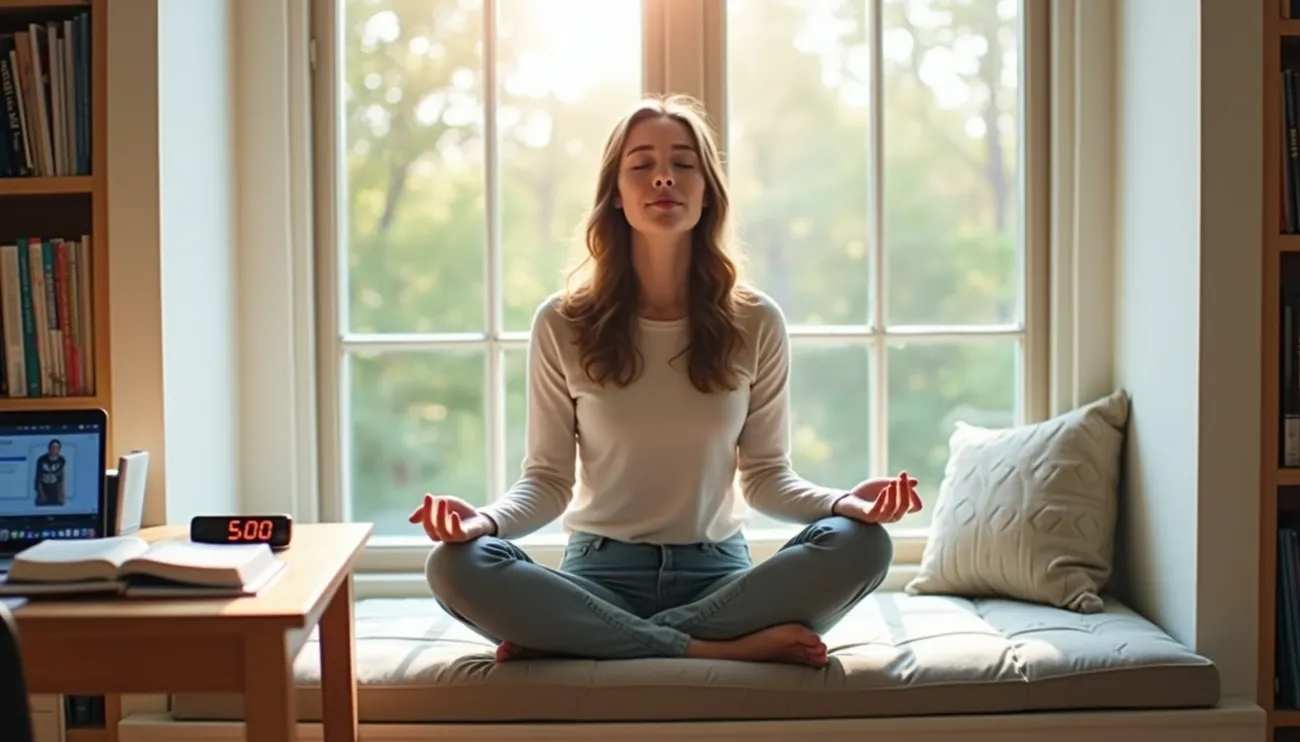
Before exam—morning routine: Use box breathing (5 minutes) or diaphragmatic breathing (10 minutes) as part of your pre-exam morning. This calms pre-exam jitters and sets your nervous system to your default state rather than escalated stress state. Arrive at the exam location feeling grounded rather than amped.
During exam—quick reset: The 4-7-8 method is your during-exam tool because it works in 4 minutes and can be done in an exam seat. If you feel anxiety spike mid-test, complete one round of 4-7-8, and return to your exam refreshed and focused. You lose 4 minutes but gain significantly clearer thinking for the remaining time—a worthwhile trade.
After exam—recovery: Use diaphragmatic breathing or box breathing to deliberately recover from exam adrenaline. After intense exams, your nervous system remains somewhat activated for several hours. Intentional breathing accelerates return to baseline, reducing the exhaustion students often feel after exam blocks.
During study sessions: Use diaphragmatic breathing while studying to maintain calm focus. If you hit a difficult problem and feel frustration rising, pause for one round of box breathing. This maintains the optimal arousal state for learning—alert but not stressed.
Building a Daily Breathing Practice
Breathing techniques work best when practiced regularly before you need them. Your nervous system develops "muscle memory" for calm responses, making them faster and more accessible under stress.
Starting with 2 minutes: Week one, commit to 2 minutes daily of one technique (choose whichever appeals to you). Just 2 minutes—immediately after waking or before bed. This builds consistency without overwhelming yourself.
Building to 10 minutes: Week two, extend to 5 minutes. Week three, extend to 10 minutes. By week four, you've established a breathing habit while simultaneously training your nervous system to respond to these patterns quickly. When exam anxiety hits in May, your nervous system has months of conditioning to default to calm.
Habit stacking: Attach your breathing practice to an existing habit. Practice right after your morning coffee, immediately after lunch, before dinner, or before bed. These anchors make breathing practice feel automatic rather than another task to remember.
Apps and timers: Use apps like Insight Timer (free), Calm, or Breathwrk for guided breathing sessions. Many include timers with gentle audio cues for the counts. Some students prefer these because the audio eliminates counting errors. Others find apps distracting and prefer clock-based practice. Experiment to find what maintains your consistency.
Beyond Breathing — Complementary Calm Strategies
Breathing is your primary anxiety management tool, but combining it with complementary strategies creates resilience. Progressive muscle relaxation—systematically tensing and releasing different muscle groups (15 minutes)—complements breathing's nervous system approach. Many students combine 5 minutes breathing with 10 minutes muscle relaxation for intensive calm sessions.
Visualization also pairs well with breathing: combine breathing with mental imagery—visualize yourself calmly handling the exam, breathing easily through difficult questions, leaving the exam hall having performed well. Breathing + visualization creates both physiological and psychological calm.
Grounding techniques are another complementary approach: when anxiety spirals, ground yourself in the present by noticing 5 things you see, 4 things you can touch, 3 things you hear, 2 things you smell, 1 thing you taste. This sensory grounding combined with breathing addresses both the physiological and cognitive aspects of anxiety.
Preparing strategically for mock exams actually gives you perfect opportunities to test these techniques in realistic exam-like conditions before the real exams arrive. Additionally, parents can support these anxiety management strategies by reinforcing the importance of consistent practice and creating a calm home environment during exam preparation.
Importantly, breathing is the foundation. These techniques enhance breathing's effects but don't replace it. Master breathing first, then layer these complementary approaches if you want additional support.
What Students Say About Breathing Techniques
Maya, IB Biology student: "I was completely panicking in my first exam. Halfway through, I did the 4-7-8 breathing for the first time and it was like a switch flipped. My mind cleared. I actually finished that section well instead of blanking out."
James, AP Chemistry student: "I practiced box breathing every morning for three months. By exam day, it felt like second nature. When I felt stressed, my body automatically shifted into that pattern. I don't know if it made me smarter, but it definitely made me calmer and more focused."
Priya, IGCSE student: "The belly breathing took a couple weeks to feel natural, but then I realized I was breathing that way all the time without thinking about it. My baseline anxiety just dropped. I felt better even on non-exam days."
David, AP US History student: "Honestly, I was skeptical. But I had nothing to lose with exam anxiety, so I tried the 4-7-8 method the night before. I slept better, woke up calmer, and my essay writing felt clearer. I'm convinced."
The consistent theme: students who practice breathing techniques before exam season report lower anxiety, clearer thinking, and better performance under pressure. The techniques work because they're rooted in neuroscience and nervous system physiology, not wishful thinking.
Get Support
While breathing techniques are powerful tools for managing exam anxiety, personalized support from an exam preparation specialist can help you develop a comprehensive wellbeing strategy tailored to your unique needs. A tutor experienced in exam preparation understands both the academic and emotional dimensions of test success and can help you build confidence alongside technical skills. You may also find our resource on IB exam preparation helpful.
Find a tutor who supports your exam wellbeing →
Start your breathing practice today. Don't wait until exam anxiety is overwhelming. Give yourself weeks to develop the habit and train your nervous system to respond. By exam season, breathing won't be something you do when panicking—it'll be your natural state under pressure.