Online vs In-Person Tutoring: Which Is Better for IB and AP Students?
For IB and AP students in 2026, online tutoring is as effective as in-person tutoring, and in most cases more practical. The research is clear: one-to-one tutor...
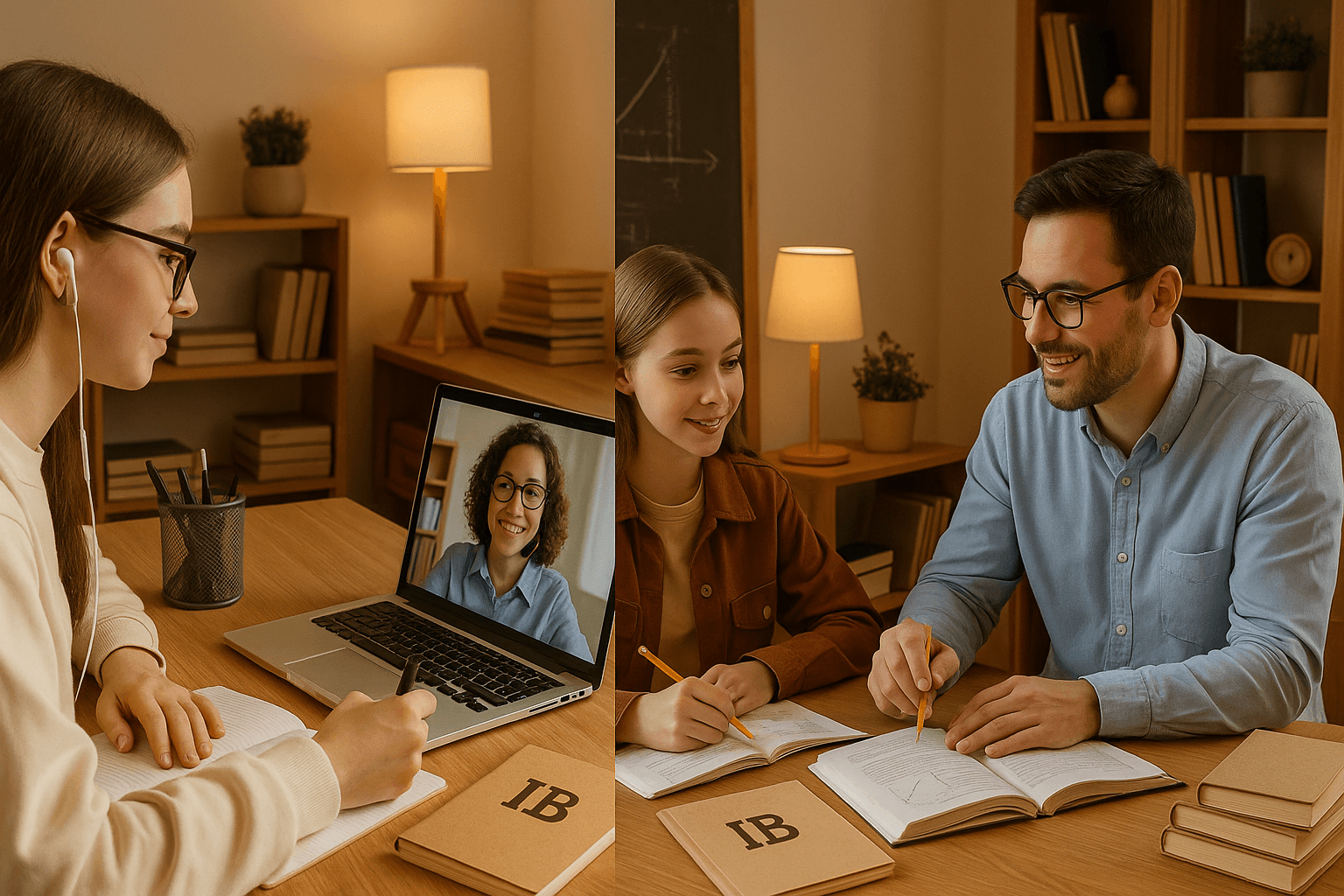
For IB and AP students in 2026, online tutoring is as effective as in-person tutoring, and in most cases more practical. The research is clear: one-to-one tutoring outcomes depend on the quality of the tutor, the consistency of sessions, and the student's engagement between sessions, not whether the tutor is physically in the room. Online tutoring wins on access to specialist tutors, scheduling flexibility, and cost. In-person wins on accountability for students who struggle to focus on screen.
Key Takeaways
- Academic outcomes are equivalent for online and in-person one-to-one tutoring for students aged 16+
- Online tutoring provides access to IB examiners and AP readers worldwide, which is the decisive advantage for specialist subjects
- Online is typically 10-20% cheaper than in-person because there is no travel time or venue cost
- In-person may be better for younger students or those with significant attention difficulties
- Most IB and AP students (ages 16-18) focus equally well in both formats
Ready to try online tutoring? Get matched with a specialist tutor in 24 hours.
The Evidence: Online vs In-Person Results
Multiple meta-analyses of tutoring research confirm that the delivery format (online vs in-person) is not a significant predictor of academic outcomes. What matters is the quality of instruction, the tutor-student relationship, and the frequency of sessions.
For IB and AP students specifically, online tutoring has an additional structural advantage: it dramatically expands the pool of available tutors. An IB Physics HL examiner in London can tutor a student in Dubai, Singapore, or Toronto just as effectively as someone sitting across the table. For specialist subjects where qualified tutors are scarce locally, this is not a nice-to-have; it is the difference between getting a qualified tutor and settling for someone generic.
Where Online Tutoring Excels
Access to Specialist Tutors
This is the single biggest advantage. IB examiners, AP readers, and experienced curriculum-specific teachers are spread across the world. If you limit your search to in-person tutors within commuting distance, you are working with a fraction of the available talent. Online removes that constraint entirely.
For subjects like IB Maths AA HL, IB Economics HL, AP Physics C, or AP Calculus BC, the number of truly qualified tutors in any single city is small. Online makes the global pool accessible.
Scheduling Flexibility
IB and AP students have packed schedules: six subjects, extracurriculars, CAS (IB), standardised test prep, and personal commitments. Online sessions are easier to schedule because there is no travel time for either party. If a session needs to be rescheduled, finding an alternative slot is simpler.
Session Recording
Most online tutoring platforms allow sessions to be recorded. Your child can rewatch a complex calculus explanation, review an essay feedback session, or revisit an IA guidance discussion during revision. This is a significant study resource that in-person tutoring cannot match.
Cost
Online tutors typically charge 10-20% less than equivalent in-person tutors because they have no travel time, no venue costs, and can serve students across time zones efficiently. For families investing in 10-20 hours of tutoring, this difference adds up.
Technology Tools
Shared whiteboards, screen sharing, document annotation, and collaborative editing tools make online sessions highly interactive. For subjects that involve diagrams (Biology, Physics, Economics), code (Computer Science), or essay feedback (History, English), these tools can be more efficient than pen and paper.
Where In-Person Tutoring Has an Edge
Accountability and Focus
Some students find it harder to concentrate on screen than in person. This is more common with younger students (under 16) or students with diagnosed attention difficulties. If your child consistently zones out during video calls with teachers, in-person tutoring may produce better results.
For most IB and AP students (ages 16-18), this is not a significant issue. They are accustomed to screen-based learning and can maintain focus during a 60-90 minute one-to-one session.
Hands-On Subjects
For subjects with a significant practical component (IB Group 4 sciences with lab work, for example), in-person tutoring allows hands-on demonstration. However, most IB science tutoring focuses on theory, exam technique, and IA support rather than lab skills, so this advantage is narrower than it appears.
Relationship Building
Some students build rapport more easily in person. The informal moments before and after a session, the body language cues, and the shared physical space can help build trust. For students who are shy or reluctant about tutoring, an initial in-person session may ease the transition.
Unsure which format suits your child? Talk to our Client Success Manager for personalised advice.
A Side-by-Side Comparison
| Factor | Online | In-Person |
|---|---|---|
| Tutor quality/access | Global pool of specialists | Limited to local area |
| Cost per hour | $40-$130 | $50-$150 + travel |
| Scheduling ease | High | Moderate |
| Session recording | Usually available | Not available |
| Student focus (ages 16-18) | Equivalent for most | Slightly better for some |
| IA/essay feedback | Screen annotation (efficient) | Paper markup |
| Travel time | None | 15-60 min each way |
| Hands-on work | Limited | Possible |
| Technology tools | Whiteboards, screen share, collab docs | Physical whiteboard, paper |
What the Format Does Not Change
Regardless of whether tutoring is online or in-person, the following factors determine outcomes:
Tutor quality. A specialist IB examiner will outperform a general tutor in either format. Always prioritise qualifications and IB/AP experience over delivery method.
Session frequency and consistency. Weekly sessions with homework between them produce better results than sporadic sessions in either format. Consistency matters more than intensity.
Student engagement. A student who actively participates, asks questions, and completes assigned practice will improve. A passive student will not, regardless of format.
Clear goals. Tutoring works best when everyone (parent, student, tutor) agrees on what success looks like: a specific grade target, an IA mark, or a score on a practice paper.
Our Recommendation
For most IB and AP students, we recommend online tutoring as the default, primarily because of access to specialist tutors. The quality of the tutor matters more than the format, and online gives you the widest selection.
Consider in-person if your child is under 16, has significant attention difficulties on screen, or specifically prefers a physical tutoring environment. Even then, try one or two online sessions first; many parents are surprised by how well their child engages.
At ++tutors, all our tutoring is delivered online. See how our matching process works, or read our guide on whether online IB tutoring works.
Frequently Asked Questions
Is online tutoring as effective as in-person?
Yes, for students aged 16 and above. Research consistently shows that one-to-one tutoring outcomes depend on tutor quality and session consistency, not delivery format. Online tutoring has the additional advantage of access to specialist tutors worldwide.
What equipment does my child need for online tutoring?
A laptop or desktop with a webcam, microphone, and stable internet connection. A second screen or tablet can be helpful for referencing materials during sessions but is not required. Most platforms run in a web browser.
Can my child switch between online and in-person?
If your tutor offers both formats, yes. However, most specialist IB and AP tutors work exclusively online because it allows them to serve students globally. Switching tutors mid-engagement to change format is possible but means rebuilding the tutor-student relationship.
Is online tutoring cheaper than in-person?
Typically 10-20% cheaper per hour, because online tutors have no travel time or venue costs. Over a 10-15 hour engagement, this can save $100-$300.
Find Your Online Tutor in 24 Hours
Get matched with a certified IB examiner or AP teacher tailored to your subject, level, and schedule. 4.9★ rated by 500+ students. Money-back guarantee.
Get Matched Now →