IB Chemistry Tutor: How to Find Expert Help for HL and SL
IB Chemistry consistently ranks among the hardest IB subjects, with a global average grade of approximately 4.5 out of 7. The gap between HL and SL is substanti...
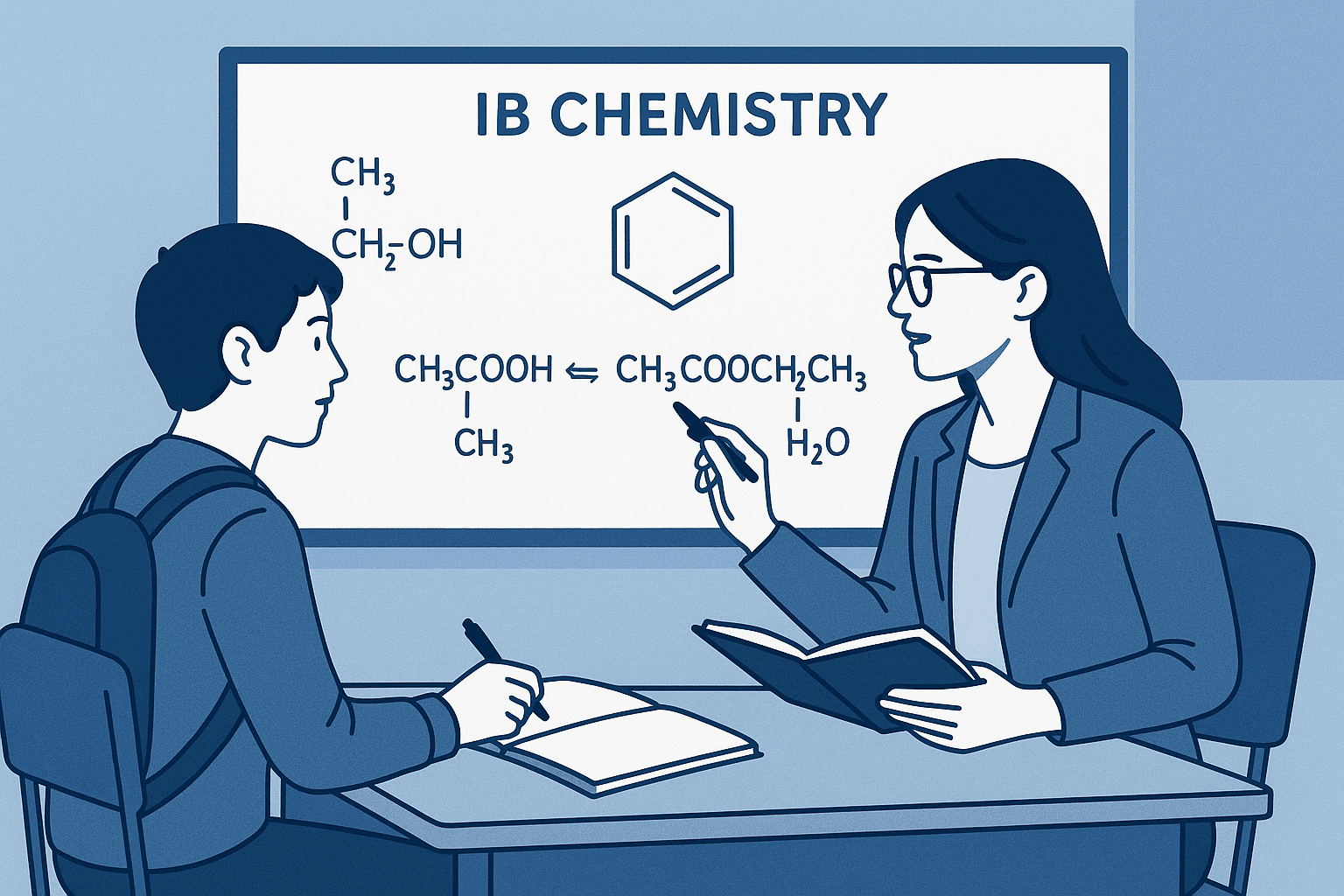
IB Chemistry consistently ranks among the hardest IB subjects, with a global average grade of approximately 4.5 out of 7. The gap between HL and SL is substantial: HL adds organic chemistry, spectroscopy, and deeper kinetics and thermodynamics content that many students find overwhelming. Finding a tutor who knows the IB Chemistry mark scheme, not just the chemistry, is what separates students who improve rapidly from those who plateau.
(This guide has been updated for the 2025-26 academic year.)
Key Takeaways
- IB Chemistry has one of the lowest average grades in the Diploma Programme, making it one of the most common subjects students seek tutoring for.
- The Internal Assessment counts for 20% of the final grade, and most marks are lost on methodology, analysis, and evaluation rather than the chemistry itself.
- HL students need a tutor comfortable with organic chemistry, spectroscopy, acids and bases equilibria, and electrochemistry, as these are the most challenging HL-only topics.
- An IB examiner-tutor can identify mark scheme patterns that classroom teachers often miss, particularly for Paper 2 extended response and Paper 3 option questions.
Why IB Chemistry Is One of the Hardest IB Subjects
Three factors make IB Chemistry uniquely difficult. First, the content volume: HL Chemistry covers 21 topics across 11 core chapters plus additional HL material, with an option topic on top. Students must master quantitative problem-solving (stoichiometry, equilibrium calculations, thermodynamics) alongside conceptual understanding (bonding, periodicity, organic reaction mechanisms).
Second, the HL/SL difficulty gap is one of the largest in any IB science. SL Chemistry is manageable for most students who keep up with the pace. HL Chemistry adds topics like organic chemistry reaction pathways, spectroscopic identification (IR, mass spec, 1H NMR), detailed acid-base equilibria, and electrochemical cells. These topics require significant additional study time and a tutor who can explain them at a conceptual level, not just procedurally.
Third, the exam format punishes vague understanding. Paper 2 extended response questions and Paper 3 data-based questions require students to apply knowledge to unfamiliar contexts, use IB-specific command terms precisely ("deduce" is not the same as "explain"), and show working in a format the mark scheme rewards.
The combination of high content volume, a steep HL curve, and exam technique requirements is why IB Chemistry tutoring demand is consistently among the highest of all IB subjects. At ++tutors, our Chemistry tutors are certified IB examiners who have marked thousands of papers and IAs. They know exactly where students lose marks and how to fix it. Get matched with an IB Chemistry specialist.
What an IB Chemistry Tutor Actually Does
Effective IB Chemistry tutoring goes beyond explaining reactions and equations. Here is what a specialist tutor focuses on:
Exam technique: Teaching students how to structure extended response answers, interpret command terms, and allocate time across papers. An examiner-tutor knows that a 6-mark Paper 2 question has a specific mark allocation (often 1 mark per point with a maximum of 6 distinct points), and they train students to hit every mark efficiently.
IA support: The Internal Assessment is worth 20% of the final grade. Most marks are lost not on the chemistry but on the methodology (research question clarity, variable control, data collection design), analysis (appropriate use of uncertainties, graphical representation), and evaluation (realistic assessment of limitations and improvements). A tutor who has marked IAs knows the difference between a 15/24 IA and a 22/24 IA.
Past paper practice: Working through real IB Chemistry past papers under timed conditions, with the tutor providing examiner-level feedback. This includes identifying question types (calculation, explanation, data analysis), recognising common traps, and building the speed needed to finish papers on time.
Closing specific knowledge gaps: Rather than re-teaching the entire syllabus, a good tutor diagnoses which topics cause the most mark loss and targets those directly. For many students, this means focusing on stoichiometry, electrochemistry, and organic chemistry rather than reviewing topics they already understand.
IB Chemistry HL Tutoring: What to Focus On
HL Chemistry students face three topics that cause the most difficulty:
Organic Chemistry (Topic 20): Reaction mechanisms, functional group transformations, and synthesis pathways. Students need to learn reaction sequences (not just individual reactions) and predict products from multi-step syntheses. This requires a tutor who can teach the logic behind organic chemistry, not just memorisation of reactions.
Acids and Bases (Topic 18): Buffer calculations, pH curves, titration analysis, and Ka/Kb equilibrium expressions. These calculations are among the most mathematically demanding in the course and require confident algebraic skills alongside chemical understanding.
Electrochemistry (Topic 19): Voltaic and electrolytic cells, standard electrode potentials, and Faraday's laws. Students frequently confuse the direction of electron flow, the sign conventions for electrodes, and the conditions under which cells are spontaneous.
Additionally, HL Paper 3 includes an option topic. Your tutor should know which option your school has chosen (Medicinal Chemistry, Materials, Biochemistry, or Energy) and be prepared to cover it. Not all tutors are equally strong across all options, so confirm this during the selection process.
If your child is working through HL topics and finding the material overwhelming, that is completely normal. IB Chemistry HL is designed to challenge university-bound science students. The right tutor turns confusion into clarity by breaking complex topics into manageable steps and connecting them to exam technique. At ++tutors, your tutor will build a targeted study plan around your child's weakest HL areas. Find your IB Chemistry tutor now.
IB Chemistry SL Tutoring: Key Areas
SL Chemistry covers fewer topics but still demands precision. The areas where SL students most commonly lose marks are:
Stoichiometry and balancing equations (Topic 1): This is the foundation of everything in chemistry. Weak stoichiometry skills cascade into errors across nearly every other topic. If your child struggles with mole calculations, limiting reagent problems, or solution concentration, this is where tutoring should start.
Energetics (Topic 5): SL covers enthalpy changes, Hess's Law, and bond enthalpy calculations. The HL version adds entropy and Gibbs free energy. SL students need to be confident with energy cycle diagrams and calculation methods, as these appear frequently on Paper 2.
Data-based questions (Paper 2): SL Paper 2 includes data-based questions that test the ability to interpret experimental data, draw conclusions, and identify sources of error. These questions require careful reading and structured responses, not just chemical knowledge.
The IB Chemistry Internal Assessment: Why You Need Specialist Help
The Chemistry IA is worth 20% of the final grade and is where the most marks are lost unnecessarily. Based on examiner reports, the most common IA mistakes are:
- Vague research questions: "How does concentration affect rate of reaction?" is too broad. Examiners reward specific, measurable questions with clearly defined variables.
- Poor methodology justification: Students describe what they did but not why. The mark scheme rewards justification of equipment choices, trial numbers, and controlled variable management.
- Inadequate uncertainty analysis: Many students report percentage uncertainty for individual measurements but fail to propagate uncertainties through calculations or discuss their significance in the evaluation.
- Superficial evaluation: Writing "human error" as a limitation earns zero marks. Examiners want specific, realistic limitations tied to the methodology, with concrete improvements that would actually change the outcome.
An IB Chemistry examiner-tutor has marked hundreds of IAs and knows exactly what separates each markband. They can review your child's IA draft and identify mark-losing errors before submission. For topic ideas that examiners respond well to, see our IB Chemistry IA topics guide.
Questions to Ask an IB Chemistry Tutor
Before hiring, ask these questions to verify genuine IB Chemistry expertise:
- Have you marked IB Chemistry IAs as an examiner? IA marking experience is the single best indicator of whether a tutor can provide targeted IA feedback.
- Which option topic are you strongest in? If your school studies Medicinal Chemistry and the tutor's strength is Biochemistry, the match may not be ideal for Paper 3 preparation.
- How do you track progress between sessions? Look for tutors who use diagnostic assessments, past paper scores, or topic checklists rather than simply covering whatever the student asks about each week.
For a comprehensive guide to evaluating IB tutors across all subjects, read our guide to finding the right IB tutor. If cost is a factor, our IB tutor cost breakdown covers what to expect at each price point.
How to Book an IB Chemistry Tutor With ++tutors
Visit our IB Chemistry tutoring page to see how we match students with Chemistry specialists. Every tutor in our network is a certified IB examiner or teacher, and our Client Success Manager handles the matching within 24 hours. You also get recorded sessions on Lesson Space, ongoing progress monitoring, and a money-back guarantee after the first session.
If your child also needs support in related sciences, explore our IB Biology tutoring and IB Physics tutoring options. Many families book tutors for multiple science subjects to ensure consistency across their IB programme.
Find Your IB Chemistry Tutor in 24 Hours
Get matched with a certified IB Chemistry examiner or teacher tailored to your child's level, option topic, and goals. 4.9-star rated by 500+ families. Money-back guarantee after the first session.
Frequently Asked Questions
How many sessions do I need to improve my IB Chemistry grade?
Most students improve by 1 grade within 8 to 12 sessions and by 2 grades within 16 to 24 sessions, depending on their starting point and consistency. IA-only support typically requires 4 to 6 focused sessions. Your tutor will assess current levels in the first session and recommend a realistic plan. For a detailed cost estimate, see our IB tutor cost guide.
Can a tutor help with my IB Chemistry IA?
Yes. IA support is the most common reason students seek IB Chemistry tutoring. An examiner-tutor can help with topic selection, research question formulation, methodology design, data analysis, and evaluation. They provide feedback against the actual IA mark scheme criteria, identifying where marks are being lost and how to recover them before final submission.
What is the difference between an IB examiner and an IB teacher as a tutor?
An IB teacher has classroom experience delivering the IB Chemistry curriculum and understands pacing, student challenges, and effective teaching methods. An IB examiner has additionally marked official IB papers and IAs, giving them direct insight into how marks are awarded and where students commonly fall short. The most effective tutors are often both: experienced IB teachers who also serve as examiners. At ++tutors, we prioritise tutors with examining experience for this reason.