How to Write an Excellent Chemistry IA: Top Chemistry IA Topics and Tips
How to Write an Excellent Chemistry IA: Top Chemistry IA Topics and Tips Did you know that the Chemistry Internal Assessment (IA) accounts for 20% of your final IB Chemistry grade? 🔬 That's right – one-fifth of your chemistry grade depends on this single project. No wonder students often feel overwhelmed when choosing their chemistry […]
Key Takeaways
- Let's dive into the exciting world of IB Chemistry IA requirements! Understanding these requirements is your first step toward creating an outstanding investigation that will impress your examiners.
- Ready to embark on an exciting journey of selecting your Chemistry IA topic? This crucial decision will shape your entire investigation experience!.
- Now that you've chosen your exciting chemistry IA topic, it's time to transform your idea into a well-structured investigation! Let's dive into the essential planning steps that will set you up for su.
- Get ready to unleash your inner scientist! The success of your chemistry IA depends heavily on having the right tools and knowing how to use them effectively.
- It's time for the exciting part – putting your brilliant investigation into words! Let's transform your meticulous research into a compelling chemistry IA that will make your examiners say "wow!.
How to Write an Excellent Chemistry IA: Top Chemistry IA Topics and Tips
Let's dive into the exciting world of IB Chemistry IA requirements! Understanding these requirements is your first step toward creating an outstanding investigation that will impress your examiners. This comprehensive guide covers everything you need to know about your Chemistry Internal Assessment, from choosing a viable topic to structuring your analysis for maximum marks.
That’s right – one-fifth of your chemistry grade depends on this single project. No wonder students often feel overwhelmed when choosing their chemistry IA topics and planning their investigations. For more on this, see our guide on writing chemistry lab reports.
The good news? A well-chosen topic and proper planning can transform this challenging assignment into an exciting opportunity to showcase your scientific skills. Some students even discover their passion for research through their Chemistry IA! You may also find our resource on balancing redox reactions helpful.
Whether you’re just starting to brainstorm chemistry IA topics or ready to dive into your investigation, this comprehensive guide will walk you through every step of creating an excellent Chemistry IA. From selecting the perfect topic to mastering data analysis, we’ve got you covered. Explore our detailed guide on Le Chatelier's principle for more tips.
Ready to turn your Chemistry IA from a source of stress into your ticket to success? Let’s get started!
If you're feeling uncertain about where to start with your Chemistry IA, you're not alone — it's one of the most common challenges IB Chemistry students face. An experienced IB Chemistry tutor can help you develop your topic, structure your argument, and avoid the mistakes that cost marks. Tell us what you need help with →
Understanding Chemistry IA Requirements
Let’s dive into the exciting world of IB Chemistry IA requirements! Understanding these requirements is your first step toward creating an outstanding investigation that will impress your examiners.
Key Components of a Successful IA
Your Chemistry IA should be a focused scientific investigation that takes approximately 10 hours to complete and results in a 3000 word report. The key components that make your IA shine include:
- A clear, purposeful research question
- Well-designed methodology
- Thorough data collection and analysis
- Critical evaluation of results
- Professional scientific communication
Grading Criteria Breakdown
Get ready for some fantastic news – the new 2025 Chemistry IA format has been streamlined into four main criteria, each worth 6 marks [2]. Here’s your roadmap to success:. Learn more in our guide on mastering organic chemistry.
- Research Design (6 marks): Communicate your methodology effectively and include relevant background theory [2]
- Data Analysis (6 marks): Record, process, and present data that directly addresses your research question [2]
- Conclusion (6 marks): Draw conclusions consistent with your processed data and uncertainties [2]
- Evaluation (6 marks): Evaluate your methodology and suggest meaningful improvements [2]
Common Misconceptions to Avoid
Don’t let these common pitfalls derail your chemistry investigation! Many students make the mistake of choosing overly simple topics, which can limit their ability to demonstrate their chemistry knowledge. Another frequent error is neglecting uncertainties in the investigation – remember, showing that you understand the credibility of your results increases validity and helps you score well in the Analysis criteria.
When it comes to variables, ensure you have sufficient control variables – this is often overlooked but crucial for scoring organization marks. Your investigation should include at least 5 manipulations of your independent variable with 3 trials for each manipulation.
Remember, your Chemistry IA isn’t just about getting the right results – it’s about demonstrating your scientific thinking and methodology. The investigation should be complex enough to showcase your abilities while remaining manageable within the 10-hour timeframe.
Choosing Your Chemistry IA Topic
Ready to embark on an exciting journey of selecting your Chemistry IA topic? This crucial decision will shape your entire investigation experience!
Brainstorming Techniques for Topic Selection
The key to finding the perfect chemistry IA topic lies in combining your personal interests with academic requirements. Here are some proven brainstorming strategies:
- Connect with Your Interests: Link chemistry concepts to your hobbies, cultural background, or daily activities
- Explore Your Favorite Chemistry Areas: Whether you love organic chemistry or prefer working with reactions, start with topics you genuinely enjoy
- Consider Real-World Applications: Think about how chemistry relates to environmental issues, health concerns, or food science
30 Proven Chemistry IA Topic Ideas
Get inspired by these exciting investigation possibilities! Here’s a selection of engaging topics that have led to successful IAs:
- Environmental Chemistry
- Investigating the effectiveness of different brands of antacids
- Exploring factors affecting rust formation
- Analyzing the dissolved oxygen content in water bodies
- Food Chemistry
- Determining vitamin C content in various fruits
- Analyzing caffeine levels in different coffee brands
- Investigating the effect of temperature on food preservatives
- Physical Chemistry
- Studying reaction rates at different temperatures
- Exploring chemical equilibria
- Investigating the solubility of various salts
Evaluating Topic Feasibility and Scope
Chemistry IA Ideas & Pitfalls Guide
Master your IB Chemistry IA with expert topic ideas, feasibility tools, timelines, and scoring tips to plan, execute, and write a high-scoring investigation.
Download FreeBefore finalizing your topic, consider these essential factors:
- Time Management: Your investigation should be complete within 10 hours [7]
- Resource Availability: Ensure your school lab has the necessary equipment [8]
- Data Collection: Plan for 5 manipulations of your independent variable with 3 trials each [9]
- Safety Considerations: Verify that all procedures can be conducted safely in a school setting
Remember, the most successful chemistry IAs often take simple concepts and explore them from unique angles. Your topic should be specific enough to allow meaningful data collection while remaining manageable within the given constraints [7].
Planning Your Investigation
Now that you’ve chosen your exciting chemistry IA topic, it’s time to transform your idea into a well-structured investigation! Let’s dive into the essential planning steps that will set you up for success.
Developing a Strong Research Question
Your research question is the compass that guides your entire investigation. The best research questions are specific, measurable, and focused on a clear chemical relationship. For example, instead of asking “How does temperature affect reaction rate?” try “How does temperature (20-60°C) affect the rate of decomposition of hydrogen peroxide using potassium iodide as a catalyst?”
Identifying Variables and Controls
A successful chemistry IA requires careful attention to variables. Here’s what you need to track:
- Independent Variable: The factor you’ll change (must have 5 different values with 3 trials each)
- Dependent Variable: What you’ll measure as a result
- Controlled Variables: All other factors that must remain constant
Remember, your investigation needs at least 5 manipulations of your independent variable with 3 trials for each to ensure reliable results.
Creating an Experimental Timeline
Get ready for an exciting 19-week journey! Here’s your roadmap to IA success:
- Initial Planning (Weeks 1-2)
- Topic selection and preliminary research
- Research question refinement [11]
- Research and Experimentation (Weeks 3-8)
- Detailed research plan development
- Data collection and experimental work [11]
- Analysis and Writing (Weeks 9-14)
- Data analysis
- First draft completion [11]
- Revisions and Finalization (Weeks 15-18)
- Teacher feedback incorporation
- Final edits and formatting [11]
- Submission Preparation (Week 19)
- Final proofreading
- Submission preparation [11]
Your experimental design should be practical and achievable within your school’s resources. Before starting, ensure you have access to all necessary equipment and chemicals. Consider potential hazards and include safety precautions in your planning – for example, using a fume hood for experiments involving harmful gasses [12].
Remember to record both quantitative and qualitative observations during your experiment. Create data tables beforehand to ensure organized data collection. Your tables should include proper column headings with units and measurement uncertainties.
Get excited about your investigation – this is your chance to showcase your scientific thinking skills while exploring fascinating chemistry concepts!
Data Collection and Analysis Strategies
Get ready to unleash your inner scientist! The success of your chemistry IA depends heavily on having the right tools and knowing how to use them effectively. Let’s explore the exciting world of data collection and analysis!
Essential Lab Equipment and Setup
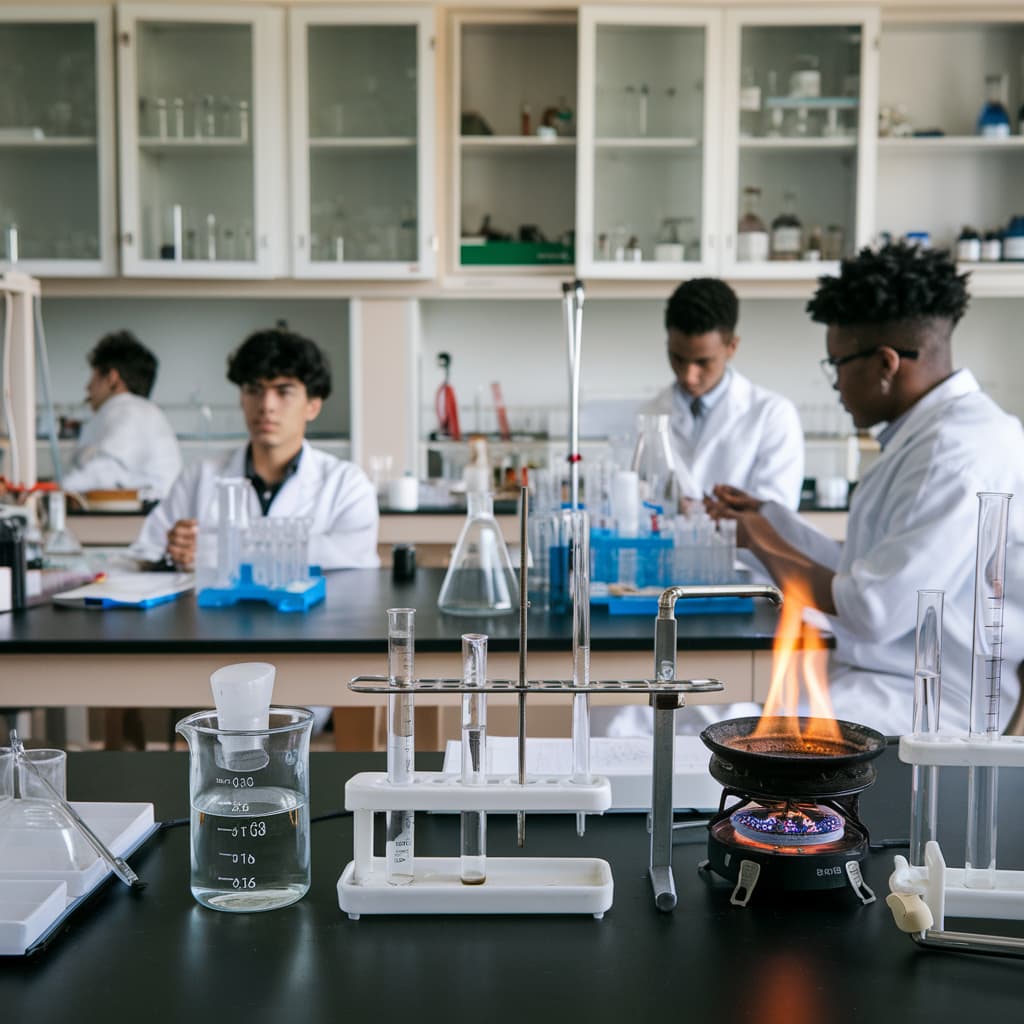
Your chemistry investigation needs reliable equipment to produce accurate results. Here’s your essential equipment checklist:
- Measurement Tools: Graduated cylinders, volumetric flasks, and pipettes for precise liquid measurements
- Analysis Equipment: Spectrophotometers for quantitative analysis and beakers for mixing solutions
- Safety Gear: Safety goggles, gloves, and lab coats for protection
- Documentation Tools: Digital cameras for qualitative observations and lab notebooks for data recording
Recording and Organizing Data Effectively
Time to master the art of data collection! Your investigation requires a minimum of 5 manipulations of your independent variable with 3 trials each. Here’s how to organize your data like a pro:
Create clear, professional data tables with these essential elements:
- Descriptive title
- Column headings with units and measurement uncertainties
- Consistent decimal places
- Grid lines for clarity
Pro Tip: Align all decimals in your tables and ensure each column ends at the same decimal place. This attention to detail will impress your examiners!
Statistical Analysis Techniques
Let’s make your data shine with proper statistical analysis! Here are the key calculations you’ll need:
- Uncertainty Calculations:
- For analogue equipment: Use half the smallest increment
- For digital equipment: Use the smallest increment [2]
- Data Processing:
- Calculate means and standard deviations
- Determine absolute and percentage uncertainties
- Compare results with accepted values using per cent error calculations
Remember to show at least one example of each calculation type. When creating graphs, include error bars to visualize your uncertainties. This demonstrates your understanding of data reliability!
Important: Keep your raw data separate from processed results. Create a second data table specifically for calculated results. This organization shows clear scientific thinking!
Your data collection journey is an exciting opportunity to demonstrate your scientific skills. By following these strategies, you’re well on your way to creating an impressive chemistry IA that showcases your analytical abilities!
Meeting all the criteria while keeping your Chemistry IA focused and original is a lot to manage on your own. Many of our students come to us at exactly this stage — they understand what's required but need expert guidance to pull it all together. Get matched with a Chemistry tutor →
Writing Your Chemistry IA Report
It’s time for the exciting part – putting your brilliant investigation into words! Let’s transform your meticulous research into a compelling chemistry IA that will make your examiners say “wow!”
Section-by-Section Writing Guide
Your chemistry IA should be under 3000 words.. Remember, longer isn’t always better – concise writing that exceeds this length will actually lose marks! Here’s your roadmap to writing success:
- Title and Introduction
- Start with your research question
- Include your personal connection to the topic
- Present relevant background theory
- Methodology
- Detail your experimental procedure
- List all materials and equipment
- Explain safety precautions
- Results and Analysis
- Present raw data in clear tables
- Show all calculations
- Include graphs with proper labels
- Discussion and Evaluation
- Interpret your results
- Address experimental limitations
- Suggest realistic improvements
Formatting and Citation Requirements
Get ready to make your IA look professionally polished! Here are the key formatting requirements:
- Use 12-point font size
- Include page numbers throughout
- Create clear section headings
- Label all tables and figures properly
- Record uncertainties in column headings
- Align decimal places consistently
For citations, the American Chemical Society (ACS) style is most commonly used in chemistry. You’ll need to cite sources in three possible ways:
- Author-date format: (Smith, 2023)
- Italicized numbers: (4)
- Superscript numbers: Text⁹
Using Scientific Language Appropriately
Time to showcase your chemistry expertise! Your writing should be:
Clear and Precise
- Use specific chemical terminology
- Define technical terms when first introduced
- Maintain consistent units throughout
Professional yet Engaging
- Write in active voice
- Use present tense for established facts
- Include qualitative observations alongside quantitative data
Pro Tip: Create data tables with descriptive titles and proper column headers including units and measurement uncertainties. This shows attention to detail and scientific rigor!
Remember to show all your calculation work clearly. Include one example for each type of calculation you perform – this demonstrates your understanding and helps examiners follow your thinking process!
Your bibliography should be exhaustive and in alphabetical order [20]. This isn’t just about following rules – it’s about showing respect for the scientific community and establishing your credibility as a researcher!
Conclusion
Creating an excellent Chemistry IA requires careful attention to detail, from selecting the perfect topic to presenting your findings professionally. Success depends on understanding the core requirements, planning meticulously, and executing your investigation with scientific rigor.
Your Chemistry IA journey starts with choosing a topic that excites you while meeting all technical requirements. Through proper data collection, analysis, and presentation, you demonstrate both your chemistry knowledge and scientific thinking skills. Remember to maintain professional formatting, include all necessary components, and stay within the 3000-word limit.
Armed with this comprehensive guide, you now have the knowledge needed to create an outstanding Chemistry IA that showcases your abilities and helps secure those crucial marks. Stay organized, follow the timeline, and approach each section methodically – your dedication will shine through in your final submission.
References
[1] – https://www.ahschools.us/cms/lib/MN01909485/Centricity/Domain/4810/Chem 2andIB Chem/IA Student Guide.pdf
[2] – https://lanterna.com/blog/ia-analysis-tips/
[3] – https://www.paradigmedu.in/articles/IB DP/articlepage.php?id=8
[4] – https://sites.google.com/view/ibchemistry/internal-assessment
[5] – https://www.apguru.com/blog/ib-chemistry-ia-choosing-an-investigation-topic-2
[6] – https://www.ts-tutoring.com/blog/25-chemistry-ia-ideas
[7] – https://kisacademics.com/blog/ib-chemistry-how-to-come-up-with-the-best-chemistry-ia-ideas/
[8] – https://tutorsplus.com/chemistry-ia-topic/
[9] – https://iblieve.org/tips-for-chemistry-ia/
[10] – https://papertyper.ai/blog/chemistry-ia-topics
[11] – https://www.revisiondojo.com/blog/what-is-the-timeline-for-completing-an-ia
[12] – https://www.revisiondojo.com/blog/navigating-the-ib-chemistry-ia-from-planning-to-execution
[13] – https://chem.libretexts.org/Courses/Hope_College/General_Chemistry_Labs/Lab_Equipment
[14] – https://labwale.co/blog/essential-chemistry-lab-equipment-a-comprehensive-guide/?srsltid=AfmBOoom3bL69g23P5yOcBP-C90UhXHzTUlKn3qNL8IxfsZ43P4eC8A5
[15] – https://ibrecap.com/DP/Internal Assessment
[16] – https://sites.google.com/view/crushchemistry/chemistry-ib-ia/analysis
[17] – https://mrkremerscience.com/wp-content/uploads/2013/09/ib-chemistry-ia-student-guide.pdf
[18] – https://tychr.com/ib-chemistry-ia-guide-everything-you-need-to-know/
[19] – https://libguides.library.umaine.edu/chem/citechem
[20] – https://nailib.com/blog/ib-chemistry-ia
Get Expert Help With Your Chemistry IA
Our Chemistry tutors have guided hundreds of IB students through the Chemistry IA process — from topic selection to final submission. Whether you need help finding your angle, strengthening your analysis, or polishing your draft, we'll match you with a tutor who knows exactly what examiners are looking for. Find your tutor →
Frequently Asked Questions
What makes a good Chemistry IA topic?
A good Chemistry IA topic should be personally interesting, feasible with school lab equipment, allow for quantitative data collection, and have a clear independent and dependent variable. Avoid overly common topics and choose something that lets you demonstrate genuine scientific inquiry.
How long should an IB Chemistry IA be?
The IB Chemistry IA should be approximately 6-12 pages, with a recommended word count of around 2,000 words (excluding tables, graphs, and references). Focus on quality analysis rather than length.
What is the most common mistake in Chemistry IAs?
The most common mistake is choosing a topic that is too broad or too simple. Students also frequently lose marks for insufficient error analysis, lack of personal engagement, and failing to connect their findings to the broader scientific context.
Can I use an AI solver for my Chemistry IA?
AI solvers can be helpful for checking calculations and understanding concepts during your research phase, but your IA must reflect your own original work and thinking. Always verify AI outputs and cite any tools you used appropriately.