IB Physics Tutor: How to Find Expert Help for HL and SL
IB Physics is the most formula-heavy science in the Diploma Programme and has one of the lowest average HL grades across all IB subjects. The course demands str...
IB Physics is the most formula-heavy science in the Diploma Programme and has one of the lowest average HL grades across all IB subjects. The course demands strong mathematical skills (vectors, trigonometry, and calculus basics for HL), conceptual reasoning about abstract phenomena like electromagnetic fields and wave behaviour, and the ability to design and analyse experiments for the Internal Assessment. Finding a tutor who can teach all three of these dimensions, and who knows how IB Physics exams are actually marked, makes a measurable difference in outcomes.
(This guide has been updated for the 2025-26 academic year.)
Key Takeaways
- IB Physics requires stronger maths skills than any other IB science, and weak algebra or trigonometry will limit progress regardless of conceptual understanding.
- The IA is particularly challenging in Physics because designing a valid experiment with proper uncertainty analysis is harder than in Chemistry or Biology.
- HL extensions (relativity, electromagnetic induction, quantum physics) are where most HL students lose the most marks and need the most support.
- The best IB Physics tutors are examiners who know the data booklet inside out and can teach students to use it as an exam tool, not just a reference sheet.
Why IB Physics Is Uniquely Challenging
Three characteristics set IB Physics apart from other IB sciences and make expert tutoring particularly valuable.
Mathematical intensity. Physics requires fluent use of algebra, trigonometry, vector analysis, and (for HL) introductory calculus. Students who are strong in chemistry or biology often struggle with physics because the problem-solving approach is fundamentally different. Every physics problem is a maths problem in disguise, and weak mathematical foundations create a ceiling that no amount of physics knowledge can overcome.
Abstract concepts. Topics like electromagnetic induction, wave-particle duality, and gravitational fields describe phenomena that students cannot directly observe. Understanding these requires building accurate mental models, and many classroom teachers rush through these topics due to time constraints. A tutor can spend the time needed to build genuine understanding rather than surface-level memorisation.
IA experimental design. The Physics IA is widely considered the hardest science IA because designing a valid experiment with measurable variables, controllable conditions, and meaningful uncertainty analysis is more difficult in physics than in chemistry (where you can measure concentrations) or biology (where you can count organisms). Physics experiments require precise equipment handling, careful error propagation, and creative variable selection.
At ++tutors, our Physics tutors are certified IB examiners who have marked hundreds of papers and IAs. They combine deep physics knowledge with assessment expertise to help students close the gap between understanding the content and scoring the marks. Get matched with an IB Physics specialist today.
What an IB Physics Tutor Helps With
IB Physics tutoring covers four main areas, each aligned to how the course is assessed:
Conceptual understanding: Building accurate mental models for topics that are often poorly taught at school, including waves and oscillations, electric and magnetic fields, and energy transformations. A good tutor uses diagrams, analogies, and worked examples to make abstract physics intuitive.
Exam technique: IB Physics papers include data-based questions, graph interpretation, unit analysis, and multi-step calculations. Each requires specific strategies. For example, data-based questions in Paper 2 test whether students can extract information from unfamiliar contexts, and many students lose marks by rushing to calculate before fully reading the question.
IA support: From selecting a viable topic and designing the experiment to writing the report with proper uncertainty propagation. An examiner-tutor can identify the difference between an IA that scores 15/24 and one that scores 22/24. For guidance on the science IA process, see our complete guide to writing a science IA that scores 7.
Past paper drilling: Working through real IB Physics papers under timed conditions for Papers 1, 2, and 3. The tutor provides immediate, examiner-level feedback on where marks were earned and lost.
IB Physics HL Tutoring: Hardest Topics
HL Physics adds several topics that consistently cause the most difficulty. These are the areas where targeted tutoring produces the biggest grade improvements:
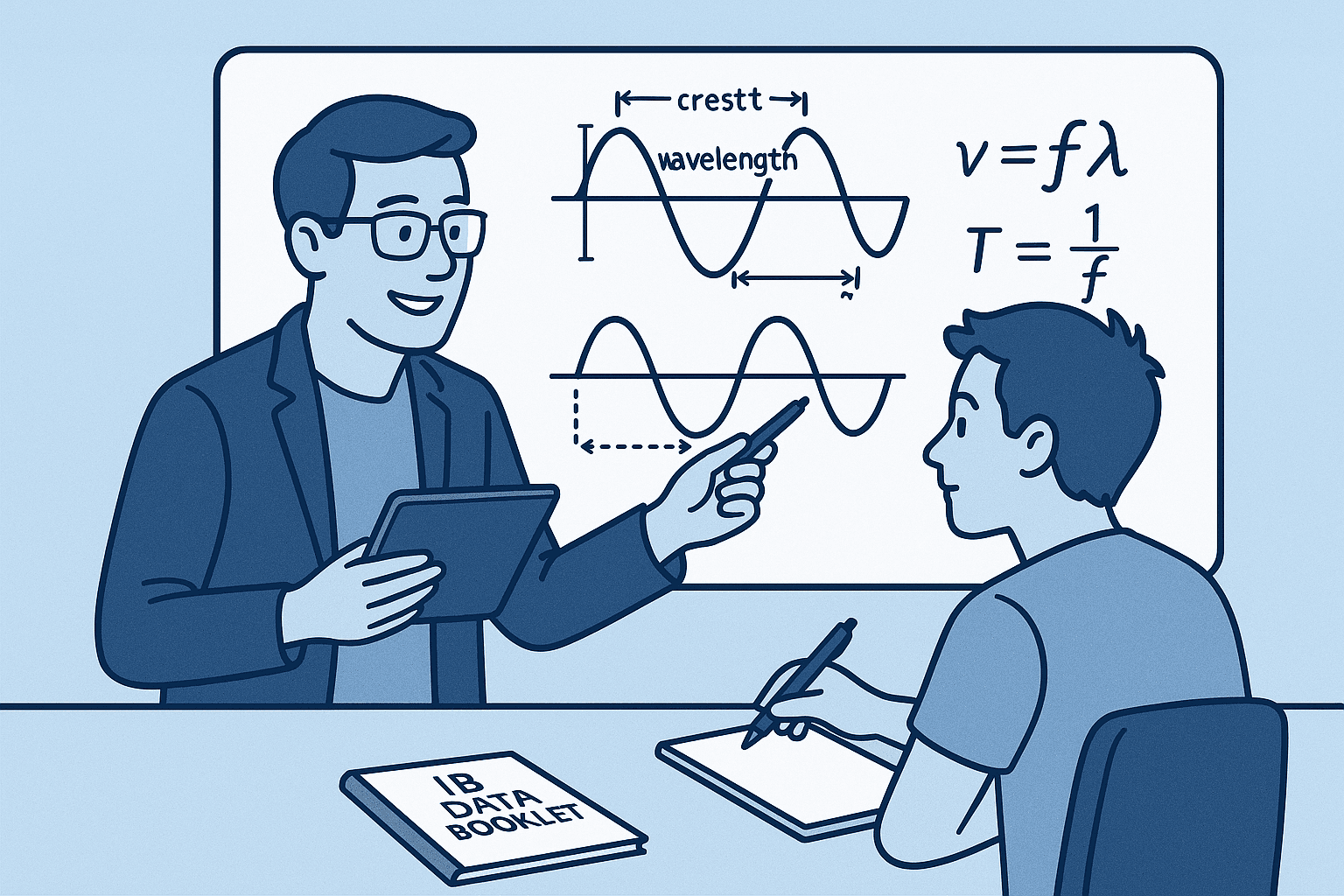
Waves and Oscillations (simple harmonic motion, resonance). SHM requires students to connect displacement, velocity, and acceleration through sinusoidal functions. Many students can memorise the equations but cannot apply them to novel situations. A tutor who works through graphical and mathematical representations side by side builds the deeper understanding the exam demands.
Electromagnetic Induction (Faraday's law, Lenz's law). This topic combines vector reasoning with calculus concepts and is where HL students most commonly score below their ability. Understanding why an induced EMF opposes the change that causes it (Lenz's law) requires careful conceptual work that benefits enormously from one-on-one tutoring.
Quantum and Nuclear Physics. The photoelectric effect, matter waves, and nuclear decay involve concepts that are counter-intuitive and mathematically rigorous. Students need to be comfortable with both the theoretical framework and the calculation methods.
Relativity (HL extension). Time dilation, length contraction, and relativistic momentum are conceptually challenging and appear on Paper 3. Few classroom teachers have the time to teach this topic thoroughly, making it a prime area for tutor support.
These HL extensions are where the biggest mark gains are possible because they represent new content that many students have not fully grasped. A tutor who has examined HL Physics papers knows which concepts are tested most frequently and which calculation methods examiners expect. If your child is finding HL Physics overwhelming, targeted support on these specific topics can make a significant difference. Find an IB Physics examiner-tutor now.
IB Physics SL Tutoring: Common Sticking Points
SL Physics is more accessible than HL but still presents challenges, particularly in three areas:
Circular motion and gravitation: Students often confuse centripetal force with centrifugal force, struggle with satellite orbit calculations, and make errors applying Newton's law of gravitation. These topics require careful mathematical setup and unit analysis.
Electricity and magnetism: Circuit analysis (series and parallel), Ohm's law applications, and magnetic field calculations are where SL students lose the most marks on Paper 2. The key is consistent practice with varied circuit diagrams and field problems.
Energy sources (Paper 3): SL Paper 3 includes data-based questions on energy topics that require students to interpret graphs, evaluate data, and make evidence-based conclusions. These questions test scientific literacy as much as physics knowledge.
The IB Physics IA: What Makes It So Hard?
The Physics IA requires students to design an original experiment from scratch, with controlled variables, repeated trials, and meaningful uncertainty analysis. The most common IA errors, based on examiner reports, are:
- Choosing an experiment that is too complex or too simple. The best Physics IAs investigate a focused relationship between two variables using equipment the student can actually control. Overly ambitious experiments fail on methodology; overly simple ones fail on depth.
- Not justifying measurement uncertainties. Examiners expect students to explain where uncertainties come from (instrument precision, environmental factors, human reaction time) and propagate them through calculations. Simply reporting percentage uncertainties is not enough.
- Weak evaluation and improvement suggestions. "Human error" is not a valid limitation. Examiners reward specific, methodological limitations (e.g., "the timer resolution of 0.01s was insufficient for measuring periods below 0.5s") with concrete improvements.
An IB Physics examiner-tutor has marked hundreds of IAs and can review your child's draft against the actual mark scheme criteria, identifying exactly where marks will be gained or lost before final submission. See our science IA scoring guide for a detailed walkthrough of what examiners look for.
What to Look for in an IB Physics Tutor
Four qualities are non-negotiable when choosing an IB Physics tutor:
Must know the data booklet inside out. The IB Physics data booklet is provided in every exam. The best tutors teach students to use it as an active tool: scanning for relevant equations, checking units, and using given constants efficiently. A tutor who still needs to look things up in the data booklet during sessions is not at the level you need.
Ideally a former or current IB Physics examiner. Teaching IB Physics and examining IB Physics are different skills. An examiner knows which questions appear most frequently, how the mark scheme allocates partial credit, and what common student errors look like from the grading side.
Comfortable with the maths. Physics tutoring often involves teaching mathematics alongside physics. If your child's IB Maths skills need strengthening, discuss this with the tutor upfront so sessions can address both.
Should work from real past papers. Tutors who create their own worksheets instead of using official IB past papers are often less effective because IB exam questions have a specific style and structure that only authentic practice can prepare students for.
For a broader perspective on choosing any IB tutor, see our complete guide to finding the right IB tutor. If cost is a consideration, our IB tutor cost guide breaks down what to expect at each price point.
How to Book an IB Physics Tutor With ++tutors
Visit our IB Physics tutoring page to get started. Our Client Success Manager will match your child with a certified IB Physics examiner or teacher within 24 hours, based on their level (HL or SL), specific topic needs, and schedule. All sessions take place on Lesson Space with screen sharing, a virtual whiteboard, and session recordings your child can review before exams.
If your child also needs support in related subjects, explore our IB Chemistry tutoring and IB Maths tutoring options.
Find Your IB Physics Tutor in 24 Hours
Get matched with a certified IB Physics examiner or teacher who knows the data booklet, the mark schemes, and the HL extensions your child is struggling with. 4.9-star rated by 500+ families. Money-back guarantee after the first session.
Frequently Asked Questions
Do I need a maths tutor as well as a physics tutor?
It depends on where the difficulty lies. If your child understands the physics concepts but makes errors in the calculations, the physics tutor can address the maths skills within physics sessions. If the mathematical gaps are more fundamental (weak algebra, trigonometry, or calculus), a dedicated IB Maths tutor working alongside the physics tutor may produce faster results. Many ++tutors families book both subjects, and the Client Success Manager coordinates the two tutors to avoid overlap.
How many sessions does it take to improve by 1 grade in IB Physics?
Most students improve by 1 grade within 8 to 16 sessions, depending on their starting level and the specific areas that need work. Students with isolated topic weaknesses (e.g., only struggling with electromagnetic induction) improve faster than those with broader gaps. Your tutor will assess current levels in the first session and provide a realistic timeline.
Can a tutor help me choose my Physics IA topic?
Yes. Topic selection is one of the most important decisions in the IA process. An examiner-tutor can evaluate whether a proposed experiment is feasible, sufficiently complex for the mark scheme, and likely to produce meaningful data. They can also suggest topics that have a strong track record of scoring well, based on their marking experience. Starting with the right topic saves weeks of wasted effort.