Tips to choose the best IB Chemistry tutor for your child
Written By : Jesica S. As parents, it could be a challenge to help our children throughout their IB preparation. It is mandatory to understand that each child is unique and has his own needs. Although parents might not be aware, students sometimes seek help and struggle to catch up with educational content. A good […]

Choosing the right IB Chemistry tutor for your child is one of the best investments in their academic success. Chemistry is conceptual, it's heavily tested on IB exams, and it's easy to fall behind if you don't understand early concepts. A great tutor can turn a struggling C-student into a confident 6-scorer within a few months. A bad tutor can waste time and money while your child remains confused. This guide walks you through what makes an effective IB Chemistry tutor and how to identify the right one for your child's specific situation. You may also find our resource on balancing redox reactions helpful. (This guide has been with the latest 2025 insights.)
The core principle: the best tutor for your child is someone who understands both the chemistry deeply and the IB curriculum specifically. There's a big difference between being able to explain chemistry and being able to teach it in a way that prepares students for the IB exam.
Key Takeaways
- It's not just chemistry with extra content.
- Good tutors don't assume they know where your child is struggling.
- Your child's tutor should have a degree in chemistry or extensive chemistry teaching experience.
- Your child should come prepared.
- Weeks 1–2: Assessment and baseline.
Why IB Chemistry Needs a Specialist Tutor
It's not just chemistry with extra content. IB Chemistry looks at familiar topics through a different lens. It emphasizes underlying principles, electron configuration, bonding, equilibrium, and thermochemistry in ways that standard chemistry doesn't. A tutor who teaches AP Chemistry or standard high school chemistry might miss what IB specifically values. Explore our detailed guide on Le Chatelier's principle for more tips.
The exam rewards conceptual understanding over memorization. The IB Chemistry exam tests whether your child can apply concepts to unfamiliar situations, not just regurgitate facts. A good tutor teaches your child to think like a chemist, not just know chemistry facts. Learn more in our guide on mastering organic chemistry.
Assessment criteria are specific. IB has detailed rubrics for free response questions. A tutor who knows these rubrics can coach your child to score full marks by explaining their reasoning clearly and showing every step. A tutor unfamiliar with IB might help your child understand but not score optimally.
Want to find an IB Chemistry tutor who knows IB Chemistry assessment inside and out? Look for a chemistry specialist with proven experience in IB curriculum →
Supporting your child through the IB can feel overwhelming, but you don't have to do it alone. A dedicated Chemistry tutor can provide the academic support your child needs while giving you peace of mind. Tell us what your child needs help with →
What an Effective IB Chemistry Tutor Does (And Doesn't Do)
They Diagnose Specific Gaps
Good tutors don't assume they know where your child is struggling. They ask questions, look at past tests, and pinpoint exactly which concepts are shaky. Is it electron configuration? Bonding? Equilibrium? Once they know, they target teaching efficiently.
What to listen for: In your first consultation, the tutor should ask detailed questions about your child's background, current struggles, and goals. If they just ask "what do you want to work on?" without deeper investigation, that's a red flag.
They Teach for Understanding, Not Memorization
They ask "why" questions. Why does sodium lose an electron and chlorine gain one? Why does increasing temperature increase reaction rate? Why does a catalyst not appear in the overall equation? A tutor who explains the "why" builds intuition that transfers to unfamiliar exam questions.
What to listen for: When they explain something, they're not just giving you facts. They're explaining the underlying principle and showing how it applies in different contexts. Beyond chemistry, your student should also be developing strong study habits that will serve them across IB subjects. Learn more about effective chemistry study strategies.
They Use Past Papers Strategically
Rather than assigning past papers and checking answers, they analyze past papers to reveal patterns. They show your child: "These three questions all test the same equilibrium principle, even though they look different. Here's the thinking pattern that works for all of them." That's teaching for the exam.
What to listen for: The tutor should mention past papers, mark schemes, and how those reveal what the exam actually tests.
They Coach Communication
They look at your child's written responses and coach clarity. "You have the right idea, but your explanation is vague. Rewrite this to show your reasoning step-by-step." This kind of feedback directly improves exam performance.
What to listen for: The tutor talks about how to write answers, not just how to calculate answers. On the IB Chemistry exam, showing your work matters as much as the answer. For more on this, see our guide on writing chemistry lab reports.
They Don't Just Do Your Child's Homework
A red flag is a tutor who enables your child to avoid learning. If every tutoring session is "here's the homework, let me show you how to do it," that's not tutoring. That's cheating with extra steps. Good tutors guide your child to do the thinking and problem-solving themselves.
What to listen for: The tutor should talk about asking your child questions, having them explain their thinking, and coaching them toward answers rather than giving answers.
Qualities of a Top IB Chemistry Tutor
1. Deep Chemistry Knowledge AND Excellent Communication
Your child's tutor should have a degree in chemistry or extensive chemistry teaching experience. But knowledge alone isn't enough. They also need to explain complex ideas in ways a high school student can understand. Test this in a trial session: do their explanations make sense? Can they break down a difficult concept into understandable pieces?
2. Specific IB Experience
Ask directly: "How many IB Chemistry students have you tutored? What was the score distribution?" A good answer shows consistent experience. "I've tutored 15+ IB students; most score 6–7" is strong. "I'm not sure, but I teach chemistry" is weak.
3. Knowledge of IB Assessment Criteria
They should be able to discuss the IB Chemistry rubric, explain what Paper 1, 2, and 3 test differently, and know how practical work is assessed. If they don't know these details, they're not IB-specialized.
4. Diagnostic and Problem-Solving Approach
Rather than teaching a preset curriculum, they diagnose your child's specific gaps and build teaching around those. If your child struggles with equilibrium, they spend time there. If another area is strong, they move through it faster. Customization matters.
5. Patience and Encouragement
Chemistry is hard. Your child will be frustrated. A good tutor is patient, breaks concepts into smaller chunks, celebrates progress, and helps your child believe they can succeed. Impatience or discouragement is a red flag.
6. Availability and Reliability
They keep scheduled sessions, reschedule if they cancel with notice, and are available when your child needs them (especially before exams). Flaky tutors waste money and damage momentum.
Red Flags: Tutors to Avoid
- They haven't tutored IB Chemistry or teach it without certification. General chemistry knowledge isn't enough. They need to understand IB specifically.
- They focus only on calculation, not conceptual understanding. "Here's the equation, use it" is not IB Chemistry tutoring.
- They don't ask what your child is struggling with. They just teach from a preset lesson plan, regardless of your child's actual needs.
- They promise a specific grade ("I'll get your child a 7"). Good tutoring helps, but the child's effort and ability matter. Overconfident promises are red flags.
- They do your child's homework for them. That's cheating, not tutoring. Your child should do the thinking.
- They're unavailable during critical times. If they can't meet before exams or during option-unit crunch, they're not reliably helpful.
- They haven't looked at past papers recently. If they don't know what's actually on the exam, they're teaching material, not exam content.
How to Evaluate a Tutor: Questions to Ask
On credentials and experience:
- What's your education and teaching background?
- How many years have you been tutoring IB Chemistry specifically?
- How many IB Chemistry students have you tutored? What was the typical score range?
- Have you taught both SL and HL? How are they different?
On teaching approach:
- How would you approach teaching my child if they struggle with [specific topic, e.g., equilibrium]?
- How do you know if a student understands something vs. just memorizing?
- How do you use past papers in your tutoring?
- How do you help students communicate their chemistry understanding in exam answers?
On assessment and communication:
- Can you explain the IB Chemistry rubric and what the exam specifically rewards?
- How do you give feedback on your students' work?
- How often would you communicate with me (the parent) about my child's progress?
- What do you expect from the student between sessions?
On commitment:
- What's your cancellation policy?
- How flexible are you with scheduling?
- Can we do a trial session before committing to ongoing tutoring?
- What happens if we feel like it's not working after a few sessions?
How to Get the Most from Chemistry Tutoring
Your child should come prepared. They should bring specific topics they're struggling with or specific practice problems. "Help me study chemistry" is vague. "Help me understand why electron configuration matters" is focused.
Your child should do independent practice between sessions. Tutoring is coaching. The learning happens when your child practices. If your child doesn't do practice problems, read explanations, or work on understanding between sessions, tutoring time is wasted. For independent study, explore resources on mastering the IB Chemistry syllabus.
You should track progress objectively. Keep samples of your child's work from before tutoring started. Compare to recent work. Are they making fewer careless errors? Understanding concepts more deeply? Getting better exam scores? Tutor should help you track this.
Be honest if it's not working. After 3–4 sessions, you should see progress. If your child still seems confused or the tutor's style isn't clicking, say so. A good tutor will adjust. If they don't or it's still not working, it's okay to find someone else.
Timeline for Tutoring Impact
Weeks 1–2: Assessment and baseline. Tutor figures out what's working and what's not. You shouldn't expect big grade improvements yet.
Weeks 3–6: Targeted teaching on weak topics. Your child should start feeling more confident on specific concepts.
Weeks 7–10: Application and practice. Tutor helps your child apply concepts to unfamiliar problems. Exam scores start improving.
Weeks 11+: Maintenance and refinement. Your child is solid on concepts. Tutoring focuses on exam technique and communication. To further support your child's learning, review our guide on using AI-powered tools for IB Chemistry.
If your child isn't showing improvement by week 6–8 of consistent tutoring, discuss with the tutor what's not working and whether adjustments are needed.
Find the Right Chemistry Tutor for Your Child
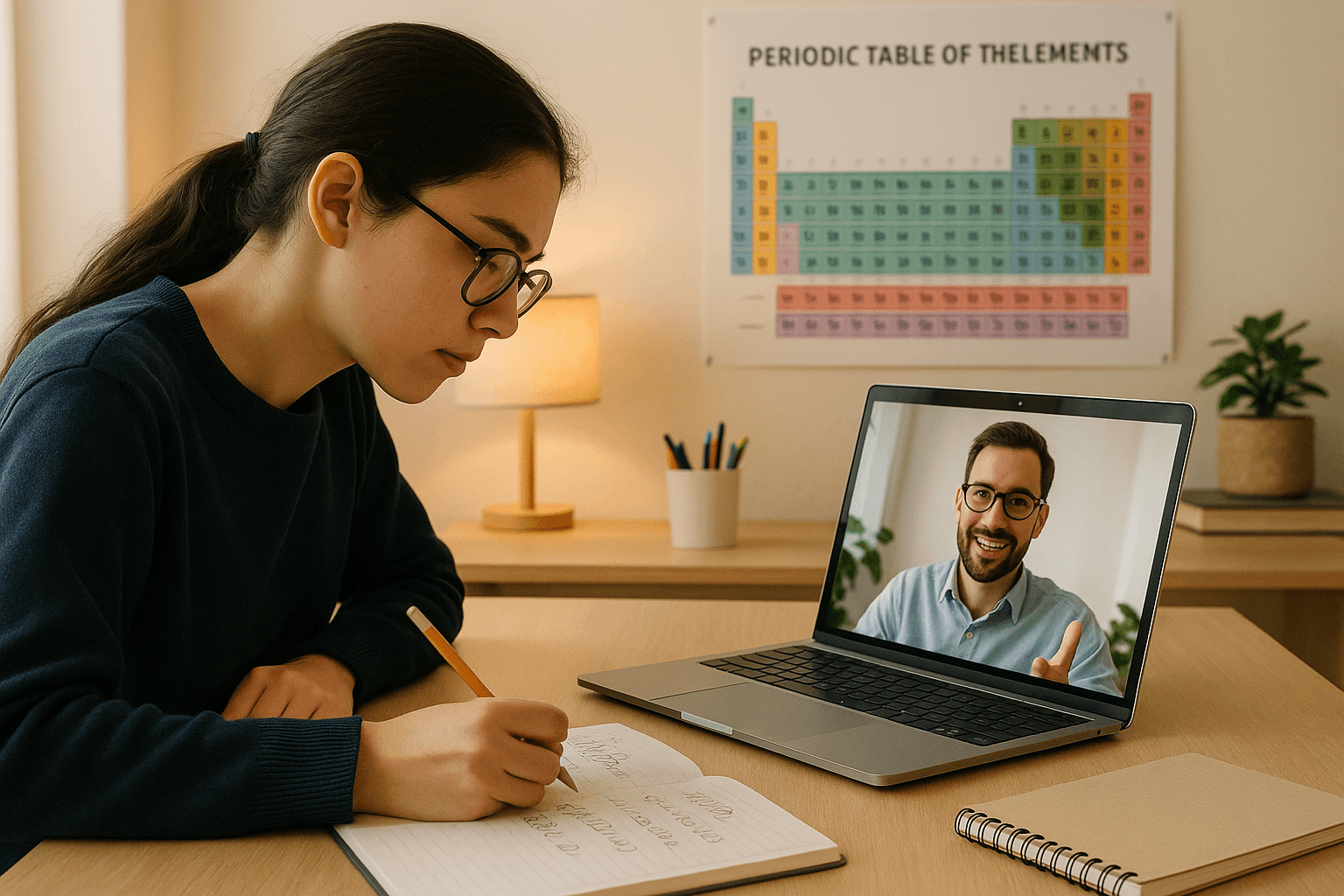
Find an IB Chemistry tutor who specializes in the curriculum and understands assessment criteria → Choosing the right tutor is an investment in your child's success. You're looking for someone who understands chemistry deeply, knows the IB exam specifically, and can teach in a way that builds your child's confidence and competence. With the right tutor, chemistry transforms from a source of stress into a manageable, even interesting, subject.
FAQs
How often should my child tutor chemistry?
For struggling students: 1–2 sessions per week. For students wanting to excel: 1 session per week is often sufficient. Consistency matters more than frequency. Regular sessions are better than occasional intensive cramming.
Should my child tutor both SL and HL chemistry?
If your child is taking HL, specialized HL tutoring is valuable. HL is significantly more challenging than SL. If your child is taking SL, a good SL tutor is sufficient. Some tutors do both, but they should be clear about the differences and focus appropriately.
When should chemistry tutoring start?
Ideally in semester 1, as soon as you notice struggling. Starting in semester 2 is possible but means your child has already fallen behind. If tutoring starts in the final months before exams, it's more intensive (more sessions per week) to catch up. Prevention is better than crisis management.
How much does a good IB Chemistry tutor cost?
Varies by location and tutor experience. General range: $40–100 per hour. IB specialists and experienced tutors typically cost more ($70–100+). Group tutoring is often cheaper ($25–50 per hour). Online tutoring is sometimes cheaper than in-person. Budget accordingly, but remember that a good tutor saves money long-term by improving grades efficiently.